

Can a 4 year old ride a 16 inch bike
Yes—a 4-year-old can ride a 16-inch bike if they measure about 40–48 in (102–122 cm) and can comfortably stand over, reach and control it.
Age alone does not confirm the fit
XBikes lists 16-inch bikes as a starting point for ages 4–7 and rider heights of 40–48 in (102–122 cm). That makes a 16-inch model a reasonable size to try for many 4-year-olds, but the child's measurements and control matter more than the birthday.
A smaller 4-year-old may fit a 14-inch or even a 12-inch bike better. The XBikes starting points are:
| Wheel size | Starting age | Rider height |
|---|---|---|
| 12 Inch | 3–4 | 34–40 in / 86–102 cm |
| 14 Inch | 3–6 | 37–45 in / 94–114 cm |
| 16 Inch | 4–7 | 40–48 in / 102–122 cm |
The ranges overlap deliberately. A child near 40–45 in may need to compare 14-inch and 16-inch bikes in person rather than choosing from height alone.
Measure your child before comparing bikes
Measure height without shoes, with the child standing straight against a wall. Also measure inseam from the floor to the crotch. Inseam is useful for checking whether the child has comfortable clearance when standing over the bicycle, although the supplied sizing standard does not set a numerical inseam requirement.
Record the child's height and inseam, then have them try the exact bicycle. Do not estimate from clothing size or choose a larger bike merely to leave room for growth. An oversized bicycle can make starting, stopping and steering harder.
Use this five-part fit check
- Stand-over: With the child straddling the bike, confirm that they can stand securely and are not forced onto tiptoes by the frame.
- Seat position: Check that they can get on and off without struggling and place their feet as needed for their current riding ability.
- Reach: Their hands should reach the handlebar without leaning far forward, locking the elbows or losing a stable seated position.
- Braking: They must be able to reach and operate the bicycle's braking controls. Because no brake specifications are supplied here, inspect the exact model and follow its manual.
- Control: Ask the child to start, steer, stop and dismount in a flat, traffic-free area under close adult supervision. Hesitation caused by unfamiliarity can improve with practice; inability to reach or control the bike indicates a fit problem.
When these 16-inch catalog options are relevant
All three supplied training-wheel bicycle listings include a 16 Inch SKU, so they are relevant models to compare when a child falls near the 16-inch starting range. Their other listed sizes also make it easier to compare downward if the 16-inch version feels too large; the catalog facts do not establish differences in geometry, components or adjustability.
 XJD Kids' Training Wheel Bike for Boys & Girls, 12/14/16 Inch – White
Available in 12 Inch, 14 Inch and 16 Inch SKUs, this training-wheel bicycle is relevant for comparing the overlapping XBikes size starting points around age four.
 Girls' Training Wheel Bike by XJD, 12–20 Inch Wheels – Blue
This training-wheel bicycle includes 12 Inch, 14 Inch, 16 Inch and 20 Inch SKUs. Its 16-inch version is relevant to the question, while the smaller versions provide fit comparisons.
 XJD Girls' Bike with Training Wheels, 12/14/16/20 Inch – Purple
Listed with 12 Inch, 14 Inch, 16 Inch and 20 Inch options, this training-wheel bicycle provides a requested-size option plus smaller sizes to compare if 16 inches does not fit.
XJD Kids' Training Wheel Bike for Boys & Girls, 12/14/16 Inch – White is listed in 12 Inch, 14 Inch and 16 Inch versions. It is relevant when comparing the three starting ranges closest to a typical 4-year-old.
Girls' Training Wheel Bike by XJD, 12–20 Inch Wheels – Blue is listed in 12 Inch, 14 Inch, 16 Inch and 20 Inch versions. For this question, compare its 12-, 14- and 16-inch SKUs; a 20-inch wheel has a separate XBikes starting point of ages 7–12 and 48–60 in (122–152 cm), so it is not interchangeable with a 16-inch bike.
XJD Girls' Bike with Training Wheels, 12/14/16/20 Inch – Purple offers the same supplied size labels: 12 Inch, 14 Inch, 16 Inch and 20 Inch. Its relevance is the available 16-inch option and the nearby smaller comparison sizes, not proof that every version fits a 4-year-old.
Training wheels may support early practice, but their presence does not correct a poor frame fit or unreachable controls. Use the exact product manual for assembly, maintenance, load limits, compatibility and torque information not provided in the catalog facts, or ask a qualified bicycle mechanic.
Check confidence as well as dimensions
Two children of equal height may need different starting points. A confident rider who can start, steer and stop may manage a correctly fitted 16-inch bicycle, while a cautious beginner may control a properly fitted smaller bike more comfortably. Compare the child's posture and actions on each candidate instead of asking which size will last longest.
If the child is below 40 in (102 cm), the XBikes guide points first toward the overlapping 12- or 14-inch ranges. If they are within 40–48 in (102–122 cm), try a 16-inch bike but still complete every fit check. Being inside the height range is a screening step, not automatic approval.
Make the final 16-inch decision
Choose the 16-inch bike only if your 4-year-old is within the starting height range and can stand over it, reach the handlebar and brakes, start, steer, stop and dismount with control. Add a properly fitting bicycle helmet that sits level, with straps adjusted according to its manufacturer's instructions. If any fit or control check fails, compare a 14-inch or 12-inch version now rather than buying the 16-inch bike for future growth.
Bikes for your next adventure
-
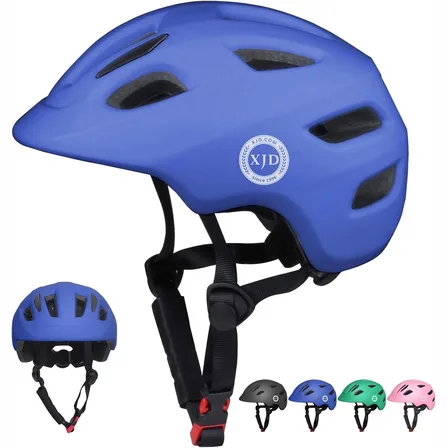
Blue XJD Kids' Bike Helmet, Adjustable Fit – Sizes XS & S
The Blue XJD Kids' Bike Helmet is a lightweight, adjustable helmet for toddlers …$20.39
-

XJD Girls Bike for Kids Ages 3-8, 12/14/16 Inch with Training Wheels – Purple
The XJD Girls Bike in Purple is a training-wheel bicycle for kids ages 3 to 8, f…$149
$169 -

Pink Girls' 12/14/16" Bike by XJD – Basket & Doll Seat
The XJD Pink Girls' Bike with Basket & Doll Seat is made for riders 71–122 cm ta…$75.99
$99.99