

How many inches bike for 4 year old
For a 4-year-old, start by comparing 12-, 14- and 16-inch bikes. Choose by measured height and actual fit: 12 inch suits 34–40 in (86–102 cm), 14 inch suits 37–45 in (94–114 cm), and 16 inch suits 40–48 in (102–122 cm).
Which wheel size should you try first?
Age narrows the choices, but it does not determine the final size. XBikes lists 12-inch bikes as a starting point for ages 3–4, 14-inch bikes for ages 3–6, and 16-inch bikes for ages 4–7. At age four, all three may therefore appear relevant; the child’s height separates them more usefully.
- Under 37 in (94 cm): begin with a 12-inch bike, provided the child is at least 34 in (86 cm) tall.
- 37–40 in (94–102 cm): compare 12- and 14-inch bikes in person. Favor the one the child can stand over and control comfortably.
- 40–45 in (102–114 cm): compare 14- and 16-inch bikes rather than choosing from age alone.
- 45–48 in (114–122 cm): a 16-inch bike is the matching XBikes starting point.
If the child falls outside these ranges, do not force a choice from this three-size group. Recheck the height measurement and compare the result with the complete size chart or seek help from a qualified bicycle mechanic.
Measure before comparing bikes
Measure the child without shoes, standing straight against a wall. Record height from the floor to the top of the head. Then measure inseam from the floor to the crotch while the child stands naturally. Height tells you which wheel sizes to investigate; inseam helps you judge whether the child can stand over a particular frame.
Wheel size alone cannot reveal frame shape, saddle range or reach. Those details can differ even when two bicycles use the same wheel diameter. Use the exact product manual for adjustment limits, assembly instructions, compatibility, load limits and torque information.
Do this fit check on the actual bike
Have the child try the bicycle rather than ordering a larger model solely for future growth. This follows the fit-first approach recommended by the American Academy of Pediatrics through HealthyChildren.
- Check stand-over: with the child standing over the bike, confirm that the frame does not prevent a stable stance.
- Check starting and stopping: the child should be able to get into position, set off and stop without the bike overwhelming them.
- Check reach: seated normally, the child should reach the handlebar without an extreme stretch or cramped posture.
- Check brake control: confirm that the child can reach and operate the bike’s supplied braking controls. Do not assume that reaching the handlebar is enough.
- Watch confidence: hesitation, tipping caused by the bike’s size, or difficulty steering are reasons to compare a smaller option.
A size is not right merely because the child can touch the pedals. Height, inseam, reach, brake control and present confidence should all support the same decision.
How the supplied XBikes options compare
The catalog options below are useful because each is offered with 12 Inch, 14 Inch and 16 Inch SKU labels—the three wheel-size starting points most likely to require comparison for a 4-year-old.
 Blue XJD Girls Bike with Training Wheels – 12/14/16 Inch
Available in 12 Inch, 14 Inch and 16 Inch labels, this training wheel bike lets parents compare the three XBikes starting sizes relevant to many 4-year-olds after measuring height and checking fit.
 XJD Boys 12/14/16" Training Wheel Bike – Blue
This training wheel bike offers 12 Inch, 14 Inch and 16 Inch selections, making it relevant for an in-person size comparison based on the child’s measured height, reach, brake control and confidence.
Blue XJD Girls Bike with Training Wheels – 12/14/16 Inch is categorized as a training wheel bike and offers 12 Inch, 14 Inch and 16 Inch selections. XJD Boys 12/14/16" Training Wheel Bike – Blue is also categorized as a training wheel bike with the same three available size labels.
Those catalog facts make both products relevant comparison options, but their titles do not establish fit. Select the size label only after matching the child’s measured height to the XBikes starting ranges and checking the individual bicycle. Use the exact product manual or a qualified bicycle mechanic for assembly, maintenance and adjustments not stated here.
Training wheels do not correct poor sizing
Both supplied products are training wheel bikes. That feature may be relevant to a child’s current confidence, but it does not make an oversized or undersized frame fit properly. The child still needs manageable stand-over, reach, steering and braking control.
Judge confidence separately from body size. A taller beginner may fall within the 16-inch height range yet feel more in control on a properly fitting 14-inch option where the ranges overlap. Conversely, do not keep a child on a smaller wheel size when the actual fit is cramped or restricts control.
Helmet and final decision
Whichever size fits, use a bicycle helmet that fits properly. U.S. Consumer Product Safety Commission guidance says the helmet should sit level and its straps should be used according to the helmet manufacturer’s instructions.
For your 4-year-old, measure height and inseam today, shortlist 12, 14 or 16 inches from the matching height range, and have the child try the shortlisted sizes. Buy only the bike on which stand-over, reach, brake operation and confident control all work now—not a larger bike intended mainly for growth.
Bikes for your next adventure
-
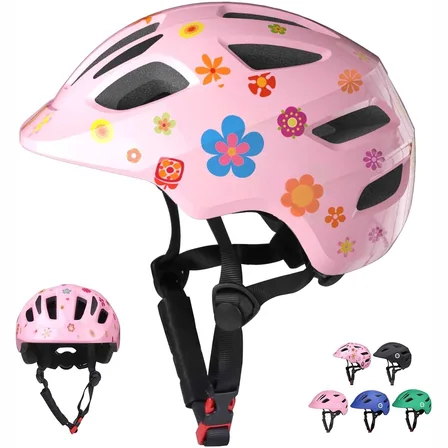
XJD Kids Bike Helmet for Girls, Pink Flowers, Adjustable (XS–S)
The XJD Kids Bike Helmet in Pink Flowers is an adjustable toddler-and-kids helme…$21.24
$24.99 -

Kids Bike Helmet by XJD for Boys & Girls – Black, Blue, Green, Pink, Purple
The XJD Kids Bike Helmet covers a wide 2-to-8-year age range thanks to two head-…$59.99
-

Kids Bike Helmet by XJD for Girls – Pink
The XJD Kids Bike Helmet in Pink is a lightweight multi-sport helmet for girls r…$59.99
$99