

How to teach a 4yr old to pedal a bike
Teach a 4-year-old to pedal by fitting the bike first, practising the pedal motion with support, then using short, calm sessions in a flat traffic-free area.
Measure before the first lesson
Measure your child’s height without shoes and check their inseam. Use height to choose a wheel-size starting point, then have the child try the actual bicycle. Age alone cannot confirm fit.
| Wheel size | XBikes starting point | What to verify in person |
|---|---|---|
| 12 Inch | Ages 3–4; 34–40 in / 86–102 cm | Stand-over clearance, easy reach and brake control |
| 14 Inch | Ages 3–6; 37–45 in / 94–114 cm | Confident starting, steering and stopping |
| 16 Inch | Ages 4–7; 40–48 in / 102–122 cm | No stretching to reach the controls or ground |
Choose according to measured height, inseam, reach, brake control and current confidence. Do not move up merely because the child is four, and do not buy an oversized bicycle for growth. A child who cannot comfortably stand over and control a bike is not ready to learn pedalling on that bike.
Set up a safe practice area
Use a smooth, level space away from vehicles, slopes and obstacles. The child should wear closed shoes and a properly fitting bicycle helmet. Position the helmet level and fasten its straps according to the helmet manufacturer’s instructions.
Before riding, confirm that the bicycle is assembled and operating as its exact manual specifies. Any assembly, adjustment, compatibility or maintenance question not covered by that manual should go to a qualified bicycle mechanic.
Teach the pedal movement first
- Explain that one foot pushes down while the other rises. Turn the pedals slowly by hand so the child can see the repeating circle.
- Hold the bicycle steady while the child sits and places both feet on the pedals. Let them rehearse several slow rotations without also having to balance.
- Place one pedal slightly forward and high enough for a strong first push. Ask the child to press it down, bring the second foot onto its pedal and continue looking ahead.
- Support the child lightly at the torso rather than steering the handlebar for them. Reduce that support as soon as they are balancing and pedalling independently.
Avoid pulling or pushing the bicycle faster than the child can control. If they repeatedly look down, lose the pedals or stop steering, simplify the exercise and restore light support.
Practise starting, stopping and steering
Pedalling is only useful when the rider can also start and stop deliberately. Practise one skill at a time: a first pedal push, several controlled rotations, a straight stop, and then gentle turns. Keep each attempt short enough that the child can reset without frustration.
Check brake reach and control on the actual bicycle before every independent run. The child should be able to use the fitted stopping system without releasing their secure grip or stretching beyond comfortable reach. Teach the exact stopping procedure specified for that bicycle rather than assuming every children’s bike operates identically.
Decide whether training wheels help
Training wheels can reduce the immediate balancing demand while a child learns the pedal sequence, starting and stopping. They are relevant when balancing and pedalling together is overwhelming. They do not replace correct fit, supervision, helmet use or brake practice, and the child will still need to learn two-wheel balance later.
These catalog choices help compare 12-, 14- and 16-inch options that include training wheels. The appropriate choice still depends on the child’s measurements and an individual fit check, not the wording of a product title.
 XJD Light Purple Girls Bike with Basket, Training Wheels, 12/14/16/20 Inch
A Training Wheel Bikes option with supplied 12 Inch, 14 Inch and 16 Inch SKU labels. Compare the child’s measured height and individual fit before choosing it for pedal practice.
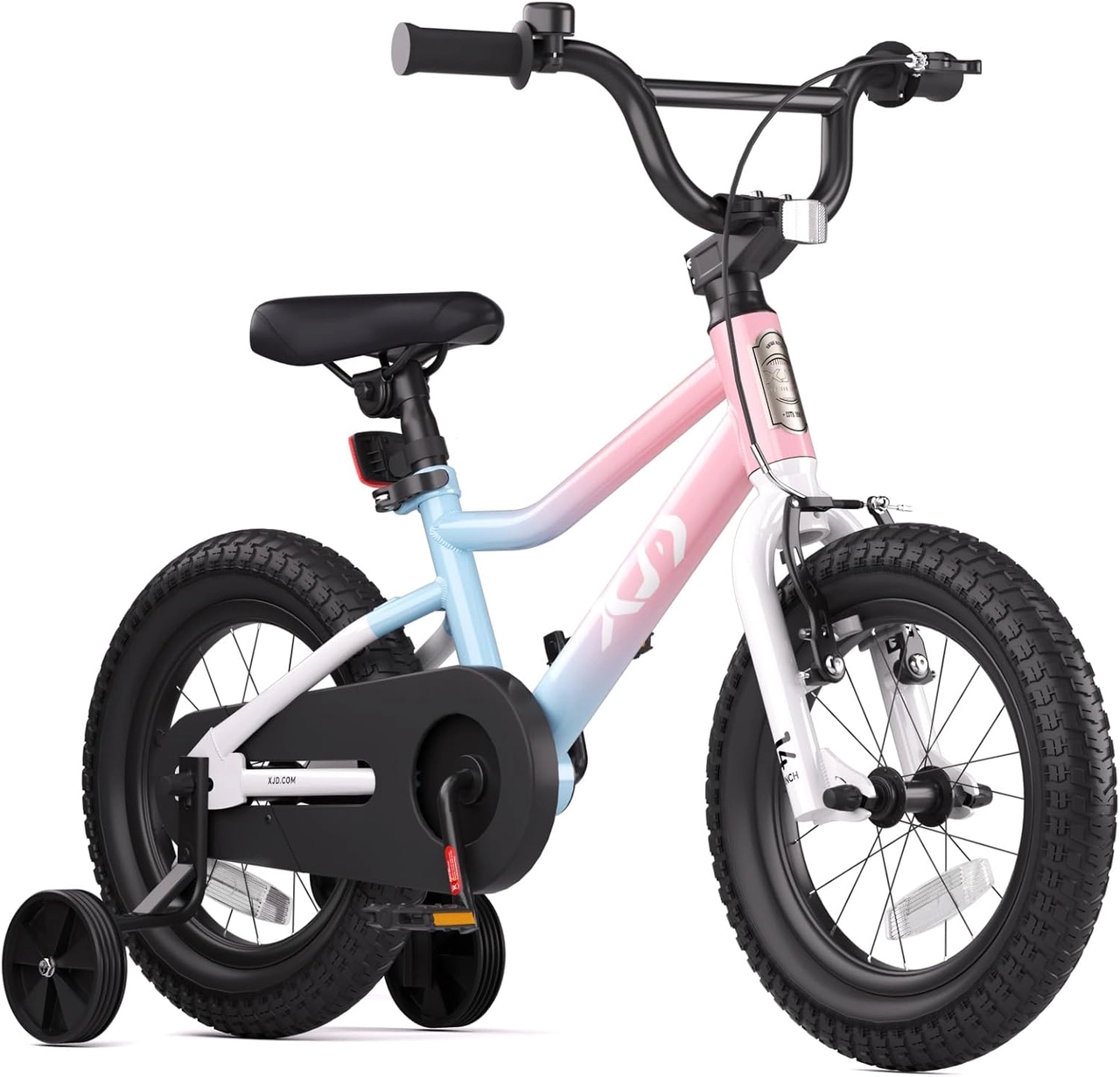 XJD Girls BMX Bike 12/14/16 Inch with Training Wheels – Pink Blue
A Kids’ BMX Bikes option supplied with 12 Inch, 14 Inch and 16 Inch SKU labels and training wheels. It is relevant when training-wheel support suits the child’s current learning stage.
 XJD Boys & Girls BMX Bike with Training Wheels, 12/14/16" – Blue
A Kids’ BMX Bikes option with training wheels and supplied 12 Inch, 14 Inch and 16 Inch SKU labels. Its relevance depends on measured height, reach, brake control and confidence.
- XJD Light Purple Girls Bike with Basket, Training Wheels, 12/14/16/20 Inch is listed under Training Wheel Bikes. Its available SKU labels supplied here are 12 Inch, 14 Inch and 16 Inch.
- XJD Girls BMX Bike 12/14/16 Inch with Training Wheels – Pink Blue is a Kids’ BMX Bikes option with supplied 12 Inch, 14 Inch and 16 Inch SKU labels.
- XJD Boys & Girls BMX Bike with Training Wheels, 12/14/16" – Blue is also listed under Kids’ BMX Bikes and has supplied 12 Inch, 14 Inch and 16 Inch SKU labels.
All three may be relevant when training wheels suit the teaching stage and one of those sizes passes the fit check. Their titles do not establish suitability for a particular four-year-old. Price, stock, components and other specifications cannot be inferred from the supplied catalog facts.
Know when to pause or progress
Pause if the child cannot stand over the bicycle comfortably, cannot reach or control the brakes, stretches for the handlebar, becomes frightened, or cannot keep the bike under control. Recheck fit before treating the difficulty as a learning problem.
Progress when the child can start with a deliberate pedal push, look ahead, keep turning the pedals, steer a simple line and stop on request. Your next decision is therefore concrete: measure height and inseam, compare 12-, 14- and 16-inch starting points, test fit and controls, then begin with supported pedal rotations in a level traffic-free space.
Bikes for your next adventure
-

Kids Bike Helmet by XJD for Boys & Girls – Black, Blue, Green, Pink, Purple
The XJD Kids Bike Helmet covers a wide 2-to-8-year age range thanks to two head-…$59.99
-

Kids Bike Helmet by XJD for Girls – Pink
The XJD Kids Bike Helmet in Pink is a lightweight multi-sport helmet for girls r…$59.99
$99 -

XJD Kids Bike for Girls – Pink, 12/14/16/20 Inch with Training Wheels
The XJD Kids Bike for Girls in Pink is a training-wheel bike built to carry your…$139
$159