

What size bike for a 3-4 year old
For most 3–4-year-olds, start with a 12-inch bike. Measure the child first: 12-inch wheels suit 34–40 in (86–102 cm), while some taller riders may fit a 14-inch bike.
Choose between 12-inch and 14-inch wheels
Age gives you a starting point, not a final answer. The XBikes sizing standard places 12-inch bikes at ages 3–4 and heights of 34–40 in (86–102 cm). It places 14-inch bikes at ages 3–6 and heights of 37–45 in (94–114 cm).
That overlap matters. A child measuring 37–40 in (94–102 cm) could fall within either starting range, so compare both sizes in person if possible. Choose the bike the child can stand over, reach and control comfortably today. Do not buy an oversized bicycle simply to allow room for growth.
| Measured rider height | Size to check first | What to do |
|---|---|---|
| 34–36 in (86–93 cm) | 12 Inch | Check stand-over clearance, reach and controls. |
| 37–40 in (94–102 cm) | 12 Inch and 14 Inch | Try both; select by actual control and confidence. |
| 41–45 in (103–114 cm) | 14 Inch | Confirm the child can start, stop and steer comfortably. |
Measure the child before comparing bikes
Measure height without shoes, with the child standing straight against a wall. Then measure inseam from the floor to the crotch while the child stands naturally. The supplied wheel-size standard uses total height, but inseam helps you judge whether the child can stand over the bicycle without being crowded by the frame.
Write down both measurements rather than relying on clothing size or a recent estimate. Compare measured height with the ranges above, then use the inseam during an actual fit check. Frame shapes and adjustment ranges can differ, so wheel diameter alone cannot confirm fit.
Run a simple fit and control check
Have the child try the bicycle with close adult supervision. The American Academy of Pediatrics recommends checking the real rider-bike fit and avoiding a bike that is too large for the child to control.
- Stand-over: Ask the child to straddle the frame with feet securely on the ground. The position should not feel cramped or force the child onto tiptoes.
- Seated position: Confirm the child can get on and off without struggling and can maintain a stable riding posture.
- Reach: Hands should reach the handlebar without an exaggerated stretch or locked arms.
- Brake control: If the bicycle has hand-operated controls, the child must be able to reach and operate them reliably. Follow the exact product manual for the bicycle’s controls and adjustments.
- Confidence: Watch for controlled steering, starting and stopping. Size down or reconsider the model if the child appears intimidated or cannot manage it consistently.
A larger wheel is not an upgrade when it reduces control. For a child near a range boundary, present ability should decide the size.
How the supplied XBikes options compare
The three catalog options are useful because each has supplied 12-inch, 14-inch and 16-inch SKU labels, allowing parents to compare the two sizes most relevant to a 3–4-year-old. The 16-inch versions are generally outside this title’s age starting point: XBikes places 16-inch wheels at ages 4–7 and heights of 40–48 in (102–122 cm), and an individual fit check remains essential.
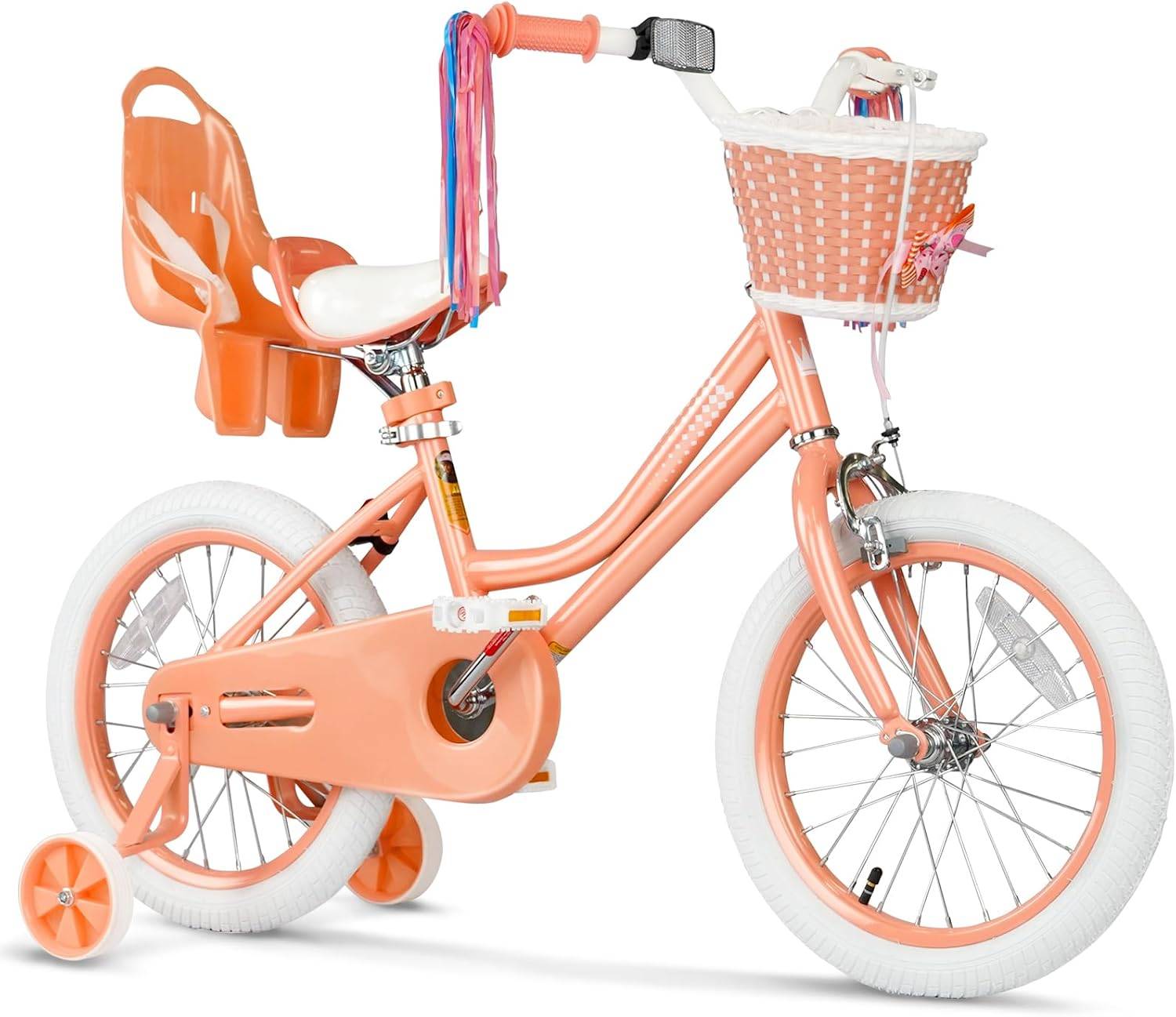 Girls 12/14/16 Inch Kids Bike by XJD with Training Wheels – Peach
A training-wheel bike offered in supplied 12-inch, 14-inch and 16-inch sizes. Compare its 12-inch and 14-inch versions using the child’s measured height and an individual fit check.
 XJD Light Purple Girls Bike with Basket, Training Wheels, 12/14/16/20 Inch
A training-wheel bike with a basket and supplied available SKU labels of 12 Inch, 14 Inch and 16 Inch. Its 12-inch and 14-inch options are relevant comparison points for measured fit.
 XJD Girls BMX Bike 12/14/16 Inch with Training Wheels – Pink Blue
A kids’ BMX bike with training wheels and supplied 12-inch, 14-inch and 16-inch sizes. Check the 12-inch or 14-inch option against height, stand-over, reach and control.
The Girls 12/14/16 Inch Kids Bike by XJD with Training Wheels – Peach is categorized as a training-wheel bike and has supplied 12-inch, 14-inch and 16-inch options. For this age question, begin by comparing its 12-inch or 14-inch version against the child’s measured height.
The XJD Light Purple Girls Bike with Basket, Training Wheels, 12/14/16/20 Inch is also categorized as a training-wheel bike. Its supplied available SKU labels for this comparison are 12 Inch, 14 Inch and 16 Inch; do not infer current availability of another size from wording in the title.
The XJD Girls BMX Bike 12/14/16 Inch with Training Wheels – Pink Blue is categorized as a kids’ BMX bike, with supplied 12-inch, 14-inch and 16-inch options. Its category differs, but sizing still depends on the same measurements and hands-on control checks.
Training wheels do not make an oversized frame appropriate. They may change how a bike balances at low speed, but the child still needs suitable stand-over clearance, reach and control access. Follow the exact product manual for assembly, adjustment, compatibility, maintenance and limits, or ask a qualified bicycle mechanic.
Before the first ride
Once the bike passes the fit check, add a properly fitting bicycle helmet. U.S. Consumer Product Safety Commission guidance says the helmet should sit level and its straps should be used according to the manufacturer’s instructions. Recheck fit after adjustments and as the child grows.
The practical decision is simple: start with 12 inches for a measured height of 34–40 in, compare 12 and 14 inches in the overlap, and choose 14 inches only when the child’s measurements, reach, braking and present confidence support it.
Bikes for your next adventure
-

Pink Girls' 12/14/16" Bike by XJD – Basket & Doll Seat
The XJD Pink Girls' Bike with Basket & Doll Seat is made for riders 71–122 cm ta…$75.99
$99.99 -

XJD Girls Bike for Kids Ages 3-8, 12/14/16 Inch with Training Wheels – Purple
The XJD Girls Bike in Purple is a training-wheel bicycle for kids ages 3 to 8, f…$149
$169 -

Light Purple XJD Toddler Bike Helmet, Adjustable, Size XS (46–51 cm)
This Light Purple XJD toddler bike helmet is made for the smallest riders — the …$20.39