

What size bike should you get a 4 year old
Most 4-year-olds should start by comparing a 12-inch and 14-inch bike. Measure your child first: height, inseam, reach and control matter more than age.
Choose the size from measured height
Use age only to identify likely options. According to the XBikes starting points, a 12-inch bike suits ages 3–4 and heights of 34–40 in (86–102 cm). A 14-inch bike covers ages 3–6 and heights of 37–45 in (94–114 cm). Their ranges overlap, so some 4-year-olds may fit either size on paper.
A 16-inch bike is a possible comparison for a taller 4-year-old because its starting range is ages 4–7 and 40–48 in (102–122 cm). It should only be chosen if the individual fit checks also work. Do not move up merely because the child has turned four or because a larger bicycle may last longer.
| Wheel size | XBikes age starting point | Rider height | Relevance at age four |
|---|---|---|---|
| 12 Inch | 3–4 | 34–40 in / 86–102 cm | Compare for children within this height range |
| 14 Inch | 3–6 | 37–45 in / 94–114 cm | Compare where the ranges overlap or the child is taller |
| 16 Inch | 4–7 | 40–48 in / 102–122 cm | Consider only for a child at least 40 in / 102 cm who passes every fit check |
Measure before shopping
- Height: Have the child stand upright without shoes against a wall. Compare the measurement with the XBikes height ranges above.
- Inseam: Measure from the floor to the crotch while the child stands naturally. Use it to check whether the child can straddle the actual bike without being pressed against its frame.
- Reach: On the bicycle, check that the child can hold the handlebar without stretching, locking the elbows or leaning awkwardly.
- Brake control: Confirm that the child can reach and operate the fitted brakes as intended while maintaining control.
Wheel size is not the same as complete bicycle fit. Frame shape, saddle adjustment and handlebar position can make two bicycles with the same wheel label feel different, so measurements narrow the choice but do not replace a trial.
Do a hands-on fit check
Have the child try each candidate bicycle. The American Academy of Pediatrics advises against buying an oversized bike for future growth and recommends checking stand-over clearance, control and brake reach.
- The child should be able to mount, start, stop and get off without struggling.
- While straddling the bike, the frame should not prevent a comfortable, stable stance.
- Seated posture should allow easy steering without an exaggerated forward reach.
- The child should be able to use the bicycle’s braking controls reliably.
- Current confidence matters: a technically possible size is not suitable if the child cannot control it comfortably.
If both 12-inch and 14-inch options match the height chart, choose by the better stand-over position, reach, braking control and confidence during the trial—not by the larger wheel label.
How the supplied bike helps with the comparison
The XJD Girls' Bike with Training Wheels, 12/14/16/20 Inch – Purple is listed in the Training Wheel Bikes category and has 12-inch, 14-inch, 16-inch and 20-inch SKU labels. Its 12-inch and 14-inch options provide the main comparison for many 4-year-olds, while its 16-inch option is relevant only for a taller child who fits the 16-inch range and passes the hands-on checks. The 20-inch option begins at ages 7–12 and heights of 48–60 in (122–152 cm), so it is not an age-four default.
These catalog options help you compare the wheel labels most relevant to the title, but the listing alone cannot establish fit for an individual child.

Training wheels may be relevant to the child’s current confidence, but their presence does not make an oversized bicycle fit correctly. Follow the exact product manual for assembly, adjustment, maintenance, compatibility and any limits not supplied here, or ask a qualified bicycle mechanic.
Complete the safety check
Use a bicycle helmet that fits properly. The U.S. Consumer Product Safety Commission advises that the helmet sit level and that its straps be used according to the helmet manufacturer’s instructions. A helmet cannot correct poor bicycle fit, reach or control, so check both separately.
Your decision for a 4-year-old
Measure height and inseam, shortlist 12-inch and 14-inch bikes from the stated ranges, and add a 16-inch comparison only when the child is at least 40 in (102 cm). Then have the child try the actual bicycle. Select the size that permits comfortable stand-over, natural reach, reliable brake operation and confident control. If those checks fail, reject that size—even if its age label appears suitable.
Bikes for your next adventure
-

Pink Girls' 12/14/16" Bike by XJD – Basket & Doll Seat
The XJD Pink Girls' Bike with Basket & Doll Seat is made for riders 71–122 cm ta…$75.99
$99.99 -

Light Pink XJD Girls' Bicycle with Basket & Training Wheels
The Light Pink XJD Girls' Bicycle with Basket & Training Wheels is a retro-style…$109.99
$129.99 -
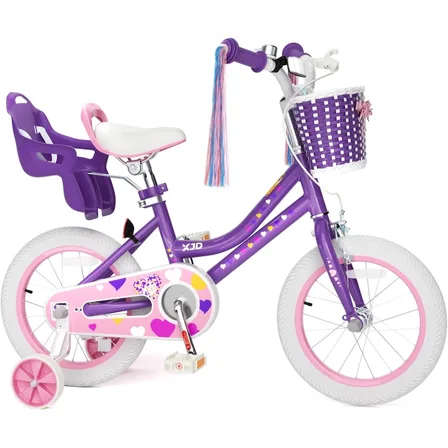
Purple XJD Girls' Bike with Doll Seat & Basket
For girls 71–122 cm tall (about ages 3–7), this XJD girls' bike in Purple pairs …$75.99
$99.99