

What size bike to buy a 4 year old
For most 4-year-olds, start by comparing a 12-, 14-, and 16-inch bike. Measure your child first: height and actual fit matter more than age.
Choose the starting wheel size from measured height
Measure your child’s height without shoes, standing straight against a wall. Then use the XBikes ranges below to identify which wheel sizes deserve an in-person fit check. Wheel size describes the wheels; it does not guarantee that every frame with that label will fit identically.
| Wheel size | XBikes age starting point | Rider height |
|---|---|---|
| 12 Inch | Ages 3–4 | 34–40 in / 86–102 cm |
| 14 Inch | Ages 3–6 | 37–45 in / 94–114 cm |
| 16 Inch | Ages 4–7 | 40–48 in / 102–122 cm |
A 4-year-old measuring below 40 inches will commonly begin with the 12- or 14-inch comparison. At 40 inches or taller, 16-inch bikes also enter the starting range. Where ranges overlap, do not automatically choose the larger option. Compare both sizes using the physical checks below.
Measure inseam before visiting or ordering
Height narrows the options, but inseam helps reveal whether the child can stand over and manage a particular frame. With shoes off, have the child stand with feet slightly apart. Place a straight, firm object between the legs, level like a bicycle saddle, and measure from its top edge to the floor.
Compare that measurement with the bicycle’s stand-over clearance and saddle adjustment information from the exact product manual. The supplied catalog facts do not provide those dimensions, so wheel size alone cannot settle the fit. If measurements are unavailable or unclear, ask a qualified bicycle mechanic to check the bicycle with the child present.
Make the child perform a simple fit check
The American Academy of Pediatrics guidance emphasizes trying the bicycle, avoiding an oversized bike bought merely for growth, and checking stand-over room, control, and brake reach. During the trial, look for all of the following:
- The child can stand over the bicycle without the frame preventing a stable stance.
- The child can get on and off without being lifted into position.
- Seated riding posture does not require an uncomfortable stretch to reach the handlebar.
- The child can steer through a turn while remaining balanced and in control.
- The child can reach and operate the fitted braking controls confidently.
- The child can start, stop, and place a foot down without panic or a sudden loss of control.
If a 16-inch bike matches the height chart but the child struggles with reach or control, compare a 14-inch bike. If the 12-inch option feels cramped or restricts comfortable steering, compare a 14-inch bike. Current confidence matters alongside body measurements.
How the supplied XBikes options help
The three supplied products are relevant because each offers 12 Inch, 14 Inch, and 16 Inch SKU labels, covering all three XBikes starting points that may apply at age four. They provide size comparison options, but their shared wheel-size labels do not replace checking each exact bicycle’s frame fit, reach, controls, and manual.
 XJD Pink Girls' Bike – Kids 12/14/16 Inch Training Wheel Bicycle
A Training Wheel Bike with 12 Inch, 14 Inch, and 16 Inch SKU labels, making it relevant for comparing the XBikes size starting points that may apply to a measured 4-year-old.
 XJD Girls Bike for Kids Ages 3-8, 12/14/16 Inch with Training Wheels – Purple
This Training Wheel Bike offers 12 Inch, 14 Inch, and 16 Inch labels. The age wording in its title is a catalog label, so individual height, reach, braking, and control still determine fit.
 Girls 12/14/16 Inch Kids Bike by XJD with Training Wheels – Peach
A Training Wheel Bike supplied in 12 Inch, 14 Inch, and 16 Inch SKU labels. It is relevant as a three-size comparison option, provided the chosen bicycle passes the child’s individual fit check.
- XJD Pink Girls' Bike – Kids 12/14/16 Inch Training Wheel Bicycle is categorized as a Training Wheel Bike and has 12 Inch, 14 Inch, and 16 Inch labels.
- XJD Girls Bike for Kids Ages 3-8, 12/14/16 Inch with Training Wheels – Purple is also categorized as a Training Wheel Bike and offers the same three size labels. The age wording is part of its catalog title, not proof that it fits a particular child.
- Girls 12/14/16 Inch Kids Bike by XJD with Training Wheels – Peach is a Training Wheel Bike available under 12 Inch, 14 Inch, and 16 Inch labels.
These products are relevant when a training-wheel bicycle suits the child’s present riding stage and one of those sizes passes the individual fit check. They are not automatically appropriate simply because the rider is four. If the child needs a different bicycle type, or none can be controlled comfortably, these catalog choices are not suitable substitutes.
Check setup, braking, and helmet fit
Before riding, follow the exact product manual for assembly, adjustments, maintenance, compatibility, load limits, and any torque requirements. Those details are not supplied here and should not be guessed. Use a qualified bicycle mechanic when the instructions are incomplete, the setup is uncertain, or controls cannot be adjusted for confident use.
A bicycle helmet is essential, but its label alone is not enough. U.S. Consumer Product Safety Commission guidance says the helmet should fit properly, sit level, and have its straps used according to the helmet manufacturer’s instructions. Recheck the fit whenever straps have moved or the child has grown.
Make the final size decision
Measure height and inseam, shortlist 12, 14, or 16 inches from the XBikes ranges, and have the child try the candidates. Choose the size they can stand over, reach, steer, brake, start, and stop with control today. For a 4-year-old between two workable sizes, reject any larger bike that reduces confidence or control rather than buying room to grow.
Bikes for your next adventure
-

Blue XJD Kids Bike Helmet for Boys & Girls
The Blue XJD Kids Bike Helmet is a lightweight, adjustable multi-sport helmet fo…$59.99
$99 -
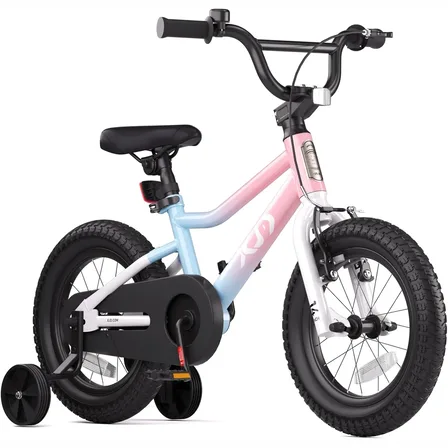
XJD Girls BMX Bike 12/14/16 Inch with Training Wheels – Pink Blue
The XJD Girls BMX Bike in Pink/Blue is built as a first pedal bike for kids roug…$99.99
$119.99 -

Kids Bike Helmet by XJD for Boys & Girls – Black, Blue, Green, Pink, Purple
The XJD Kids Bike Helmet covers a wide 2-to-8-year age range thanks to two head-…$59.99