

How many inch bike for a 2 year old
For a 2-year-old, do not choose by age alone. XBikes’ smallest starting point is a 12-inch bike, intended for riders 34–40 in (86–102 cm), but it fits only if your child can stand over, reach, steer and brake comfortably.
Is a 12-inch bike right for a 2-year-old?
A 12-inch bicycle is the first size worth checking, not an automatic recommendation. The XBikes guide places 12-inch bikes at ages 3–4 and heights of 34–40 in (86–102 cm). Because a 2-year-old is younger than that starting range, an individual fit check is essential.
If your child is below 34 in (86 cm), cannot stand over the bicycle comfortably, or struggles to reach and control its steering or brakes, the 12-inch options shown here are not yet suitable. Do not move up to a 14-inch bike merely to allow room for growth.
Measure height and inseam first
Measure your child without shoes, standing straight against a wall. Record total height from floor to the top of the head. Then measure inseam from the floor to the crotch, using a book held level between the legs to represent the saddle area.
Compare measured height with the XBikes starting points below. Inseam remains important because bicycles with the same wheel size can have different frame shapes and stand-over clearances.
| Wheel size | XBikes age starting point | Rider height | Relevance at age 2 |
|---|---|---|---|
| 12 Inch | Ages 3–4 | 34–40 in / 86–102 cm | First size to try only when height and control checks agree |
| 14 Inch | Ages 3–6 | 37–45 in / 94–114 cm | Usually a later comparison; never substitute it for a correctly fitting 12-inch bike |
| 16 Inch | Ages 4–7 | 40–48 in / 102–122 cm | Outside the supplied age starting point for a 2-year-old |
What to check during a real fit test
Numbers narrow the choice, but the child must try the actual bicycle. With close adult support, check whether the rider can:
- stand over the frame with comfortable clearance rather than being pressed against it;
- sit in a stable position and reach the handlebars without stretching or leaning excessively;
- turn the handlebars while remaining balanced and in control;
- reach and operate the bicycle’s brakes reliably, according to its actual configuration; and
- start, stop and respond to simple instructions with current confidence.
Reject the bike if control depends on the child growing into it. An oversized bicycle can make mounting, steering and stopping harder even when its listed age seems close.
How the supplied XBikes products compare
The two supplied catalog options help because both are training-wheel bicycles offered in 12-inch sizes, the smallest XBikes wheel-size starting point. Their larger variants show what not to select unless the child’s measurements and individual fit genuinely support that size.
 Light Pink XJD Girls' Bicycle with Basket & Training Wheels
Available in 12, 14, 16 and 20 Inch variants. Its 12 Inch training-wheel version is the relevant first comparison, subject to the child’s measured height and hands-on fit.
 Blue XJD Girls Bike with Training Wheels – 12/14/16 Inch
Available in 12, 14 and 16 Inch variants. Compare only the 12 Inch option first for this age, then confirm stand-over clearance, reach, braking and confident control.
Light Pink XJD Girls' Bicycle with Basket & Training Wheels is offered in 12, 14, 16 and 20 Inch variants. For this question, only its 12 Inch variant is a reasonable candidate to inspect first; the product title and training wheels do not prove that it fits a particular 2-year-old.
Blue XJD Girls Bike with Training Wheels – 12/14/16 Inch is offered in 12, 14 and 16 Inch variants. Again, compare the 12 Inch version with the child’s 34–40 in (86–102 cm) height range and then perform the complete hands-on fit check.
The 14- and 16-inch variants are different sizes, not equivalent alternatives when a child needs a 12-inch bicycle. Neither product is relevant yet if the child is too small or cannot control its 12-inch version confidently.
Safety and setup before riding
Use a bicycle helmet that fits properly, sits level and has straps adjusted according to the helmet manufacturer’s instructions. Close adult supervision and a clear riding area remain necessary; training wheels do not replace fit, control or supervision.
Assembly details, adjustment limits, maintenance, compatibility, load limits and torque values are not included in the supplied catalog facts. Follow the exact product manual for those points or have a qualified bicycle mechanic inspect and adjust the bicycle.
Your next decision
Measure height and inseam now. If height is 34–40 in (86–102 cm), arrange a supervised 12-inch fit test and accept the bike only when stand-over clearance, reach, steering, braking and confidence all work. If those checks fail, wait rather than buying a larger bicycle for growth.
Bikes for your next adventure
-
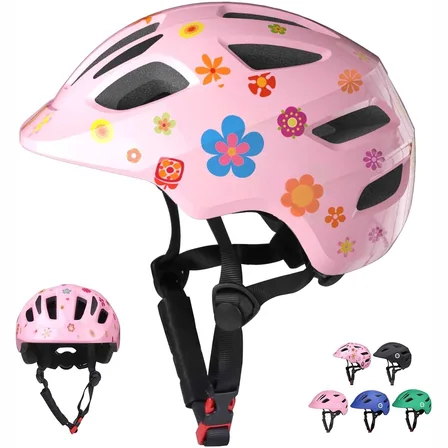
XJD Kids Bike Helmet for Girls, Pink Flowers, Adjustable (XS–S)
The XJD Kids Bike Helmet in Pink Flowers is an adjustable toddler-and-kids helme…$21.24
$24.99 -

Kids Bike Helmet by XJD for Boys & Girls – Black, Blue, Green, Pink, Purple
The XJD Kids Bike Helmet covers a wide 2-to-8-year age range thanks to two head-…$59.99
-

Kids Bike Helmet by XJD for Girls – Pink
The XJD Kids Bike Helmet in Pink is a lightweight multi-sport helmet for girls r…$59.99
$99