

Can 3years old ride a bike 2 wheels
Yes, some 3-year-olds can ride a two-wheel bike, but age alone cannot answer whether your child is ready. Measure height and inseam, then confirm stand-over clearance, reach, brake control and confidence on the exact bicycle.
Start with the child, not the age label
For a 3-year-old, the XBikes starting points place a 12 Inch bike at ages 3–4 and rider heights of 34–40 in (86–102 cm). A 14 Inch bike starts at ages 3–6 and heights of 37–45 in (94–114 cm). These ranges overlap, so a taller child is not automatically better served by the larger wheel size.
Measure your child’s standing height without shoes. Measure inseam from the floor to the crotch while the child stands naturally. Compare those measurements with the starting ranges, but make the final decision by trying the exact bike. Do not buy an oversized bicycle merely to leave room for growth.
Check whether the exact bike fits
Have your child stand over the bicycle and sit in the riding position. They should be able to get on and off without struggling or being trapped by the frame. Check that they can reach the handlebars while remaining balanced rather than stretching, twisting or locking their arms.
Next, ask them to operate the bicycle’s controls. If it has hand-operated brakes, the child must be able to reach and use them reliably; if the controls differ, follow the exact product manual. A nominally suitable wheel size is still unsuitable when the child cannot steer, stop or dismount with control.
- Consider 12 Inch first: when measured height is 34–40 in (86–102 cm), subject to the individual fit check.
- Compare 12 and 14 Inch: when height falls within their overlap of 37–40 in (94–102 cm). Choose by stand-over, reach and control.
- Consider 14 Inch: when height is 37–45 in (94–114 cm), but only if the exact bicycle fits comfortably.
- Wait or try another design: when neither size permits confident mounting, steering, stopping and dismounting.
Two wheels does not always mean ready to ride independently
A child may fit a bicycle yet lack the balance, coordination or confidence to ride without assistance. Begin in a flat, open area away from traffic and obstacles. Stay close enough to help, keep the first sessions short and stop if the child becomes frightened, tired or unable to follow simple stopping directions.
Training wheels can support early pedalling practice, but a training-wheel bicycle is not the same experience as independently balancing on two wheels. Choose according to the skill you want the child to practise now. Never treat a birthday as a deadline for removing support.
How the supplied XBikes options compare
These particular catalog options help answer the question because all are training-wheel bicycles and all offer a 12 Inch label, while selected models also offer larger labels. They may be relevant when a 3-year-old fits the chosen size and needs a training-wheel format; they are not evidence that the child is ready for unsupported two-wheel riding.
 Light Pink XJD Girls' Bicycle with Basket & Training Wheels
A training-wheel bicycle offered in 12 Inch and 14 Inch labels relevant to the supplied starting ranges for some 3-year-olds; also available in 16 Inch and 20 Inch. Confirm fit on the exact bike.
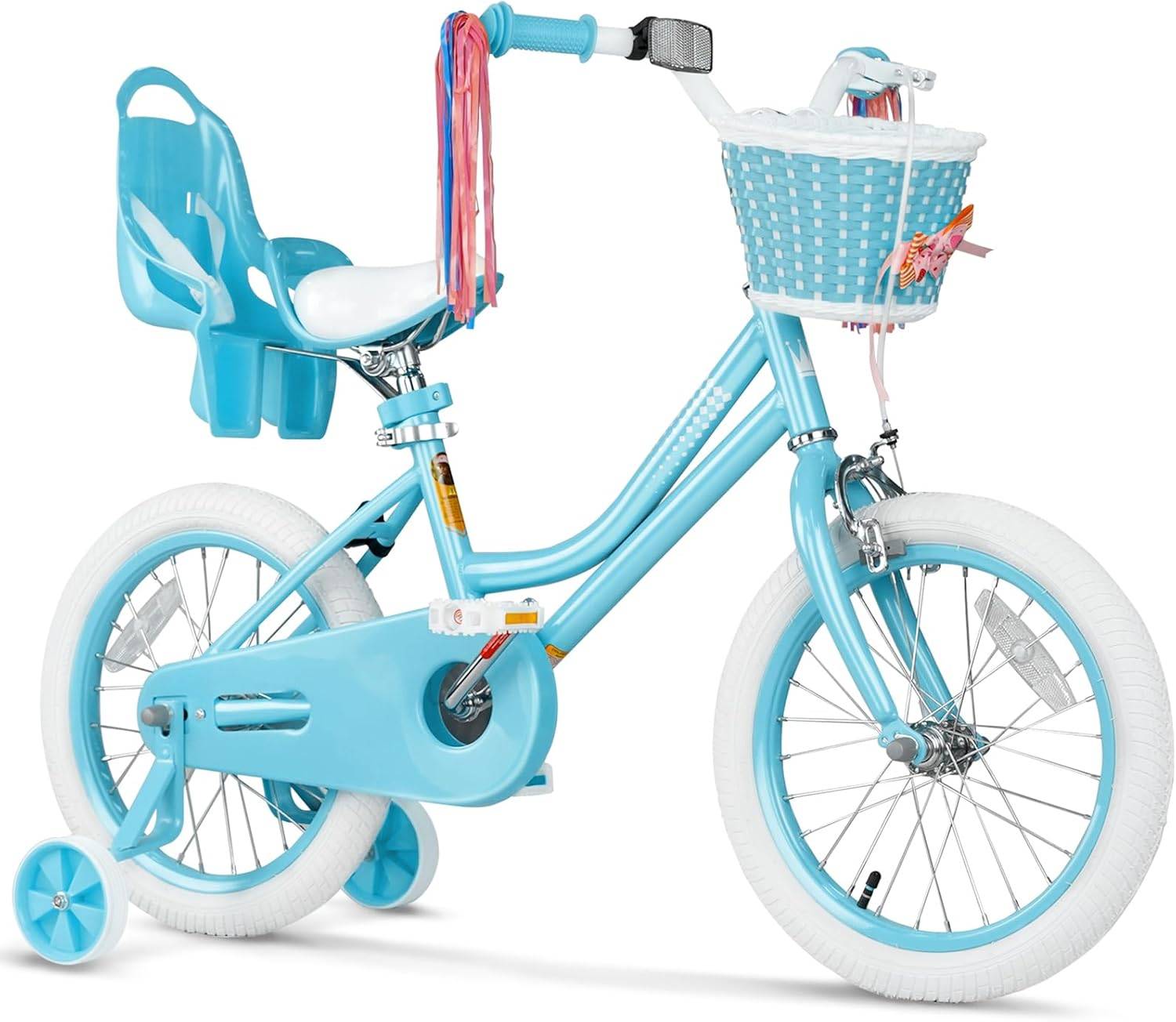 Blue XJD Girls Bike with Training Wheels – 12/14/16 Inch
A training-wheel bicycle offered in 12 Inch, 14 Inch and 16 Inch labels. Its 12 Inch and possibly 14 Inch options may be relevant after measuring the child and completing an individual fit check.
 XJD Boys 12/14/16" Training Wheel Bike – Blue
A blue training-wheel bicycle offered in 12 Inch, 14 Inch and 16 Inch labels. Consider the 12 Inch or 14 Inch option only when the child’s height, stand-over, reach and control support it.
Light Pink XJD Girls' Bicycle with Basket & Training Wheels is listed with 12 Inch, 14 Inch, 16 Inch and 20 Inch options. For a 3-year-old, compare only the 12 Inch or 14 Inch starting points unless the child’s measurements and an individual fit check clearly indicate otherwise; the supplied standard begins 16 Inch at age 4.
Blue XJD Girls Bike with Training Wheels – 12/14/16 Inch and XJD Boys 12/14/16" Training Wheel Bike – Blue each list 12 Inch, 14 Inch and 16 Inch options. Their supplied facts do not establish differences in geometry, brakes, weight or adjustability, so the titles and size labels cannot replace trying the exact model.
All three products are categorized as Training Wheel Bikes. If you specifically want a bicycle for unsupported balance practice, verify the exact configuration and instructions before choosing; the supplied catalog facts do not state whether the training wheels are removable or how they should be adjusted.
Helmet and setup checks
Use a bicycle helmet that fits properly, sits level and has straps adjusted according to the helmet manufacturer’s instructions. Adult supervision and a suitable riding area remain necessary even when the bicycle and helmet appear to fit.
Before riding, follow the exact bicycle manual for assembly, inspection, maintenance, compatibility and load limits. No torque values or procedures are supplied here. If anything is unclear, loose or difficult to operate, have a qualified bicycle mechanic inspect it rather than improvising.
Make the decision today
- Measure height and inseam.
- Start with 12 Inch; compare 14 Inch only when the height range and actual fit support it.
- Have the child demonstrate comfortable stand-over, reach, steering, braking and dismounting.
- Decide whether the immediate goal is supported pedalling or independent two-wheel balance.
If your 3-year-old fits the exact bike and can control it confidently, riding a two-wheel bicycle may be appropriate. If fit or control is uncertain, choose a better-fitting learning format or wait and try again later—never size up simply for future growth.
Bikes for your next adventure
-

Light Pink XJD Girls' Bicycle with Basket & Training Wheels
The Light Pink XJD Girls' Bicycle with Basket & Training Wheels is a retro-style…$109.99
$129.99 -

Blue XJD Girls Bike with Training Wheels – 12/14/16 Inch
If you're shopping for a first pedal bike for a daughter roughly 3 to 8 years ol…$149
$169 -

Black XJD Kids Bike for Boys – 12, 14 & 16 Inch Sizes
For a son between roughly 3 and 8 years old, the XJD Kids Bike in Black covers t…$169
$199