

Can a 3 year old learn to ride a bike
Yes, a 3-year-old can learn to ride a bike if the bicycle fits, the child is interested, and practice stays short, calm and closely supervised.
Start with readiness, not the birthday
Age three is a reasonable starting point, but it does not prove that a child is ready for a particular bike. Look for simple signs of readiness: the child wants to try, can follow brief directions, and is willing to sit on the bike without becoming distressed. Current confidence matters as much as physical size.
A child does not need to master everything in one session. First experiences can focus on getting on and off, holding the handlebar, looking ahead and stopping when asked. If the child repeatedly resists or cannot control the bicycle, pause and try again later rather than forcing progress.
Measure before comparing wheel sizes
Measure the child’s standing height without shoes. Also measure inseam from the floor to the crotch while the child stands naturally. These measurements help narrow the options, but the final decision must come from trying the actual bicycle.
| Wheel size | XBikes starting age | Rider-height starting point |
|---|---|---|
| 12 Inch | Ages 3–4 | 34–40 in / 86–102 cm |
| 14 Inch | Ages 3–6 | 37–45 in / 94–114 cm |
| 16 Inch | Ages 4–7 | 40–48 in / 102–122 cm |
For many 3-year-olds, 12 Inch is the first comparison because its starting range is ages 3–4. A taller child may fall within the 14 Inch height range, but overlap does not make the sizes interchangeable. The 16 Inch starting range begins at age four and 40 inches / 102 cm, so it should not be selected for a typical 3-year-old merely to leave room for growth.
Do the individual fit check
Have the child try the exact bicycle. Do not buy an oversized model for future growth. While the child stands over it, check that there is comfortable clearance and that getting on and off does not require leaning the bicycle dangerously far.
Then check the riding position. The child should be able to reach and steer the handlebar without stretching, turn it without losing balance, and operate the bicycle’s braking controls comfortably. Confirm that the child can start, stop and put a foot down with confidence. A height-chart match is only a starting point if reach, stand-over clearance or control is poor.
How the catalog option helps with comparison
The Black XJD Kids' BMX Bicycle with Training Wheels is relevant because its supplied choices include 12 Inch, 14 Inch and 16 Inch. Those labels let a parent compare the three nearby XBikes starting ranges against the child’s measured height and actual fit. The training wheels are identified in the product title, but the title alone does not establish suitability for every 3-year-old.

Begin with the 12 Inch option when the child measures 34–40 inches / 86–102 cm, then verify the full fit in person. Consider the 14 Inch option only when the child’s height falls within 37–45 inches / 94–114 cm and the child can comfortably manage its stand-over, reach and controls. Treat the 16 Inch option cautiously for this question because its XBikes starting point is ages 4–7 and 40–48 inches / 102–122 cm.
These are size options within one supplied product, not proof that every size is currently appropriate. No supplied facts establish its weight, materials, brake type, load limit, certification, assembly requirements or compatibility details. Follow the exact product manual for those matters, or ask a qualified bicycle mechanic.
Teach in small, controlled steps
- Choose a flat practice area away from traffic, obstacles and steep slopes.
- Show the child how to get on, hold the handlebar and look toward the intended path.
- Practice stopping and putting a foot down before trying longer movement.
- Use short sessions and finish while the child is still comfortable.
- Stay close enough to assist, but allow the child to perform each familiar step.
Training wheels may help support the bicycle while a child becomes familiar with steering and pedaling, but they do not replace a correct fit or attentive supervision. Follow the product manual for installation, adjustment and removal; if the instructions are unclear or assembly is uncertain, use a qualified bicycle mechanic.
Helmet and final decision
Use a bicycle helmet every time. It must fit properly, sit level on the head, and have its straps adjusted according to the helmet manufacturer’s instructions. Recheck the fit rather than assuming a helmet that was previously adjusted still fits.
For a 3-year-old, measure height and inseam now, compare 12 Inch first, and have the child try the exact bike. Choose it only if stand-over clearance, reach, brake control and confidence all work today; otherwise wait or compare another appropriate size instead of buying for growth.
Bikes for your next adventure
-

Blue XJD Girls Bike with Training Wheels – 12/14/16 Inch
If you're shopping for a first pedal bike for a daughter roughly 3 to 8 years ol…$149
$169 -
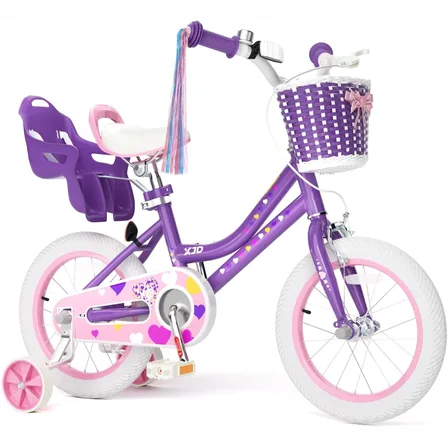
XJD Light Purple Girls Bike with Basket, Training Wheels, 12/14/16/20 Inch
The XJD Girls Bike with Basket in Light Purple is a single-speed training-wheel …$99.99
$119.99 -

Black XJD Kids Bike for Boys – 12, 14 & 16 Inch Sizes
For a son between roughly 3 and 8 years old, the XJD Kids Bike in Black covers t…$169
$199