

How many inches bike for a 3 year old
For most 3-year-olds, start with a 12-inch bike; consider 14 inches only if the child’s measured height and individual fit support it. A 12-inch bike is the XBikes starting point for riders 34–40 in (86–102 cm), while a 14-inch bike starts at 37–45 in (94–114 cm).
Choose by height before age
Age gives you a starting point, not a final size. Measure your child’s height without shoes, standing straight against a wall. Then compare that measurement with the XBikes ranges below.
| Wheel size | Starting age range | Rider height | Relevance at age 3 |
|---|---|---|---|
| 12 Inch | 3–4 | 34–40 in / 86–102 cm | The usual first size to check |
| 14 Inch | 3–6 | 37–45 in / 94–114 cm | Check only when height and fit support it |
| 16 Inch | 4–7 | 40–48 in / 102–122 cm | Generally outside the age starting point; do not size up for growth |
A tall 3-year-old may fall within both the 12-inch and 14-inch height ranges. That overlap does not make the sizes interchangeable. The better choice is the bike the child can straddle, reach and control comfortably during an in-person fit check.
Measure inseam and check stand-over clearance
Height narrows the options, but inseam helps determine whether the frame is manageable. With shoes off, have the child stand with feet slightly apart. Place a firm book gently between the legs, level with the floor, and measure from the floor to the top edge of the book.
Compare that measurement with the actual stand-over dimensions for the exact bike and configuration you are considering. Those dimensions are not supplied here, so consult the exact product information or manual. When the child straddles the bicycle, they should be able to stand securely rather than being forced onto tiptoes or against the frame.
Do a real fit check before buying
Have the child try the bicycle whenever possible. The American Academy of Pediatrics advises against buying an oversized bike merely to allow room for growth. While the bike is supported by an adult, check these points:
- The child can mount and dismount without struggling.
- The seated position permits a comfortable reach to the handlebar without excessive stretching.
- The child can steer left and right while remaining balanced and in control.
- Any brake controls can be reached and operated with the child’s hands.
- The child appears confident enough to stop, start and follow simple directions.
If the child fits the height range but cannot comfortably reach, steer or use the controls, that bike is not a suitable fit yet. Frame shapes and component positions can differ even when wheel labels match.
How the supplied XBikes options compare
The catalog options are useful because two offer both 12-inch and 14-inch labels—the main comparison for a 3-year-old—while the third begins at 14 inches. They help you compare available wheel-size labels, but the label still requires a physical fit check.
 XJD Girls BMX Bike 12/14/16 Inch with Training Wheels – Pink Blue
Available in 12, 14 and 16 Inch labels. Its 12- and 14-inch options make it relevant for comparing the main starting sizes for a 3-year-old, subject to measured height and an individual fit check.
 XJD Boys & Girls BMX Bike with Training Wheels, 12/14/16" – Blue
This kids' BMX bike is offered with 12, 14 and 16 Inch labels. Begin by comparing the 12-inch option with the child’s height, then consider 14 inches only when measurement and hands-on fit support it.
 Girls' Training Wheel Bike by XJD with Basket – Purple
Offered in 14, 16 and 20 Inch labels, this training wheel bike has no 12-inch option. It is relevant only as a 14-inch comparison when the child meets the height starting point and passes a fit check.
XJD Girls BMX Bike 12/14/16 Inch with Training Wheels – Pink Blue is listed in 12-inch, 14-inch and 16-inch options. For this question, compare its 12-inch and 14-inch labels against the child’s measured height and fit; the 16-inch starting point is ages 4–7 and heights 40–48 in (102–122 cm).
XJD Boys & Girls BMX Bike with Training Wheels, 12/14/16" – Blue also has 12-inch, 14-inch and 16-inch labels. Its 12-inch option is the logical starting comparison for a child measuring 34–40 in (86–102 cm), but reach, stand-over and control still decide.
Girls' Training Wheel Bike by XJD with Basket – Purple is offered in 14-inch, 16-inch and 20-inch labels. It has no 12-inch option, so it is relevant only when the child’s height falls within the 14-inch starting range and the exact bike passes the individual fit check. Its larger labels should not be treated as substitutes.
Training wheels do not correct an oversized fit
Training wheels can change how a bike is supported, but their presence does not make a frame easier to straddle, shorten the reach or place brake controls closer to small hands. Do not move up to 14 or 16 inches simply because training wheels are included.
For assembly, adjustment, compatibility, maintenance, load limits or torque, follow the manual for the exact product. If instructions are unclear or the controls cannot be adjusted appropriately, use a qualified bicycle mechanic rather than inventing a procedure.
Make the final 12-inch or 14-inch decision
Begin with 12 inches if your 3-year-old is 34–40 in (86–102 cm). Compare 14 inches only if the child is at least 37 in (94 cm) tall, then confirm inseam clearance, reach, steering, brake operation and confidence on that exact bicycle. Add a properly fitting bicycle helmet that sits level and has straps secured according to its manufacturer’s instructions. If either size fails the hands-on checks, do not buy larger for future growth; wait or try another exact bike with a more manageable fit.
Bikes for your next adventure
-
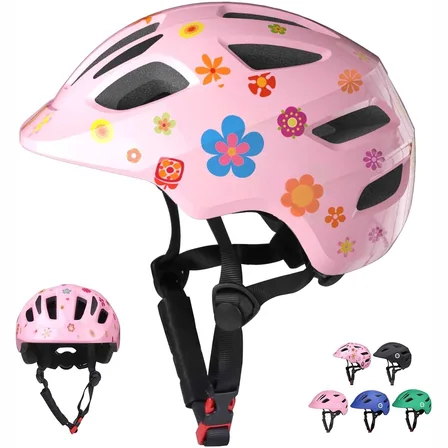
XJD Kids Bike Helmet for Girls, Pink Flowers, Adjustable (XS–S)
The XJD Kids Bike Helmet in Pink Flowers is an adjustable toddler-and-kids helme…$21.24
$24.99 -

Kids Bike Helmet by XJD for Boys & Girls – Black, Blue, Green, Pink, Purple
The XJD Kids Bike Helmet covers a wide 2-to-8-year age range thanks to two head-…$59.99
-

Kids Bike Helmet by XJD for Girls – Pink
The XJD Kids Bike Helmet in Pink is a lightweight multi-sport helmet for girls r…$59.99
$99