

What inch bike for 3 year old
For most 3-year-olds, start by trying a 12-inch bike. Consider a 14-inch bike only if the child’s measured height and individual fit support it.
Which wheel size should a 3-year-old try?
XBikes lists a 12-inch bike as a starting point for ages 3–4 and rider heights of 34–40 in (86–102 cm). A 14-inch bike starts at ages 3–6 and heights of 37–45 in (94–114 cm). These ranges overlap, so age alone cannot settle the choice.
If your child is 34–36 in (86–93 cm), begin with 12 inches. At 37–40 in (94–102 cm), compare both 12- and 14-inch bikes in person. At 41–45 in (103–114 cm), the XBikes height chart points toward 14 inches, but the child must still pass the complete fit check.
Do not move up merely to leave room for growth. An oversized bicycle can make starting, stopping, steering and reaching the controls harder.
Measure height and inseam first
- Measure standing height: Have the child stand without shoes against a wall, looking straight ahead. Mark the top of the head and measure from the floor.
- Measure inseam: With feet slightly apart, place a firm, thin book between the legs and raise it gently to simulate a saddle. Measure vertically from the floor to the book’s top edge.
- Record both measurements: Use standing height to choose the first wheel size to try. Use inseam during the actual stand-over and mounting check.
Wheel diameter does not determine every frame dimension. Two bikes with the same wheel label can differ in frame shape, saddle adjustment and reach, so an inseam measurement should not be converted into a guaranteed wheel size without checking the actual bicycle.
Perform the fit check on the actual bike
Have the child try the bicycle with close adult supervision. While standing over the frame, the child should be able to balance securely rather than being forced onto tiptoes or against the frame. Seated, the child should reach the handlebar without stretching, locking the elbows or losing a stable posture.
Next, check control. The rider should be able to turn the handlebar comfortably, operate the provided braking controls within reach, mount and dismount without struggling, and stop predictably. Confidence matters: a size that technically matches the height chart may still be inappropriate if the child appears tense or cannot manage the bicycle.
If neither candidate permits comfortable stand-over, reach and brake control, do not treat the chart as permission to buy. Try a different bicycle geometry or wait until an appropriate fit is available.
How the supplied 12- and 14-inch options compare
The supplied catalog choices are useful because each offers both a 12 Inch and 14 Inch SKU label—the two XBikes starting points most relevant to many 3-year-olds—plus a 16 Inch option for later comparison. Select the SKU deliberately; the shared product title does not establish which child-specific fit.
 XJD Girls BMX Bike 12/14/16 Inch with Training Wheels – Pink Blue
Available in 12 Inch, 14 Inch and 16 Inch labels. Its 12- and 14-inch options are relevant comparison points for a measured 3-year-old who completes an individual fit check.
 XJD Boys & Girls BMX Bike with Training Wheels, 12/14/16" – Blue
This Kids’ BMX Bike has 12 Inch, 14 Inch and 16 Inch SKU labels. Compare its 12- and 14-inch versions using rider height, stand-over, reach, brake control and confidence.
XJD Girls BMX Bike 12/14/16 Inch with Training Wheels – Pink Blue is categorized as a Kids’ BMX Bike and is offered with 12 Inch, 14 Inch and 16 Inch SKU labels. For this question, compare only its 12- and 14-inch versions after measuring the rider.
XJD Boys & Girls BMX Bike with Training Wheels, 12/14/16" – Blue is also categorized as a Kids’ BMX Bike and has the same three supplied size labels: 12 Inch, 14 Inch and 16 Inch. Its catalog wording is not evidence that every 3-year-old fits every listed size.
The provided facts do not establish frame measurements, saddle range, brake type, weight, load limit or assembly details for either product. Consult the exact product manual for those specifications and instructions, or ask a qualified bicycle mechanic when assembly, compatibility or adjustment is uncertain.
Why 16 inches is usually not the starting answer
XBikes places 16-inch bikes at ages 4–7 and heights of 40–48 in (102–122 cm). Therefore, 16 inches is not the normal starting point for the title’s age. Even when a tall 3-year-old reaches the lower height boundary, choose it only after an individual check confirms stand-over clearance, manageable reach, accessible braking controls and confident handling. Never size up solely for future growth.
Make the final decision safely
- Start with the child’s current barefoot height and inseam, not a birthday or expected growth.
- Try 12 inches first for a rider within 34–40 in (86–102 cm).
- Compare 12 and 14 inches when the rider falls within their overlapping 37–40 in (94–102 cm) range.
- Reject any bike the child cannot comfortably straddle, steer, brake, mount and stop.
- Use a properly fitting bicycle helmet. It should sit level, with its straps adjusted according to the helmet manufacturer’s instructions.
For a 3-year-old, measure now, begin with a 12-inch trial, and move to 14 inches only when the child’s height and real-world control clearly support that choice.
Bikes for your next adventure
-

XJD Girls Bike for Kids Ages 3-8, 12/14/16 Inch with Training Wheels – Purple
The XJD Girls Bike in Purple is a training-wheel bicycle for kids ages 3 to 8, f…$149
$169 -

Pink Girls' 12/14/16" Bike by XJD – Basket & Doll Seat
The XJD Pink Girls' Bike with Basket & Doll Seat is made for riders 71–122 cm ta…$75.99
$99.99 -
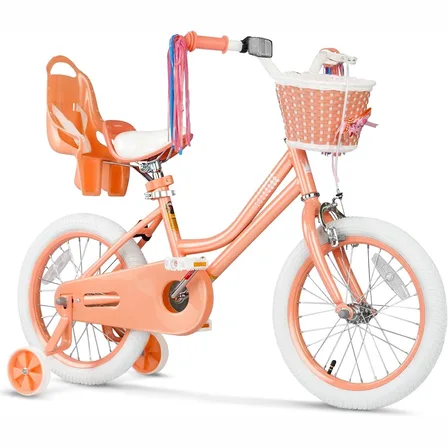
Girls 12/14/16 Inch Kids Bike by XJD with Training Wheels – Peach
The XJD Girls Bike in Peach is a training-wheel bike built for girls roughly 3 t…$149
$169