

What size bike for a 3 yr old
For most 3-year-olds, start with a 12-inch bike, then confirm fit in person. Measure your child’s height and inseam, and check stand-over clearance, reach, brake control and confidence before choosing.
Start with height, not age alone
XBikes lists a 12-inch bike as the starting point for ages 3–4 and heights of 34–40 in (86–102 cm). A 14-inch bike begins at age 3 in the chart, but its height range starts higher: 37–45 in (94–114 cm). These ranges overlap, so a child’s third birthday does not settle the choice.
| Wheel size | XBikes age starting point | Rider height |
|---|---|---|
| 12 Inch | Ages 3–4 | 34–40 in / 86–102 cm |
| 14 Inch | Ages 3–6 | 37–45 in / 94–114 cm |
| 16 Inch | Ages 4–7 | 40–48 in / 102–122 cm |
If your 3-year-old is below 37 in (94 cm), the chart points toward 12 Inch rather than 14 Inch. At 37–40 in (94–102 cm), compare both sizes through an individual fit check. A 16-inch bike is not the usual age-based starting point for a 3-year-old, even if the child reaches the bottom of its height range.
Measure your child before comparing bikes
Measure height without shoes, with the child standing straight against a wall. For inseam, have the child stand naturally and measure from the floor to the crotch. Use that inseam to evaluate the actual stand-over space on the specific bicycle; wheel diameter alone does not reveal frame clearance.
Write down both measurements and bring the shoes the child will normally wear while riding. Because frame shapes differ, do not convert the inseam into a wheel size using an invented formula. Compare it directly with the bicycle during a supervised fit check.
What a successful fit check looks like
Have your child try the bicycle rather than choosing from the chart alone. The American Academy of Pediatrics advises against buying an oversized bicycle merely to allow room for growth. On the candidate bike, check that the child can:
- stand over the frame with usable clearance rather than being pressed against it;
- sit in a controlled position and reach the handlebar without an uncomfortable stretch;
- steer while looking ahead and keeping stable control;
- reach and operate the bicycle’s brakes, if fitted, with the controls adjusted as the product manual permits;
- start, stop and put a foot down without panic or a loss of balance.
Confidence matters alongside measurements. If a size technically falls within the height range but makes starting, stopping or steering visibly difficult, it is not the right current fit.
When 12 Inch and 14 Inch overlap
For a child between 37 and 40 in (94–102 cm), both 12 Inch and 14 Inch appear in the XBikes starting ranges. Do not automatically choose 14 Inch for longer use. Compare stand-over clearance, seated reach, brake access and controlled stopping on each actual bike. Prefer the size the child can control now.
The supplied catalog choices are useful because each offers 12 Inch and 14 Inch labels for this direct comparison, plus a 16 Inch label that may help families understand the next chart range. They are training-wheel bicycles, so they are relevant only if that format suits the child’s current learning needs and the individual bike fits.
 XJD Pink Girls' Bike – Kids 12/14/16 Inch Training Wheel Bicycle
A training-wheel bicycle offered with 12 Inch, 14 Inch and 16 Inch SKU labels. Its 12- and 14-inch options provide relevant fit comparisons for a 3-year-old when checked against measured height and hands-on control.
 Girls 12/14/16 Inch Kids Bike by XJD with Training Wheels – Peach
This peach training-wheel bicycle has 12 Inch, 14 Inch and 16 Inch SKU labels. The 12- and 14-inch versions may be relevant comparison options, but the child’s measurements, reach, brake control and confidence determine fit.
How the two catalog options relate
XJD Pink Girls' Bike – Kids 12/14/16 Inch Training Wheel Bicycle is listed in Training Wheel Bikes with 12 Inch, 14 Inch and 16 Inch SKU labels. For a 3-year-old, begin by comparing its 12 Inch label with the child’s measurements; consider its 14 Inch label only when height and the hands-on checks support it.
Girls 12/14/16 Inch Kids Bike by XJD with Training Wheels – Peach has the same supplied wheel-size labels and category. The catalog facts establish a color/title distinction, but they do not establish differences in geometry, brakes, weight, materials or components. Use each exact product manual or a qualified bicycle mechanic for assembly, maintenance, adjustment, load limits, compatibility and torque information.
The 16 Inch versions are comparison points, not automatic choices for a tall 3-year-old: XBikes places 16 Inch at ages 4–7 and heights of 40–48 in (102–122 cm), and age or height never replaces an individual control check.
Do this before the first ride
- Measure height and inseam.
- Use 12 Inch as the initial chart reference; compare 14 Inch only within its stated height range.
- Have the child try the exact bike and verify stand-over, reach, steering, brake operation and confident stopping.
- Reject an oversized choice made mainly for growth.
- Fit a bicycle helmet so it sits level, fits properly and uses its straps according to the helmet manufacturer’s instructions.
For a 3-year-old, choose the 12- or 14-inch bicycle that matches the measured height range and passes every hands-on control check today; if neither does, keep looking rather than sizing up.
Bikes for your next adventure
-

Blue XJD Girls Bike with Training Wheels – 12/14/16 Inch
If you're shopping for a first pedal bike for a daughter roughly 3 to 8 years ol…$149
$169 -
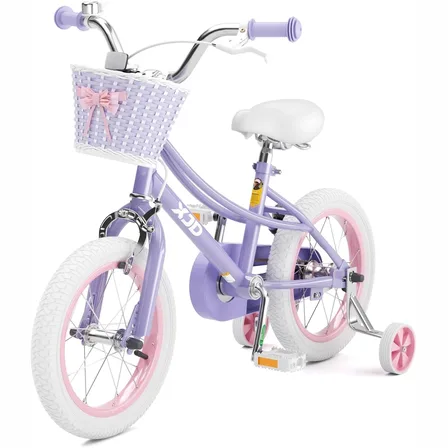
Girls' Training Wheel Bike by XJD with Basket – Purple
If you're shopping for a first bike for a girl roughly 3 to 12 years old (91–152…$75.99
-
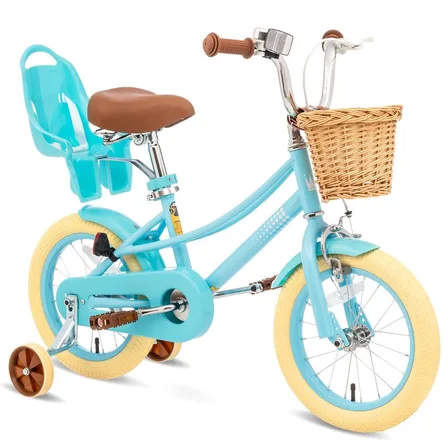
Girls' Training Wheel Bike by XJD, 12–20 Inch Wheels – Blue
This XJD girls' training wheel bike in Blue covers one of the widest fit ranges …$139
$159