

What size bike for my 3 year old
For most 3-year-olds, start by comparing a 12-inch and 14-inch bike. Measure your child’s height and inseam, then choose by actual fit—not age alone.
Use height to choose the first wheel size
Measure your child without shoes, standing straight against a wall. Record total height from the floor to the top of the head. For inseam, have the child stand with feet slightly apart and measure from the floor to the crotch. The inseam does not select a wheel size by itself, but it helps you check whether the child can stand over and mount the actual bicycle comfortably.
| Wheel size | XBikes starting age | Rider height | Relevance at age 3 |
|---|---|---|---|
| 12 Inch | Ages 3–4 | 34–40 in / 86–102 cm | The usual first comparison for a smaller 3-year-old. |
| 14 Inch | Ages 3–6 | 37–45 in / 94–114 cm | Compare when the child is at least 37 in / 94 cm tall. |
| 16 Inch | Ages 4–7 | 40–48 in / 102–122 cm | Normally a later size; do not select it merely for growth. |
The height bands overlap because children with the same height can differ in leg length, arm reach, coordination and confidence. Where two sizes appear possible, the better choice is the one the child can control now.
Check the bike with your child on it
Have your child try the exact bicycle before deciding whenever possible. The American Academy of Pediatrics advises against buying an oversized bicycle for a child to grow into. A bike that looks economical for the future may be awkward to start, stop or steer today.
- Stand-over: With the child straddling the frame, confirm that standing over it is comfortable and controlled rather than cramped or precarious.
- Seat position: Check that the child can get on and off confidently and can establish the foot contact required by the bicycle’s instructions.
- Reach: Seated normally, the child should reach the handlebar without stretching, locking the arms or leaning excessively.
- Brakes: If the bike has hand controls, verify that the child can reach and operate them reliably. Follow the exact product manual for the bicycle’s controls.
- Control: Let the child demonstrate starting, steering and stopping in a suitable supervised area. Current confidence matters more than the number printed on the wheel.
How to decide between 12 and 14 inches
If your 3-year-old measures 34–36 in / 86–93 cm, the XBikes chart points to 12 inches. At 37–40 in / 94–102 cm, both 12-inch and 14-inch ranges apply, so compare the actual bikes and favor manageable stand-over, reach and braking. At 41–45 in / 103–114 cm, the chart points to 14 inches for this age.
Do not move to a 16-inch bike simply because your child is close to the upper end of another range. The XBikes starting point for 16 inches is ages 4–7 and 40–48 in / 102–122 cm. Even when height overlaps, an individual fit check remains necessary.
Relevant XBikes catalog comparisons
The supplied options are useful because two offer both 12-inch and 14-inch labels for a direct size comparison, while the third begins at 14 inches. Their larger labels show what is available, but they do not prove that a larger bicycle fits a particular 3-year-old.
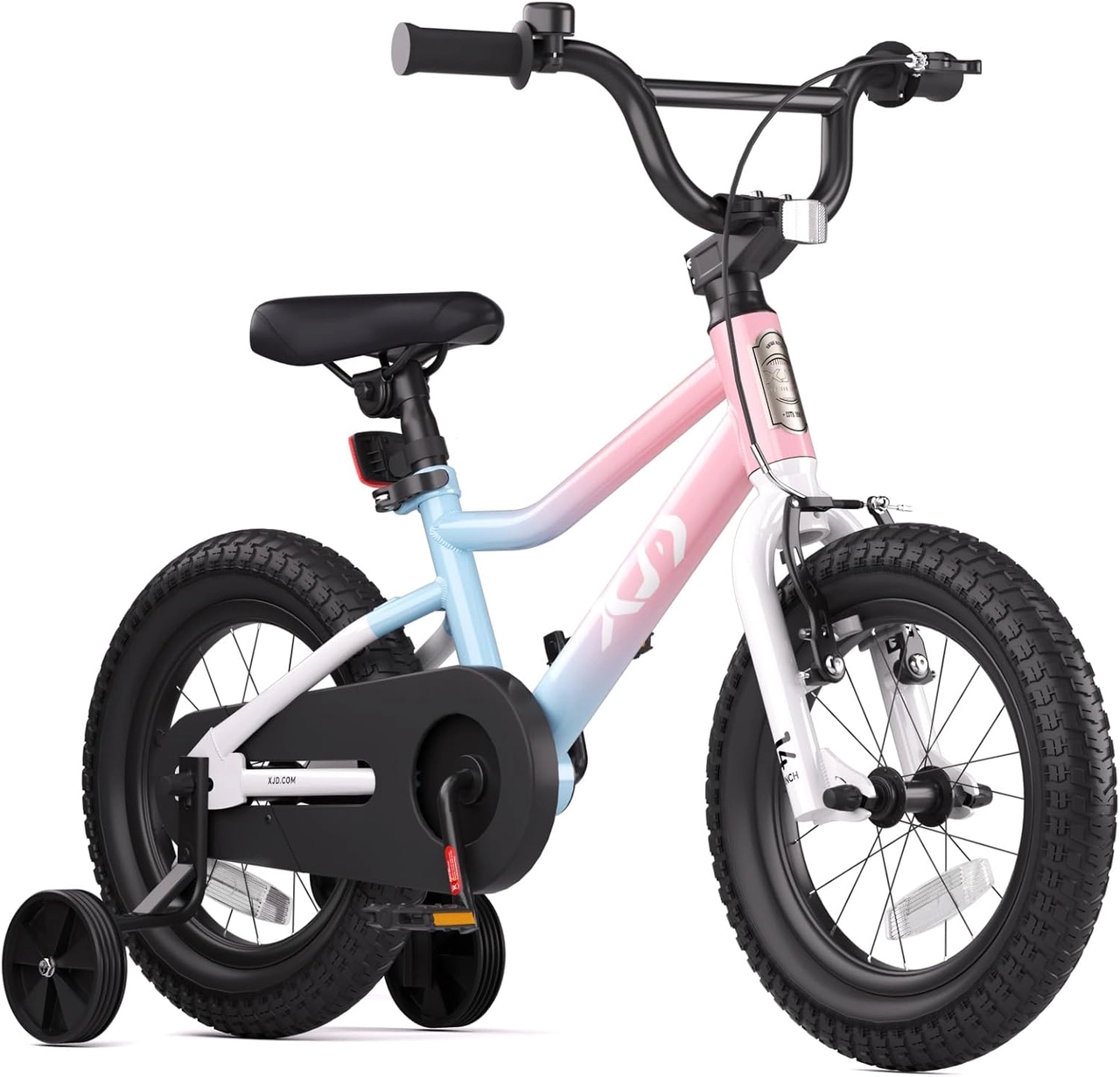 XJD Girls BMX Bike 12/14/16 Inch with Training Wheels – Pink Blue
Offers 12 Inch and 14 Inch SKU labels that match the main XBikes chart comparisons for age three, plus a 16 Inch label that requires the later-size fit criteria.
 XJD Boys & Girls BMX Bike with Training Wheels, 12/14/16" – Blue
A Kids’ BMX Bikes option with 12 Inch and 14 Inch labels relevant to the age-three size comparison; its 16 Inch version should be assessed separately against height and hands-on fit.
 Girls' Training Wheel Bike by XJD with Basket – Purple
This Training Wheel Bike begins at 14 Inch, making that version relevant only for a child at least 37 in / 94 cm tall who passes an individual fit check.
XJD Girls BMX Bike 12/14/16 Inch with Training Wheels – Pink Blue is listed under Kids’ BMX Bikes and has 12 Inch, 14 Inch and 16 Inch SKU labels. Its 12-inch and 14-inch versions are the relevant comparisons for most children covered by the age-three chart.
XJD Boys & Girls BMX Bike with Training Wheels, 12/14/16" – Blue is also a Kids’ BMX Bikes option with 12 Inch, 14 Inch and 16 Inch labels. Compare its 12-inch and 14-inch versions using the same height and hands-on checks; the title alone does not establish fit.
Girls' Training Wheel Bike by XJD with Basket – Purple is categorized as a Training Wheel Bike and is offered in 14 Inch, 16 Inch and 20 Inch labels. Only its 14-inch version is a plausible chart-based comparison for a 3-year-old, and only from 37 in / 94 cm with a successful fit check. Its 16-inch and 20-inch versions should not be treated as substitutes.
Training wheels do not correct poor sizing
Training wheels may change how a listed product is used, but their presence does not make an oversized frame easier to reach, mount or brake. Choose the correct current fit first. For assembly, adjustment, compatibility, maintenance and torque requirements, follow the manual for the exact product or use a qualified bicycle mechanic.
Complete the safety check
Use a bicycle helmet that fits properly, sits level and has straps adjusted according to the helmet manufacturer’s instructions, as advised by the U.S. Consumer Product Safety Commission. Recheck bicycle fit as the child grows and after meaningful seat or control adjustments.
Your next step is simple: write down your 3-year-old’s height and inseam, compare 12-inch and 14-inch models within the chart, and choose only after your child can stand over, reach, steer and brake the exact bike confidently.
Bikes for your next adventure
-
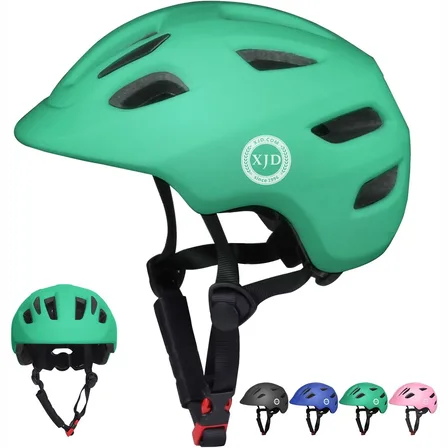
Green XJD Toddler Bike Helmet with Adjustable Fit, XS (46–51 cm)
The XJD toddler bike helmet in Green is built for the youngest riders — the size…$20.39
$23.99 -

Kids Bike Helmet by XJD for Boys & Girls – Black, Blue, Green, Pink, Purple
The XJD Kids Bike Helmet covers a wide 2-to-8-year age range thanks to two head-…$59.99
-

Kids Bike Helmet by XJD for Girls – Pink
The XJD Kids Bike Helmet in Pink is a lightweight multi-sport helmet for girls r…$59.99
$99