

What size bike is good for 3 year old
For most 3-year-olds, start by trying a 12-inch bike. Consider a 14-inch bike only if the child’s measured height, inseam, reach and control support it.
Choose between 12 and 14 inches
XBikes lists a 12-inch wheel as a starting point for ages 3–4 and heights of 34–40 in (86–102 cm). A 14-inch wheel starts at ages 3–6 and heights of 37–45 in (94–114 cm). Because those ranges overlap, age alone cannot settle the choice.
| Wheel size | XBikes age starting point | XBikes height starting point | What it means at age 3 |
|---|---|---|---|
| 12 Inch | 3–4 | 34–40 in / 86–102 cm | The usual first size to try |
| 14 Inch | 3–6 | 37–45 in / 94–114 cm | Worth comparing for a taller child who can control it |
| 16 Inch | 4–7 | 40–48 in / 102–122 cm | Generally outside the age starting point; do not size up merely for growth |
A child near the overlap should try both 12- and 14-inch bicycles. Select the one that permits a confident start, stop, turn and dismount today. A larger wheel is not automatically a better value if it reduces control.
Measure the child before comparing bikes
- Measure standing height: Have the child stand barefoot against a wall, looking straight ahead. Measure from the floor to the top of the head.
- Measure inseam: With feet slightly apart, measure from the floor to the crotch. This helps evaluate clearance and whether the child can put feet down as intended.
- Check reach on the actual bicycle: The child should reach the handlebar without stretching, locking the elbows or leaning excessively forward.
- Check brake access and control: If the bicycle has hand controls, confirm the child can reach and operate them. Follow the exact product manual for the bicycle’s controls and adjustment procedure.
Wheel labels do not provide frame geometry or minimum seat height. Compare the child’s measurements with the exact bicycle specifications, then complete an in-person fit check rather than relying on the wheel number alone.
Use a simple fit test
Have the child try the assembled bicycle in a clear, level area with close adult supervision. Check that the child can get on and off without becoming trapped or losing balance. There should be appropriate stand-over clearance, and the child should be able to place their feet as required for starting and stopping.
Next, watch for relaxed steering. The child should turn the handlebar while remaining centered and should not have to stretch for the grips. Confirm that every braking control is within reach and can be used deliberately. Confidence matters: hesitation, difficulty stopping or an inability to steer predictably means the fit or bicycle setup needs reconsideration.
Do not buy an oversized bicycle solely so the child can grow into it. If neither available size allows comfortable stand-over, reach and control, wait or look for a different frame fit.
How the supplied training-wheel bikes compare
These catalog options help because all three are training-wheel bicycles offered in both 12-inch and 14-inch labels, the two sizes most relevant to this question. Their 16-inch variants provide a comparison but use the ages 4–7 and heights 40–48 in (102–122 cm) starting point, so they should not be treated as the default for a 3-year-old.
 XJD Kids Bike for Girls – Pink, 12/14/16/20 Inch with Training Wheels
Offers 12- and 14-inch training-wheel options relevant to a 3-year-old fit comparison, plus 16- and 20-inch labels that should not be chosen merely for growth.
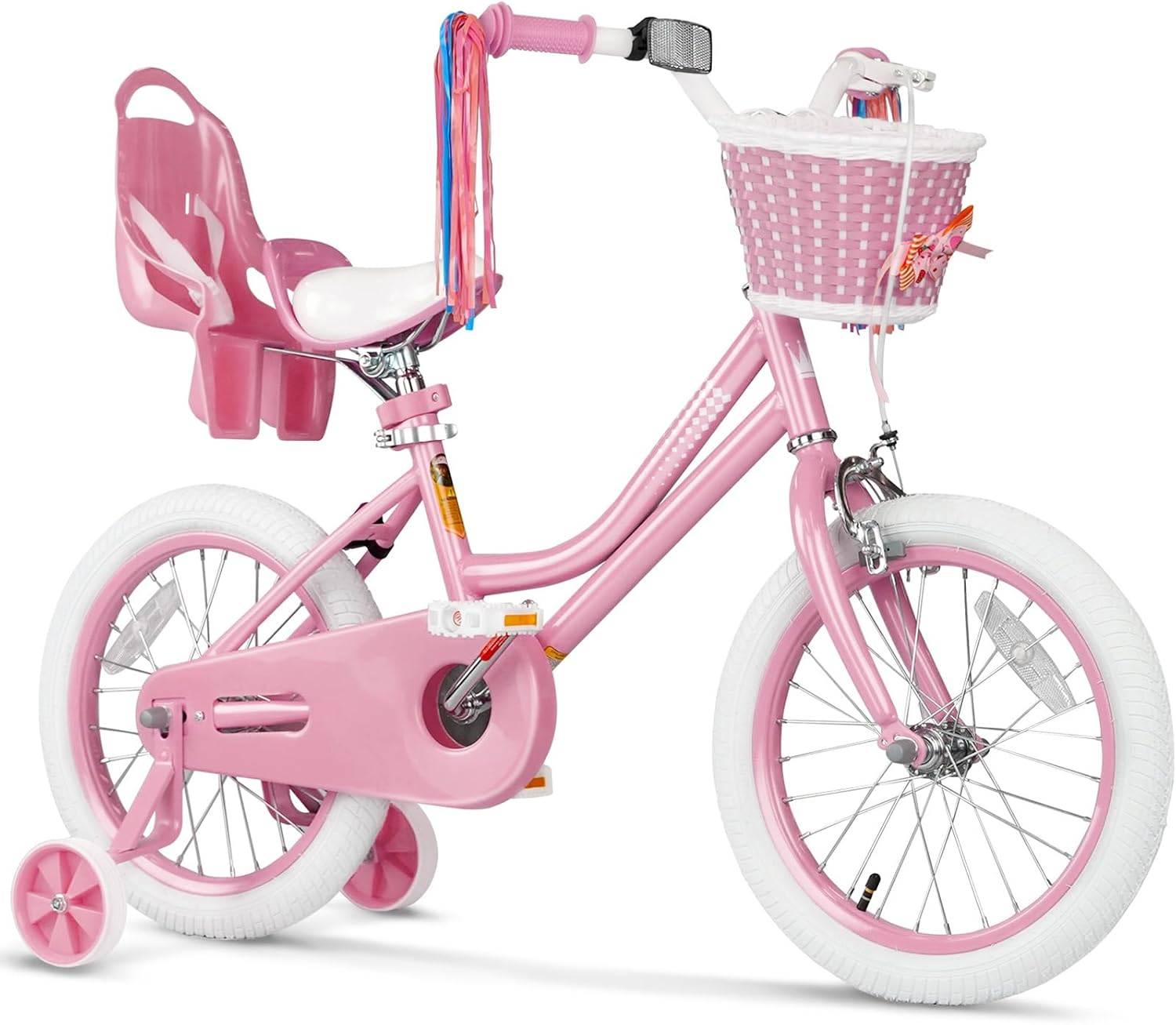 XJD Pink Girls' Bike – Kids 12/14/16 Inch Training Wheel Bicycle
Its supplied 12- and 14-inch training-wheel variants are useful comparison points for this age; measured height, inseam, reach, control and confidence must determine fit.
 Girls 12/14/16 Inch Kids Bike by XJD with Training Wheels – Peach
Available with 12-, 14- and 16-inch labels and training wheels. For a 3-year-old, the 12- and 14-inch variants are the relevant sizes to try individually.
- XJD Kids Bike for Girls – Pink, 12/14/16/20 Inch with Training Wheels offers 12-, 14-, 16- and 20-inch SKU labels. For this age, compare only the individually suitable 12- or 14-inch options; the larger labels do not justify sizing up.
- XJD Pink Girls' Bike – Kids 12/14/16 Inch Training Wheel Bicycle offers 12-, 14- and 16-inch SKU labels. Its 12- and 14-inch choices match the relevant starting ranges, subject to the same physical fit and control checks.
- Girls 12/14/16 Inch Kids Bike by XJD with Training Wheels – Peach also offers 12-, 14- and 16-inch SKU labels. Use the measured height and an actual tryout to choose between its relevant 12- and 14-inch variants.
The catalog facts do not establish dimensions such as stand-over height, seat range, brake type, weight or load limit. Verify those details in the exact product listing and manual. Follow that manual for assembly and maintenance, or use a qualified bicycle mechanic.
Finish the decision safely
Choose 12 inches if the child fits its 34–40 in (86–102 cm) starting range and controls that bicycle more confidently. Compare 14 inches if the child is at least 37 in (94 cm) tall and can comfortably clear, reach, steer and stop that specific bicycle. Height-range eligibility is only the first screen; inseam and real control decide the fit.
Pair the bicycle with a properly fitting bicycle helmet. It should sit level, and its straps should be used according to the helmet manufacturer’s instructions. Before buying, measure the child, shortlist 12 inches, compare 14 inches only when the measurements support it, and choose the bicycle the 3-year-old can control now.
Bikes for your next adventure
-

Light Purple XJD Toddler Bike Helmet, Adjustable, Size XS (46–51 cm)
This Light Purple XJD toddler bike helmet is made for the smallest riders — the …$20.39
-

Light Pink XJD Girls' Bicycle with Basket & Training Wheels
The Light Pink XJD Girls' Bicycle with Basket & Training Wheels is a retro-style…$109.99
$129.99 -

Blue XJD Kids Bike Helmet for Boys & Girls
The Blue XJD Kids Bike Helmet is a lightweight, adjustable multi-sport helmet fo…$59.99
$99