

What size bike should a 3 year old ride
Most 3-year-olds should start by trying a 12-inch bike; compare a 14-inch only if the child is at least 37 in (94 cm) tall and can control it comfortably.
Choose between 12 and 14 inches
Under the XBikes starting points, a 12-inch bike covers ages 3–4 and heights of 34–40 in (86–102 cm). A 14-inch bike covers ages 3–6 and heights of 37–45 in (94–114 cm). The overlapping age ranges do not make the sizes interchangeable: measured height and an individual fit check decide which one works.
| Wheel size | XBikes age starting point | Rider height | What it means at age 3 |
|---|---|---|---|
| 12 Inch | 3–4 | 34–40 in / 86–102 cm | The first size to try for many 3-year-olds |
| 14 Inch | 3–6 | 37–45 in / 94–114 cm | Worth comparing for a taller child who can manage the fit |
| 16 Inch | 4–7 | 40–48 in / 102–122 cm | Normally outside the age starting point for a 3-year-old; do not size up for growth |
If the child is below 34 in (86 cm), neither 12 nor 14 inches falls within the supplied height starting points. If the child is 34–36 in (86–93 cm), begin with 12 inches. From 37–40 in (94–102 cm), compare both sizes in person, but choose the bike the child can mount, balance, steer and stop more confidently. At 41–45 in (103–114 cm), 14 inches matches the supplied height range, though the full fit check still applies.
Measure the child before shopping
Measure standing height without shoes, with the child upright against a wall. Record the result in inches or centimetres and compare it with the ranges above.
Then measure inseam. With shoes off and feet slightly apart, place a thin, firm book between the legs and raise it gently to represent the saddle area. Measure from the floor to the top edge of the book. The supplied standard does not give an inseam number to match, so use this measurement when checking the actual bicycle rather than applying an invented cutoff.
Bring the height and inseam measurements to the fit check. Age narrows the search; it does not establish that the frame, saddle position or controls suit a particular child.
Check the actual fit and controls
Have the child try the bicycle. The American Academy of Pediatrics advises against buying an oversized bike merely to allow room for growth. Check these points on the exact model:
- Stand-over: the child should be able to stand over the bicycle without the frame preventing a stable stance.
- Mounting and starting: getting on, settling into position and beginning to ride should not require an adult to hold the child upright.
- Reach: the child should hold the handlebar without stretching, locking the elbows or losing a centred position.
- Steering: ask for gentle turns in both directions and watch whether the child remains composed.
- Brake control: the child must be able to reach and operate the fitted braking controls. Confirm the exact operation in the product manual.
- Confidence: hesitation, wobbling caused by excessive reach, or difficulty stopping is a reason to reject that fit even when the age label appears suitable.
How the supplied XBikes options compare
Both supplied catalog options offer 12 Inch, 14 Inch and 16 Inch SKU labels, so they let a parent compare the two sizes most relevant to a 3-year-old without assuming that one size fits every child. The XJD Light Purple Girls Bike with Basket, Training Wheels, 12/14/16/20 Inch is categorized as a Training Wheel Bike, while the XJD Girls BMX Bike 12/14/16 Inch with Training Wheels – Pink Blue is categorized as a Kids' BMX Bike. Their supplied available SKU labels are 12 Inch, 14 Inch and 16 Inch.
 XJD Light Purple Girls Bike with Basket, Training Wheels, 12/14/16/20 Inch
Offers supplied 12 Inch and 14 Inch SKU labels relevant to comparing fits for a 3-year-old; it is categorized as a Training Wheel Bike. Choose only after checking the child’s measurements and control.
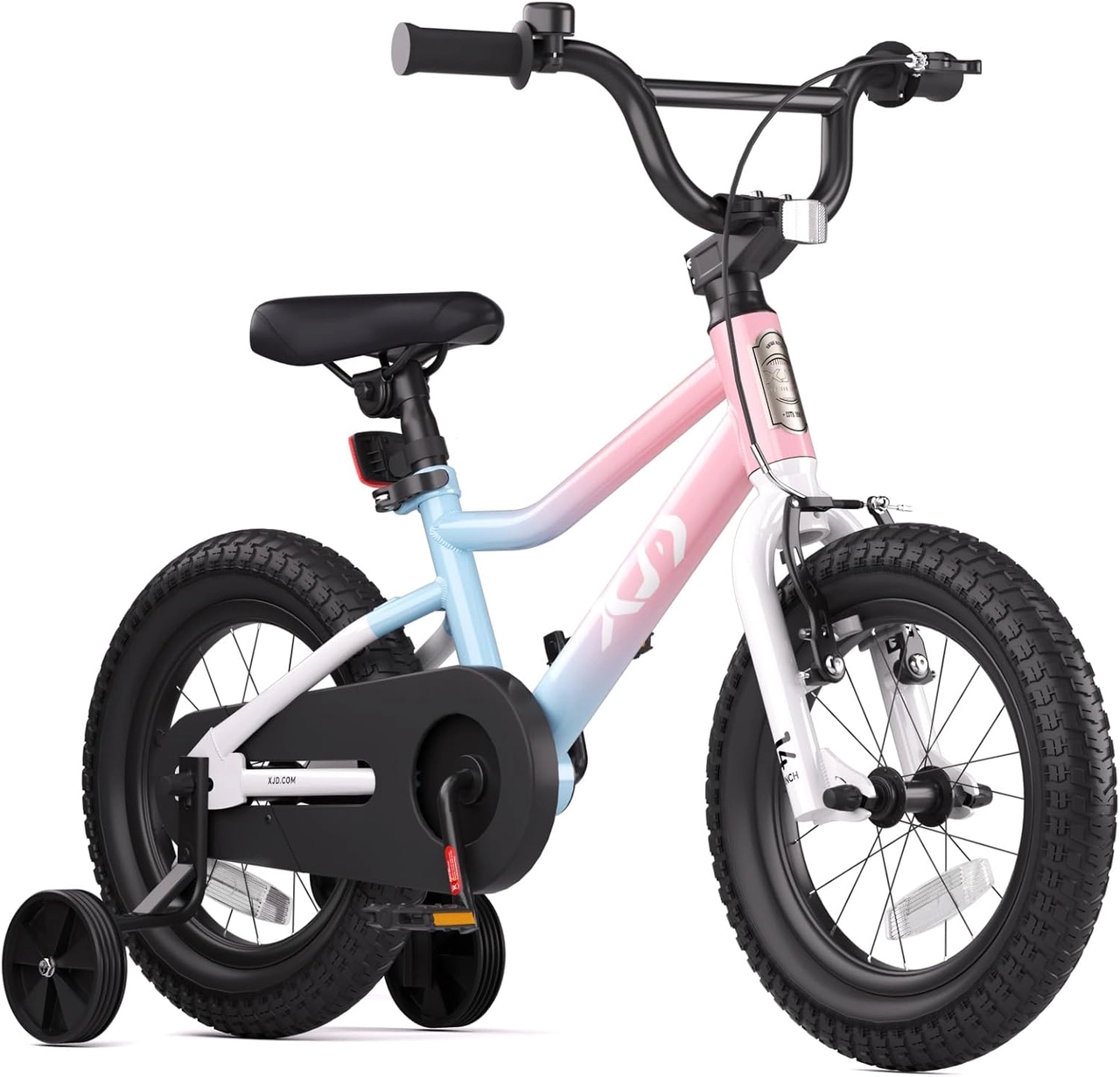 XJD Girls BMX Bike 12/14/16 Inch with Training Wheels – Pink Blue
Offers supplied 12 Inch and 14 Inch SKU labels for individual fit comparison and is categorized as a Kids' BMX Bike. Its 16 Inch option should not be chosen merely for growth.
For this question, focus on the 12-inch and 14-inch variants. The presence of a 16-inch label does not make that size appropriate for a 3-year-old: XBikes places 16 inches at ages 4–7 and heights of 40–48 in (102–122 cm), and fit still overrides age. The catalog facts do not provide geometry, saddle range, brake type, weight, load limit or assembly details, so consult the exact product manual or a qualified bicycle mechanic rather than assuming those specifications.
Do the final safety check
Once a size passes the fit test, follow the exact manual for assembly, adjustments, maintenance and compatibility. If anything about setup or brake operation is uncertain, use a qualified bicycle mechanic.
Add a properly fitting bicycle helmet. U.S. Consumer Product Safety Commission guidance says it should sit level and its straps should be used according to the helmet manufacturer’s instructions. A helmet does not correct a bicycle that is too large or difficult to control.
Next step: measure the child’s height and inseam today, begin with a 12-inch trial, and compare a 14-inch bike only at 37 in (94 cm) or taller. Choose it only if stand-over, reach, steering, braking and confidence are all comfortable; never select the larger size simply for future growth.
Bikes for your next adventure
-

XJD Girls Bike for Kids Ages 3-8, 12/14/16 Inch with Training Wheels – Purple
The XJD Girls Bike in Purple is a training-wheel bicycle for kids ages 3 to 8, f…$149
$169 -

Pink Girls' 12/14/16" Bike by XJD – Basket & Doll Seat
The XJD Pink Girls' Bike with Basket & Doll Seat is made for riders 71–122 cm ta…$75.99
$99.99 -

Black XJD Kids Bike for Boys – 12, 14 & 16 Inch Sizes
For a son between roughly 3 and 8 years old, the XJD Kids Bike in Black covers t…$169
$199