

What size bike to buy for 3 year old
Most 3-year-olds should start by trying a 12-inch bike, but height and fit decide the size. Measure your child, then check stand-over, reach, brakes and control.
Start with measured height, not the birthday
Under the XBikes starting points, a 12-inch bike covers ages 3–4 and rider heights of 34–40 in (86–102 cm). A 14-inch bike covers ages 3–6 and heights of 37–45 in (94–114 cm). Because these ranges overlap, being three years old does not identify one guaranteed size.
Measure the child standing upright without shoes, with their back against a wall and eyes facing forward. Record the floor-to-top-of-head height. Then measure inseam: have the child stand with feet slightly apart and measure from the floor to the crotch. Height narrows the options; inseam helps determine whether the child can stand over and mount the actual bicycle comfortably.
How to choose between 12 and 14 inches
| Measured result | What to try | What must still be checked |
|---|---|---|
| 34–36 in (86–93 cm) | Start with 12 inch | Stand-over, reach, brake access and control |
| 37–40 in (94–102 cm) | Try 12 and 14 inch | Compare which bike the child controls confidently |
| 41–45 in (103–114 cm) | Try 14 inch | Confirm every individual fit point |
| Outside these ranges | Do not select by age alone | Recheck measurements and assess an appropriate size in person |
A 16-inch bike is ordinarily a starting point for ages 4–7 and heights of 40–48 in (102–122 cm). A tall three-year-old may enter its height range, but that does not make 16 inches an automatic choice. Current confidence, reach and control can still make the smaller fitting option more appropriate.
Perform the fit check on the actual bike
Have the child try each candidate bicycle. The American Academy of Pediatrics advises against buying an oversized bicycle merely for growth. A bike that will fit later can be difficult to manage now.
- Check stand-over: with the child straddling the bicycle, their feet should be firmly supported on the ground rather than leaving them unstable. Use the inseam measurement to screen candidates, but confirm on the assembled bike because frame shapes differ.
- Check reach: seated in a normal riding position, the child should reach the handlebar without stretching, locking the arms or leaning awkwardly.
- Check brake access: the child must be able to reach and operate the bicycle’s controls. Do not assume a particular brake design; inspect the exact model and follow its manual.
- Check control: ask the child to mount, start, steer, stop and dismount in a controlled setting. Choose the size they can manage now, not the size predicted to last longest.
How the supplied bike helps with this decision
The XJD Pink Girls' Bike – Kids 12/14/16 Inch Training Wheel Bicycle is relevant because its supplied size labels include 12 Inch, 14 Inch and 16 Inch. Those options let you compare the likely starting sizes against the measured height ranges and the child’s actual fit; the title itself is only a catalog label, not proof that every option fits a three-year-old.
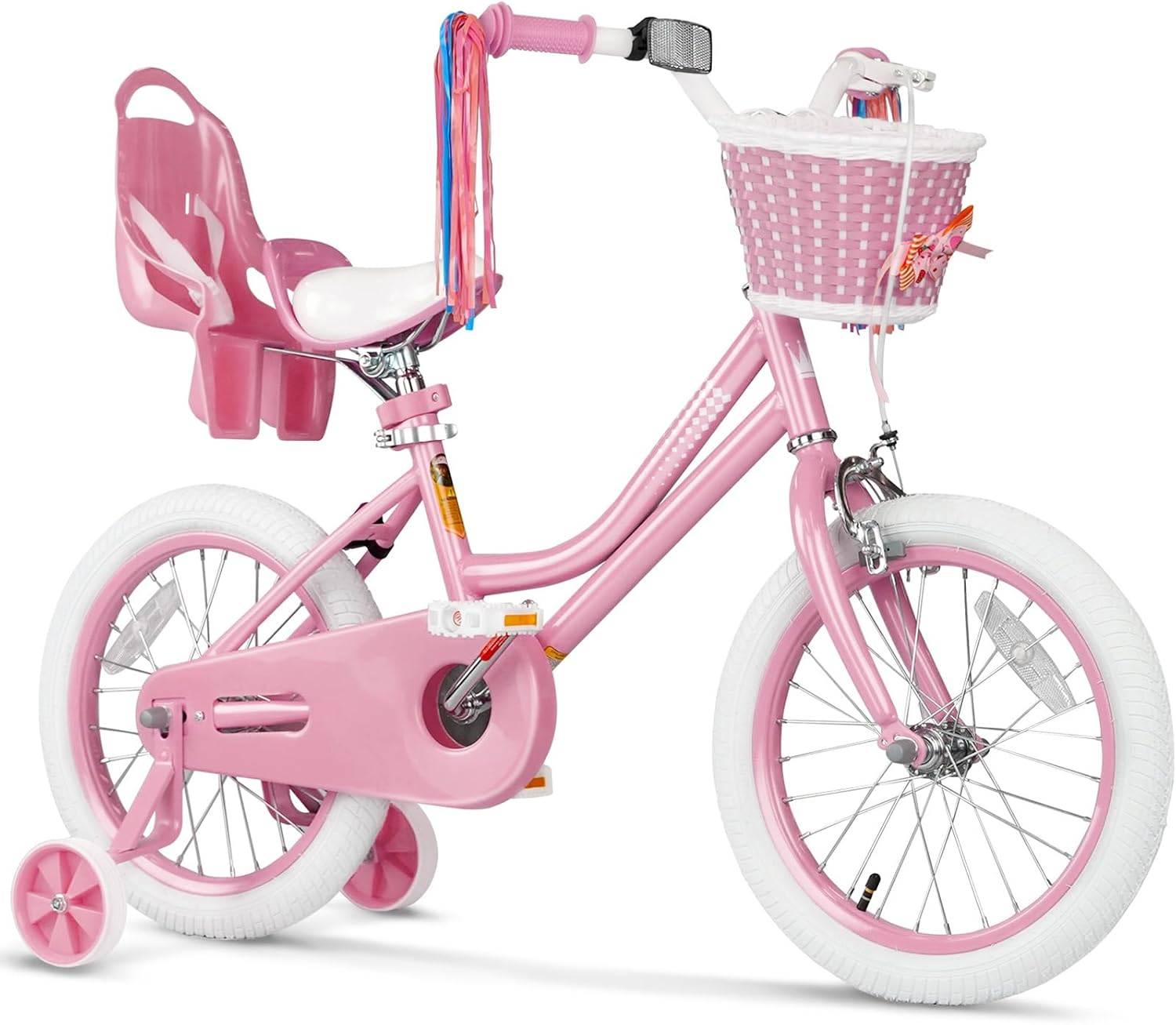
Begin with the 12 Inch option for a child measuring 34–40 in (86–102 cm). In the overlap from 37–40 in (94–102 cm), compare its fit directly with the 14 Inch option. Consider 14 Inch for a child within 37–45 in (94–114 cm), provided stand-over, reach, braking and control all work. Treat 16 Inch cautiously at age three: although its height starting point is 40 in (102 cm), its age starting point is four, and an individual trial remains essential.
The catalog facts identify this product as a training-wheel bicycle but do not provide assembly steps, brake type, load limit, dimensions beyond wheel labels, or compatibility details. Follow the exact product manual for assembly and maintenance. If any fit, adjustment or setup is uncertain, use a qualified bicycle mechanic.
Before the first ride
Repeat the control check in a level area away from traffic. A properly fitting bicycle helmet is also necessary: the U.S. Consumer Product Safety Commission advises that it sit level, fit properly and use its straps according to the helmet manufacturer’s instructions. A helmet cannot correct a bicycle that is too large or difficult to control.
Your next step is simple: measure height and inseam today, use 12 inches as the first trial for the usual three-year-old range, compare 14 inches only where the measurements support it, and buy only after your child can stand over, reach, brake and control that exact bike.
Bikes for your next adventure
-

XJD Girls BMX Bike 12/14/16 Inch with Training Wheels – Pink Blue
The XJD Girls BMX Bike in Pink/Blue is built as a first pedal bike for kids roug…$99.99
$119.99 -

Blue XJD Kids Bike Helmet for Boys & Girls
The Blue XJD Kids Bike Helmet is a lightweight, adjustable multi-sport helmet fo…$59.99
$99 -

Kids Bike Helmet by XJD for Boys & Girls – Black, Blue, Green, Pink, Purple
The XJD Kids Bike Helmet covers a wide 2-to-8-year age range thanks to two head-…$59.99