

Are boys bikes measured by tire size
Yes. Boys’ bikes are commonly labeled by tire or wheel diameter, such as 12 Inch or 16 Inch, but that number alone does not confirm a proper fit.
What the size number means
A boys’ bike described as 12, 14, 16, 18, 20, 24 or 26 Inch is generally identified by its wheel size. It is not a measurement of the frame, seat height or the child. Two bikes with the same labeled wheel size can still feel different because their frame shape, saddle position, handlebar reach and controls may differ.
Use the wheel-size label to narrow the choices, then fit the actual bicycle to the rider. “Boys’ bike” describes how a bike is marketed; it does not change the measurements that determine whether a child can ride and control it.
Measure the rider before comparing bikes
Start with the child’s current height, measured without shoes against a wall. Also measure inseam from the floor to the crotch while the child stands naturally. Height provides a useful wheel-size starting point, while inseam helps you judge clearance and whether the child can get on, stop and stand comfortably.
Write down both measurements rather than relying on clothing size or a remembered growth-chart figure. Age can suggest where to begin, but measured height and an individual fit check should decide whether a bike is suitable.
XBikes wheel-size starting points
| Wheel size | Starting age | Rider height |
|---|---|---|
| 12 Inch | 3–4 | 34–40 in / 86–102 cm |
| 14 Inch | 3–6 | 37–45 in / 94–114 cm |
| 16 Inch | 4–7 | 40–48 in / 102–122 cm |
| 18 Inch | 5–9 | 43–52 in / 109–132 cm |
| 20 Inch | 7–12 | 48–60 in / 122–152 cm |
| 24 Inch | 10–14 | 54–64 in / 137–163 cm |
| 26 Inch | Youth and adults | Over 60 in / 153 cm |
These ranges overlap deliberately: children of similar ages do not always have the same proportions or riding ability. When a measured height falls into two rows, compare both sizes in person if possible. Choose according to clearance, reach, brake control and confidence rather than automatically selecting the larger wheel.
What to check on the actual bicycle
Have the child try the bicycle. With the child standing over it, check that there is comfortable clearance rather than contact with the frame. Once seated, the rider should be able to reach the handlebar without an awkward stretch and steer without losing a stable position.
Ask the child to operate each brake control fitted to the bike. The rider needs to reach and use the controls reliably, not merely touch them with fingertips. Observe a start, a controlled stop and a turn in a suitable supervised area. Hesitation, an extreme reach, difficulty stopping or loss of balance indicates that the nominal wheel size has not produced a workable fit.
Do not buy an oversized bike solely to allow room for growth. A size that may fit later can reduce control now. Recheck fit as the child grows, and follow the exact product manual or consult a qualified bicycle mechanic for assembly, adjustments, maintenance, compatibility, load limits and torque information.
How the supplied bike helps with comparison
The catalog option relevant to this question is the XJD Kids' Training Wheel Bike for Boys & Girls, 12/14/16 Inch – White, categorized as a training wheel bike and offered with 12 Inch, 14 Inch and 16 Inch SKU labels. Those three labeled sizes provide useful comparison points for riders whose measured heights fall within the corresponding XBikes ranges. They do not remove the need to check inseam, stand-over clearance, reach, brake control and confidence on the selected bike.

This product is relevant when a training wheel bike in one of those three catalog sizes matches the child’s measurement-based starting range. It is not a substitute when the fit check indicates an 18 Inch, 20 Inch, 24 Inch or 26 Inch bike; none of those sizes is supplied for this product. A nearby label is only a comparison point, never an equivalent size.
Make the final size decision
- Measure the child’s height and inseam now.
- Use the table to identify one or two candidate wheel sizes.
- Compare the exact SKU label with the candidate size; do not infer dimensions from the product photo or title alone.
- Have the child try the bike and check stand-over clearance, seated reach, steering, braking, starting and stopping.
- Select the size the child can control confidently today, even if a larger option appears to offer more growing room.
Before riding, add a properly fitting bicycle helmet. It should sit level and its straps should be used according to the helmet manufacturer’s instructions. The practical answer is therefore: read a boys’ bike’s tire-size label first, but buy only after the child’s measurements and hands-on control confirm that specific size.
Bikes for your next adventure
-

Kids Bike Helmet by XJD for Boys & Girls – Black, Blue, Green, Pink, Purple
The XJD Kids Bike Helmet covers a wide 2-to-8-year age range thanks to two head-…$59.99
-
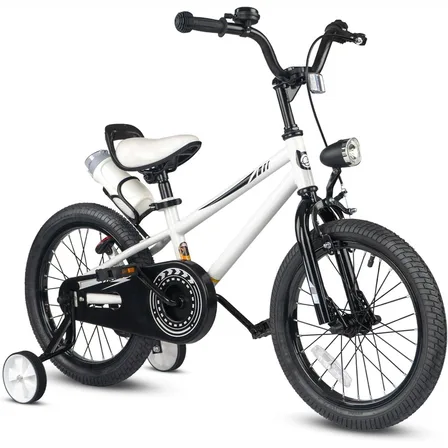
XJD Kids' Training Wheel Bike for Boys & Girls, 12/14/16 Inch – White
The XJD kids' training wheel bike in White is made for riders ages 3–8 (roughly …$169
$199 -

Black XJD Kids Bike for Boys – 12, 14 & 16 Inch Sizes
For a son between roughly 3 and 8 years old, the XJD Kids Bike in Black covers t…$169
$199