

What height of bike should you get a 48 boy
A boy who is 48 inches (122 cm) tall is at the boundary between a 16-inch and 20-inch bike. Try both sizes and choose by actual fit and control.
Start with his measured height
Measure him barefoot, standing straight against a wall. Record his full height from the floor to the top of his head. If “48” means 48 inches tall, the XBikes starting points place him at the maximum of the 16-inch range and the minimum of the 20-inch range.
| Wheel size | XBikes rider-height range | Meaning at 48 inches |
|---|---|---|
| 16 Inch | 40–48 in / 102–122 cm | At the upper limit |
| 20 Inch | 48–60 in / 122–152 cm | At the lower limit |
Age is secondary: the XBikes starting point is ages 4–7 for a 16-inch bike and ages 7–12 for a 20-inch bike. These ranges narrow the search, but they cannot decide between two boundary sizes.
Measure inseam before choosing
Have him stand barefoot with his feet slightly apart. Place a firm, thin book between his legs and raise it gently to simulate a bicycle saddle. Measure from the floor to the top edge of the book. This is his inseam.
Compare that measurement with the stand-over space and minimum saddle position of each exact bicycle being considered. Those dimensions were not supplied here, so consult the product manual or ask a qualified bicycle mechanic. He must be able to mount, stop and get off without the frame obstructing him.
Make the 16-inch versus 20-inch fit check
Have him try each candidate bicycle rather than choosing from the wheel label alone. A suitable bike should let him:
- Stand over the bicycle with comfortable clearance.
- Reach the handlebar without locking his elbows, stretching his torso or losing a balanced riding position.
- Turn the handlebar in both directions while remaining in control.
- Reach and operate the brakes confidently with his hands in their normal riding position.
- Start, stop and place a foot down without panic or awkward movement.
Current confidence matters. A child who is still developing balance or braking control may handle the correctly fitted smaller option better, while another child at the same height may comfortably control a correctly fitted 20-inch bike. Do not buy an oversized bike merely to allow room for growth. If neither size passes every check, keep looking for a different bicycle with more suitable geometry.
When the supplied 16-inch option is relevant
The Black XJD Kids Bike for Boys – 12, 14 & 16 Inch Sizes is listed as a training-wheel bike with 12-inch, 14-inch and 16-inch size labels. For a boy who is exactly 48 inches tall, only its 16-inch option overlaps the supplied height starting points, and even that option is at the very top of its 40–48-inch range. The 12-inch range ends at 40 inches, while the 14-inch range ends at 45 inches, so those two options are not appropriate starting points for a 48-inch rider.
This catalog option helps answer the question because its 16-inch variant represents one side of the boundary comparison; it remains relevant only if the individual stand-over, reach, braking and confidence checks are successful.

A 20-inch bicycle is the other starting point at this height, but no 20-inch product was supplied for this article. That means the displayed product should not be treated as the automatic choice simply because it is available in the catalog facts. If the child looks cramped, cannot use a normal riding posture, or has no practical growing room on its 16-inch version, compare a separately selected 20-inch bicycle in person.
Check the exact bike before riding
Wheel size does not describe every frame dimension. Follow the exact bicycle manual for assembly, adjustment, compatibility, load limits, maintenance and torque requirements; none of those details were supplied here. If any setup or adjustment is unclear, use a qualified bicycle mechanic.
Also provide a properly fitting bicycle helmet. It should sit level and be secured with its straps according to the helmet manufacturer’s instructions. Recheck bike control after saddle or handlebar adjustments, because a change that makes the bike taller can also affect starting, stopping and reach.
The decision at 48 inches
Begin by trying a 16-inch and a 20-inch bike. Choose the one he can stand over, reach, steer and brake confidently today. Consider the supplied 16-inch Black XJD option only if it passes those checks; otherwise move to a properly fitting 20-inch candidate rather than forcing either size.
Bikes for your next adventure
-

XJD Boys 12/14/16" Training Wheel Bike – Blue
The XJD Boys Bike in Blue is a training wheel bike for riders 71–122 cm tall—rou…$169
$199 -
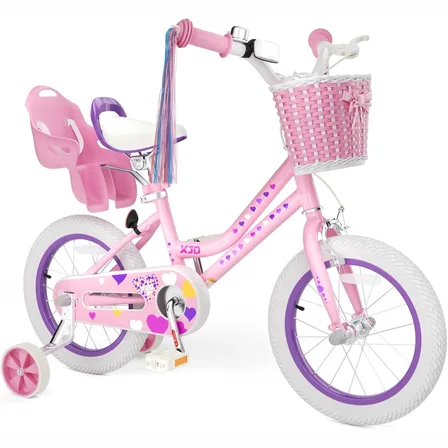
Light Pink XJD Girls' Bicycle with Basket & Training Wheels
The Light Pink XJD Girls' Bicycle with Basket & Training Wheels is a retro-style…$109.99
$129.99 -

Pink Girls' 12/14/16" Bike by XJD – Basket & Doll Seat
The XJD Pink Girls' Bike with Basket & Doll Seat is made for riders 71–122 cm ta…$75.99
$99.99