

What size bike for 48 inch boy
For a boy who is 48 inches tall, compare an 18-inch bike with a 20-inch bike first. He is at the top of the 18-inch range and the start of the 20-inch range, so measure his inseam and check both bikes in person before choosing.
Why 48 inches points to two wheel sizes
XBikes uses rider height as a starting point: an 18-inch bike covers 43–52 inches, while a 20-inch bike covers 48–60 inches. A 48-inch rider therefore falls within both ranges. Neither number settles the choice because children of the same height can have different leg lengths, arm lengths and levels of control.
Do not move automatically to the 20-inch bike simply to leave room for growth. The American Academy of Pediatrics advises having the child try the bicycle, avoiding an oversized bike bought for future growth, and checking stand-over clearance, control and brake reach.
Measure height and inseam
Measure the child without shoes. For height, have him stand upright against a wall and measure from the floor to the top of his head. Confirm that the result is about 48 inches rather than relying on an old measurement.
For inseam, place a firm, thin book between his legs with its spine pressing upward as a bicycle saddle would. Keep the book level, then measure from the floor to its top edge. Compare that measurement with the stand-over and saddle-adjustment guidance for the exact bicycle being considered. If those details are not available in the listing, consult the product manual, manufacturer or a qualified bicycle mechanic.
Use this size comparison
| Wheel size | XBikes starting range | Meaning at 48 inches |
|---|---|---|
| 16 Inch | Ages 4–7; 40–48 in / 102–122 cm | Top edge of the height range; consider only if the individual fit and controls suit him. |
| 18 Inch | Ages 5–9; 43–52 in / 109–132 cm | Within the range and a primary size to try. |
| 20 Inch | Ages 7–12; 48–60 in / 122–152 cm | At the lower edge and also a primary size to try. |
Age is secondary to measured dimensions and actual control. A younger or cautious 48-inch rider may handle one size differently from an older, confident rider, but confidence alone does not make a poorly fitting bicycle appropriate.
Check the fit on the actual bicycle
Have the child wear his usual riding shoes and try each candidate bicycle. A useful fit check includes all of the following:
- He can straddle the frame with practical clearance rather than being pressed against it.
- He can get on and off without the bicycle overwhelming him.
- He can reach the handlebar without stretching, locking his elbows or losing a balanced posture.
- He can steer through turns while remaining controlled.
- He can reach and operate the bicycle's braking controls reliably.
- At an appropriate saddle setting, he can start, stop and put a foot down with confidence.
If the 20-inch bicycle causes stretching, uncertain starts or poor brake control, it is too large now even though 48 inches begins its stated range. If an 18-inch bicycle feels cramped or restricts normal steering and pedalling posture, compare another correctly sized model rather than forcing the fit.
How the supplied 16-inch products relate
The two supplied catalog choices are available only in 12-inch, 14-inch and 16-inch versions. Their 16-inch options reach the upper starting-point limit of 48 inches, so they can help as smaller-size comparison points. They should not replace an 18-inch or 20-inch trial when either provides the better individual fit.
XJD Kids' Training Wheel Bike for Boys & Girls, 12/14/16 Inch – White is categorized as a training-wheel bike and is offered in 12-inch, 14-inch and 16-inch labels. XJD Boys & Girls BMX Bike with Training Wheels, 12/14/16" – Blue is categorized as a kids' BMX bike and has the same three available wheel-size labels. Because only the 16-inch version approaches a 48-inch rider's height, the 12-inch and 14-inch versions are outside the supplied height starting points for him.
These particular products are relevant when a parent wants to compare the largest supplied training-wheel options with the child's measured fit and present confidence; their catalog facts do not establish that either one will fit a particular 48-inch child.
 XJD Kids' Training Wheel Bike for Boys & Girls, 12/14/16 Inch – White
Available in 12-, 14- and 16-inch labels. Its 16-inch version is a smaller comparison point for a 48-inch rider, subject to an individual fit and control check.
 XJD Boys & Girls BMX Bike with Training Wheels, 12/14/16" – Blue
This kids' BMX bike with training wheels comes in 12-, 14- and 16-inch labels. Only the 16-inch option approaches the supplied height range for a 48-inch rider, and fit must still be checked.
Make the decision
Begin with side-by-side trials of 18-inch and 20-inch bicycles, using the measured inseam, stand-over clearance, reach, brake operation and riding control to decide. Include a supplied 16-inch model only as a smaller comparison if needed. Whichever bicycle fits, add a properly fitting helmet that sits level and has its straps adjusted according to the helmet manufacturer's instructions. For assembly, adjustment limits, maintenance, compatibility or torque, follow the exact bicycle manual or use a qualified bicycle mechanic.
Bikes for your next adventure
-

Black XJD Kids Bike for Boys – 12, 14 & 16 Inch Sizes
For a son between roughly 3 and 8 years old, the XJD Kids Bike in Black covers t…$169
$199 -

XJD Boys 12/14/16" Training Wheel Bike – Blue
The XJD Boys Bike in Blue is a training wheel bike for riders 71–122 cm tall—rou…$169
$199 -
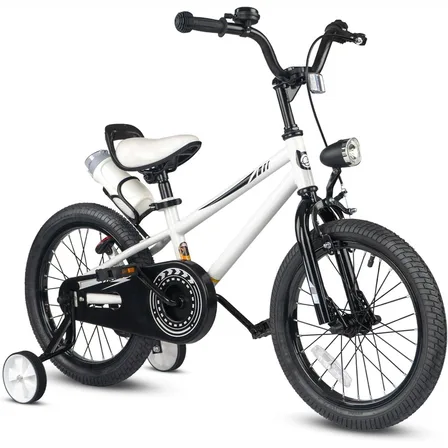
XJD Kids' Training Wheel Bike for Boys & Girls, 12/14/16 Inch – White
The XJD kids' training wheel bike in White is made for riders ages 3–8 (roughly …$169
$199