

What size bike for 48 tall boy
For a boy who is 48 inches tall, compare 18-inch and 20-inch bikes first. A 16-inch bike is also within the XBikes height range, but at its upper limit, so choose only after an individual fit check.
Why 48 inches sits between bike sizes
According to the XBikes starting points, a 48-inch rider is at the top of the 16-inch range, within the 18-inch range, and at the beginning of the 20-inch range. That overlap means height alone cannot select the bike.
| Wheel size | XBikes rider-height range | What 48 inches means |
|---|---|---|
| 16 Inch | 40–48 in / 102–122 cm | The rider is at the upper boundary. |
| 18 Inch | 43–52 in / 109–132 cm | The rider is within the range. |
| 20 Inch | 48–60 in / 122–152 cm | The rider is at the lower boundary. |
Age is secondary. The starting ranges are ages 4–7 for a 16-inch bike, 5–9 for an 18-inch bike, and 7–12 for a 20-inch bike, but measured height, inseam, reach, brake control and current confidence should decide the fit.
Measure the rider before comparing bikes
Confirm that 48 inches is the boy’s current height without shoes, not an estimate or an old measurement. Then measure his inseam: with shoes off, have him stand upright with his feet naturally spaced and measure from the floor to the crotch.
Use that inseam measurement to check the stand-over clearance on each actual bicycle. Wheel size does not reveal frame shape or stand-over height, and those product dimensions were not supplied here. Check the exact product manual or ask a qualified bicycle mechanic if the necessary dimensions are unclear.
Perform the fit check on each candidate
Have the child try the complete bicycle rather than deciding from its wheel label. The American Academy of Pediatrics advises against buying an oversized bicycle merely for future growth. A bike that is too large can make starting, stopping and steering harder now.
- Check stand-over: With the rider straddling the bicycle, confirm that he can stand over it comfortably rather than being forced onto his toes or against the frame.
- Check seated control: He should be able to get into position, start, steer and stop without stretching, twisting or losing balance.
- Check reach: His arms should control the handlebar comfortably. Reject a bike that requires an awkward forward stretch.
- Check braking: Confirm that his hands can reach and operate the actual brake controls confidently. Do not assume a wheel size guarantees suitable brake reach.
- Compare confidence: If the 20-inch bike technically fits but feels difficult to control, compare the 18-inch option. If a 16-inch bike feels cramped or leaves little useful adjustment, move up rather than relying on the height chart alone.
How the supplied XBikes option is relevant
The supplied catalog option, XJD Boys & Girls BMX Bike with Training Wheels, 12/14/16" – Blue, is available with 12-inch, 14-inch and 16-inch labels. For a 48-inch boy, only its 16-inch version reaches his stated height under the XBikes ranges; the 12-inch and 14-inch versions do not. It helps as a 16-inch comparison at the boundary, but the supplied catalog contains no 18-inch or 20-inch version of this product.

Do not treat the training-wheel wording in the product title as proof of fit or readiness. The supplied facts do not establish its dimensions, brake type, adjustment range, load limit or compatibility details. Consult the exact product manual or a qualified bicycle mechanic for assembly, maintenance and technical compatibility questions.
When the 16-inch catalog bike makes sense
The 16-inch version remains relevant if the boy can stand over it comfortably, has an unstrained riding position, can operate its controls, and does not appear cramped. It may also deserve closer comparison when his present confidence makes a larger bicycle difficult to start, steer or stop.
It is not the right choice merely because 48 inches appears at the end of its range. If he looks crowded, cannot use a suitable riding position, or has already outgrown its practical adjustment, compare properly fitted 18-inch and 20-inch bicycles instead. Those sizes are distinct alternatives, not equivalents, and the larger one should not be selected only to leave room for growth.
Make the final 48-inch decision
Begin with side-by-side fit checks of 18-inch and 20-inch bikes, using the measured inseam, stand-over, reach, braking and riding confidence. Include the supplied 16-inch XJD model only as a boundary-size comparison. Choose the bicycle the boy can control comfortably today, then fit a bicycle helmet so it sits level and its straps are adjusted according to the helmet manufacturer’s instructions.
Bikes for your next adventure
-

Black XJD Kids Bike for Boys – 12, 14 & 16 Inch Sizes
For a son between roughly 3 and 8 years old, the XJD Kids Bike in Black covers t…$169
$199 -

XJD Boys 12/14/16" Training Wheel Bike – Blue
The XJD Boys Bike in Blue is a training wheel bike for riders 71–122 cm tall—rou…$169
$199 -
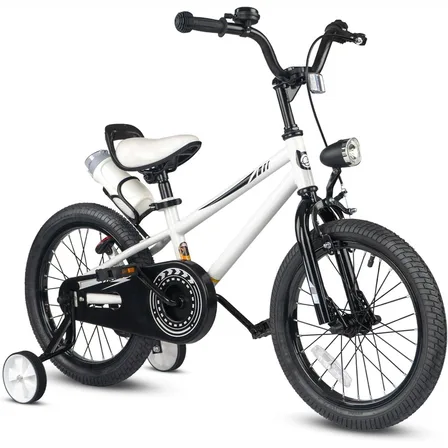
XJD Kids' Training Wheel Bike for Boys & Girls, 12/14/16 Inch – White
The XJD kids' training wheel bike in White is made for riders ages 3–8 (roughly …$169
$199