

What size bike for a boy
Choose a boy’s bike by matching his measured height to the wheel-size chart, then confirm stand-over clearance, reach, brake control and confidence in person.
Start with height, not age
Measure the rider without shoes, standing straight against a wall. Record his total height from the floor to the top of his head. Age can suggest where to begin, but children of the same age may need different sizes.
Next, measure inseam. Have him stand with his feet slightly apart, then measure from the floor to the crotch. Use that measurement during an actual fit check: he needs suitable clearance when standing over the bicycle rather than being pressed against the frame.
These measurements narrow the search; they do not prove that a particular frame fits. Frame shapes, reach and control positions can differ even when bicycles have the same wheel size.
Compare his measurement with these starting points
| Wheel size | Age starting point | Rider-height starting point |
|---|---|---|
| 12 Inch | 3–4 | 34–40 in / 86–102 cm |
| 14 Inch | 3–6 | 37–45 in / 94–114 cm |
| 16 Inch | 4–7 | 40–48 in / 102–122 cm |
| 18 Inch | 5–9 | 43–52 in / 109–132 cm |
| 20 Inch | 7–12 | 48–60 in / 122–152 cm |
| 24 Inch | 10–14 | 54–64 in / 137–163 cm |
| 26 Inch | Youth and adults | Over 60 in / 153 cm |
Where height ranges overlap, compare both sizes in person. Do not automatically select the larger one. The correct choice is the bicycle on which the boy can stand over, reach comfortably, steer predictably and operate the brakes reliably.
Perform a practical fit check
Have the child try the bicycle in the clothes and closed-toe shoes he normally rides in. With an adult stabilizing the bike, check the following:
- Stand-over: He can straddle the bicycle with appropriate clearance and both feet securely supporting him.
- Starting and stopping: He can get into position, start and stop without the bicycle overwhelming him.
- Reach: He can hold the handlebars without locking his elbows, leaning excessively or stretching.
- Steering: He can turn the bars while remaining balanced and in control.
- Brake control: He can reach and operate the bicycle’s provided braking controls confidently.
- Confidence: The bicycle feels manageable at his present skill level, not merely usable after he grows.
American Academy of Pediatrics guidance supports having a child try the bicycle and avoiding an oversized bike bought for future growth. If either candidate compromises stand-over clearance or control, reject it even if the age column appears suitable.
How the supplied boys’ bike compares
The XJD Boys 12/14/16" Training Wheel Bike – Blue is categorized as a training-wheel bike and has 12 Inch, 14 Inch and 16 Inch SKU labels. Those three catalog options help families compare the smaller wheel-size starting points directly; the title’s word “Boys” is a product label, not evidence that it fits every boy.

Based on the XBikes chart, begin by comparing the child’s measured height with the relevant 12-, 14- or 16-inch range, then check the exact bicycle in person. This product is relevant only when one of those wheel-size options matches the rider’s measurements and he can control that particular bike. It is not a substitute for an 18-, 20-, 24- or 26-inch bicycle when the fit check points to one of those sizes.
Do not size up just for growth
A too-large bike can make mounting, stopping, steering and reaching the brakes harder now. A bike that is close enough to “grow into” is still the wrong choice if the rider cannot manage it today. Likewise, do not select a smaller bicycle solely because it looks less intimidating if his position is cramped or his knees, reach or steering are restricted.
If the child’s height falls close to a boundary, arrange side-by-side trials. Observe several controlled starts, stops and turns in a traffic-free area. Present confidence matters: a less experienced rider may control one fitting option more comfortably, while a confident rider may still need the smaller option if the larger bicycle fails any control check.
Finish the decision safely
Once the size and fit are confirmed, use a bicycle helmet that fits properly, sits level and has straps adjusted according to its manufacturer’s instructions, consistent with U.S. Consumer Product Safety Commission guidance. Adult supervision and a suitable riding area remain important.
For assembly, adjustment, maintenance, load limits, compatibility and torque requirements, follow the exact product manual or ask a qualified bicycle mechanic; those details cannot be inferred from wheel size.
Your next step is simple: measure the boy’s height and inseam, shortlist the chart size, and buy only after he demonstrates comfortable stand-over, reach, braking and control on the exact bicycle.
Bikes for your next adventure
-
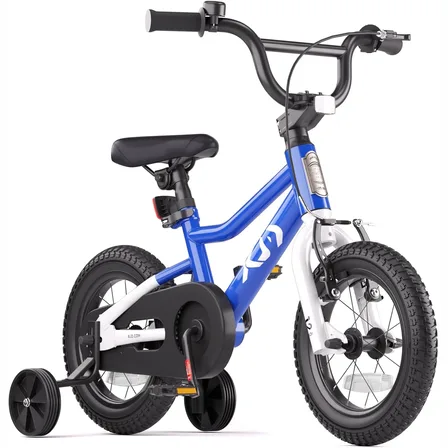
XJD Boys & Girls BMX Bike with Training Wheels, 12/14/16" – Blue
The XJD Boys & Girls BMX Bike in Blue is a first pedal bike for kids roughly age…$99.99
$119.99 -

Black XJD Kids Bike for Boys – 12, 14 & 16 Inch Sizes
For a son between roughly 3 and 8 years old, the XJD Kids Bike in Black covers t…$169
$199 -

XJD Boys 12/14/16" Training Wheel Bike – Blue
The XJD Boys Bike in Blue is a training wheel bike for riders 71–122 cm tall—rou…$169
$199