

What size bike for a six year old boy
Most six-year-old boys will compare 14-, 16- and 18-inch bikes, but height and an individual fit check—not age alone—should decide the size.
Start with his measured height
Measure your child without shoes, standing straight against a wall. Compare that height with the XBikes starting points below. Wheel size is only a starting category: two six-year-olds of the same height can have different leg lengths, reach and confidence.
| Wheel size | XBikes age starting point | Rider height | Meaning for a six-year-old |
|---|---|---|---|
| 12 Inch | Ages 3–4 | 34–40 in / 86–102 cm | Consider only if his measured height falls in this range and the bicycle fits in person. |
| 14 Inch | Ages 3–6 | 37–45 in / 94–114 cm | A possible match near the smaller end of typical six-year-old choices. |
| 16 Inch | Ages 4–7 | 40–48 in / 102–122 cm | A common comparison range for this age, subject to the complete fit check. |
| 18 Inch | Ages 5–9 | 43–52 in / 109–132 cm | Worth comparing for a taller child, but it must not be bought oversized. |
| 20 Inch | Ages 7–12 | 48–60 in / 122–152 cm | Relevant only if his height and real-world control support it; age six does not automatically rule it in or out. |
If his height appears in overlapping rows, do not choose the larger wheel automatically. Move to an in-person check of inseam clearance, reach, braking and control.
Measure inseam and check stand-over clearance
For inseam, have him stand without shoes with his feet slightly apart. Place a firm book upward between his legs to simulate the saddle area, then measure from the floor to the top edge of the book. Use that measurement when checking the bicycle maker’s exact geometry or manual; the supplied standard does not provide a numerical inseam requirement.
With the child standing over the bike, he should have usable clearance rather than being pressed against the frame. He must be able to mount and dismount without struggling. If clearance is doubtful, consult the product manual or a qualified bicycle mechanic instead of assuming that a wheel-size label guarantees fit.
Test reach, steering and brake control
Seat him on the bicycle and ask him to hold the grips naturally. He should not have to stretch, lock his elbows or lean so far forward that steering becomes awkward. Check that he can turn the handlebar while remaining balanced and looking ahead.
He also needs to operate the bicycle’s brakes confidently with the controls fitted to that exact model. Verify that he can reach and use them without releasing his secure grip or changing position excessively. Brake type and adjustment details are not supplied here, so follow the exact product manual or ask a qualified bicycle mechanic.
Let current confidence influence the decision
A confident rider and a child still learning to start, stop or balance may need different fits even at the same height. During a supervised trial, have him demonstrate a controlled start, straight-line riding, turning, braking and a safe dismount. The bicycle should feel manageable at low speed, where poor fit is often easiest to notice.
Do not buy a larger bicycle merely to leave room for growth. If he cannot stand over it comfortably, reach the controls or stop predictably today, it is too large today. A smaller listed age range is not automatically wrong when his measurements and control support the fit.
How the supplied BMX options help
The XJD Boys & Girls BMX Bike with Training Wheels, 12/14/16" – Blue is available in 12 Inch, 14 Inch and 16 Inch labels. Those options let parents compare three adjacent starting sizes against the child’s measured height, with 14 and 16 inches especially relevant to many six-year-old height ranges. The 12-inch option is relevant only for a child within its 34–40 in / 86–102 cm starting range and after a successful fit check.
These catalog options help answer the question because they provide actual 12-, 14- and 16-inch comparison points in one named product. They do not include an 18- or 20-inch option, so if measurements direct you toward either larger size, this product is not a substitute.

The words “Boys & Girls” and “with Training Wheels” are parts of the exact catalog title; they do not prove suitability for a particular child. No assembly procedure, load limit, brake specification or compatibility detail was supplied. Follow the exact product manual for those matters, or use a qualified bicycle mechanic.
Make the final size decision
- Measure his standing height and inseam without shoes.
- Use height to shortlist the applicable wheel-size rows, even when they overlap.
- Have him try each shortlisted size rather than relying on his sixth birthday.
- Reject any bike that compromises stand-over clearance, natural reach, steering, brake use or controlled stopping.
- Choose only the size he can control now; do not size up solely for future growth.
Before riding, add a properly fitting bicycle helmet. It should sit level and its straps should be used according to the helmet manufacturer’s instructions. For a six-year-old boy, the answer is therefore the smallest correctly fitting choice among his height-based candidates—often 14, 16 or 18 inches—not a size selected from age alone.
Bikes for your next adventure
-
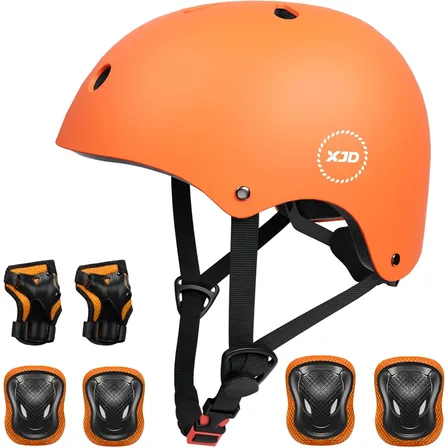
Orange Kids Helmet & Pad Set by XJD – Sizes S & M
The Orange XJD Kids Helmet & Pad Set is built for children around 3 to 8 years o…$24.64
-
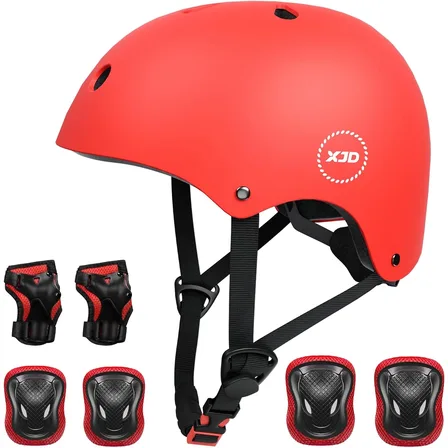
Red XJD Helmet & Protective Gear Set for Kids, Medium
If your child rides a bike, scooter, or skateboard, this red XJD helmet and prot…$25.49
$29.99 -

Kids Bike Helmet by XJD for Boys & Girls – Black, Blue, Green, Pink, Purple
The XJD Kids Bike Helmet covers a wide 2-to-8-year age range thanks to two head-…$59.99