

What size bike for big ten year old boy
A big ten-year-old boy will usually start with a 24-inch bike if he is 54–64 in (137–163 cm) tall. Choose by measured fit, not age or the word “big.”
Use height to choose the first wheel size
Measure him barefoot, standing straight against a wall. Compare that height with the XBikes starting points that cover most ten-year-olds:
| Wheel size | XBikes age starting point | Rider height | When to consider it |
|---|---|---|---|
| 20 Inch | 7–12 | 48–60 in / 122–152 cm | He falls in this height range and can control the complete bike comfortably. |
| 24 Inch | 10–14 | 54–64 in / 137–163 cm | This is the likely starting point for a taller or “big” ten-year-old. |
| 26 Inch | Youth and adults | Over 60 in / 153 cm | He exceeds 60 inches and passes an individual fit and control check. |
The ranges overlap because wheel diameter alone does not determine fit. Frame shape, saddle position and handlebar reach can differ between bicycles of the same nominal wheel size. Age is therefore only a starting point; measured height and an actual trial decide.
Measure inseam before comparing bikes
Height narrows the choice, but inseam helps reveal whether he can stand over a particular frame. Have him stand in socks with his feet naturally apart. Place a firm, thin book between his legs, bring it up gently to simulate a saddle, and measure vertically from the floor to the book’s top edge.
Do not turn that number into a wheel size using an unrelated chart. Instead, take it to the bicycle and compare it with the actual stand-over height specified for that exact model. With the child straddling the bike, he should be able to stand securely rather than being forced onto tiptoes or against the frame. Follow the exact product manual or ask a qualified bicycle mechanic if the model’s measurement or adjustment method is unclear.
Make the final decision with a hands-on fit check
Have him try each candidate rather than buying a larger bicycle purely for future growth. The American Academy of Pediatrics’ fit guidance emphasizes stand-over space, control and brake reach. During the trial, check that he can:
- mount, start and stop without the bike pulling him off balance;
- reach the handlebars without locking his elbows or stretching his torso;
- turn the bars while remaining centered and confident;
- reach and operate the brakes positively with his hands in their normal riding position;
- place his feet as required for controlled starts and stops on that particular bicycle.
If a 24-inch bike makes any of these actions awkward, compare a correctly fitted 20-inch model even if his age suggests 24 inches. If he is over 60 inches tall, a 26-inch model becomes a starting point, but it is not automatically correct. Reject any candidate he cannot control now.
How the supplied XBikes products relate
The supplied catalog options help show the upper end of the smaller-bike range: XJD Kids' Training Wheel Bike for Boys & Girls, 12/14/16 Inch – White is offered in 12, 14 and 16 Inch labels, while XJD Boys & Girls BMX Bike with Training Wheels, 12/14/16" – Blue is also offered in 12, 14 and 16 Inch labels. They provide relevant nearest-size comparison points, but neither product offers the 20-, 24- or 26-inch sizes likely to be considered for a big ten-year-old.
 XJD Kids' Training Wheel Bike for Boys & Girls, 12/14/16 Inch – White
Available only in 12, 14 and 16 Inch labels, this training-wheel bike is a smaller nearest-size comparison point, not a substitute for the likely 20-, 24- or 26-inch requirement.
 XJD Boys & Girls BMX Bike with Training Wheels, 12/14/16" – Blue
This kids’ BMX bike comes in 12, 14 and 16 Inch labels. Those sizes make it relevant only as a smaller comparison point unless the rider’s measured height and individual fit support one.
Under the XBikes starting points, 16 Inch covers ages 4–7 and heights 40–48 in (102–122 cm). Accordingly, these products are not substitutes for a needed 20-, 24- or 26-inch bicycle. Consider either one only if his actual height falls within its supplied size range and a hands-on check confirms stand-over, reach, braking and control. Do not use the presence of training wheels or wording in a catalog title as evidence of fit.
Avoid sizing up for growth
An oversized bike can make mounting, steering and stopping harder at the moment those actions need to feel predictable. Extra growing room is not useful if the rider cannot reach the controls or recover his balance. Choose the size he can handle today, then use only the adjustment limits and procedures stated in that exact bicycle’s manual. For assembly, maintenance, compatibility, load limits or torque information not supplied here, follow the manual or use a qualified bicycle mechanic.
Before he rides
Once the bicycle fits, add a properly fitted bicycle helmet. U.S. Consumer Product Safety Commission guidance says the helmet should sit level and its straps should be adjusted according to the manufacturer’s instructions. Recheck the fit whenever equipment or riding conditions change.
For this big ten-year-old, measure height and inseam now: start with 24 inches at 54–64 inches tall, compare 20 inches at 48–60 inches or 26 inches above 60 inches, and buy only the bike on which he passes every stand-over, reach, brake and confidence check.
Bikes for your next adventure
-

Flower Pink XJD Girls Bike with Doll Seat & Basket
The XJD Flower Pink girls' bike is made for riders 71–122 cm tall (roughly ages …$69.99
-

Pink Girls' 12/14/16" Bike by XJD – Basket & Doll Seat
The XJD Pink Girls' Bike with Basket & Doll Seat is made for riders 71–122 cm ta…$75.99
$99.99 -
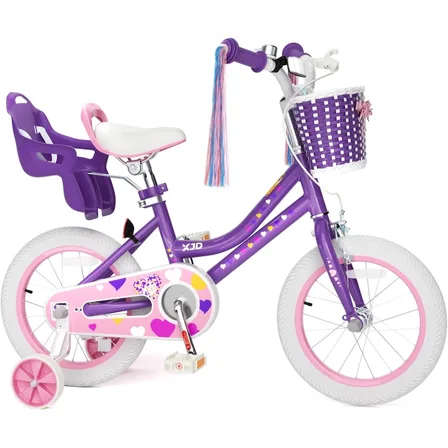
Purple XJD Girls' Bike with Doll Seat & Basket
For girls 71–122 cm tall (about ages 3–7), this XJD girls' bike in Purple pairs …$75.99
$99.99