

What size bike for my 7 year old boy
For a 7-year-old boy, start with a 20-inch bike if he is 48–60 in (122–152 cm) tall, or an 18-inch bike if he is 43–52 in (109–132 cm). A smaller rider measuring 40–48 in (102–122 cm) may still fit a 16-inch bike. Measure him and check the actual fit before choosing.
Choose by measured height, not age alone
Seven-year-olds vary considerably in height and confidence, so age cannot settle the size. Have your child stand straight without shoes against a wall, looking ahead, with heels on the floor. Mark the top of his head and measure vertically from the floor.
Compare that result with the XBikes starting points most relevant to this age:
| Wheel size | XBikes age starting point | Rider height starting point |
|---|---|---|
| 16 Inch | Ages 4–7 | 40–48 in / 102–122 cm |
| 18 Inch | Ages 5–9 | 43–52 in / 109–132 cm |
| 20 Inch | Ages 7–12 | 48–60 in / 122–152 cm |
The overlapping ranges are intentional starting points, not proof that every bike with that wheel size will fit. If his height falls within two ranges, his inseam, reach, control and confidence should decide which bike to try first.
Measure inseam for stand-over clearance
Height narrows the choice; inseam helps reveal whether the frame is manageable. With your child still barefoot, place a firm book between his legs and raise it gently to mimic a bicycle saddle. Measure from the floor to the top edge of the book.
At a bicycle fitting, ask him to straddle the frame with both feet planted securely on the ground. He needs usable clearance rather than contact with the frame. Frame shapes differ, so there is no responsible way to choose from wheel diameter and inseam alone. Follow the exact product manual for its fitting directions, or ask a qualified bicycle mechanic when the clearance is uncertain.
Perform a hands-on control check
Once the height range and stand-over check look suitable, have him sit in a normal riding position while an adult stabilizes the bicycle. Check whether he can reach the handlebars naturally without stretching, turning his shoulders or locking his elbows.
- He should be able to mount and dismount without struggling.
- He should steer through turns while remaining balanced and in control.
- His hands must reach and operate the brakes confidently from the riding position.
- The bicycle should not feel intimidating when starting, stopping or putting a foot down.
Do not buy an oversized bicycle merely to leave growing room. A larger wheel-size range does not compensate for poor stand-over clearance, excessive reach or weak brake control. If he cannot manage those checks, try the smaller appropriate option even when his age points toward a larger one.
Where the supplied 12, 14 and 16-inch bike fits
The Black XJD Kids Bike for Boys – 12, 14 & 16 Inch Sizes is a training-wheel bike offered in 12 Inch, 14 Inch and 16 Inch SKU labels. For this exact question, its 16 Inch option is the only supplied size that overlaps the XBikes age-seven starting points, and it is relevant only when the rider measures within the 16-inch 40–48 in (102–122 cm) height range and passes an individual fit check. The 12 Inch and 14 Inch options are useful comparison points for understanding the range, but their XBikes starting ranges are ages 3–4 at 34–40 in (86–102 cm) and ages 3–6 at 37–45 in (94–114 cm), respectively; age seven alone does not support choosing them.

If your seven-year-old measures above 48 in (122 cm), the supplied product does not include the 18 Inch or 20 Inch options that his measurement may indicate. In that case, treat it as a nearest-size comparison point rather than a substitute: a 16-inch bike is not equivalent to an 18-inch or 20-inch bike.
Match size to current confidence
A confident rider near an overlap may be ready to try the larger applicable size, provided he can straddle, reach, steer and brake correctly. A hesitant or newly learning rider may control the smaller applicable size more comfortably. Confidence never overrides fit: neither choice works if the controls or frame are beyond his reach.
For assembly, adjustment, maintenance, load limits and other specifications not provided here, follow the exact product manual or use a qualified bicycle mechanic. Do not improvise settings or procedures from wheel size alone.
Make the final size decision
- Measure his standing height and inseam without shoes.
- Use 16, 18 or 20 Inch as the initial comparison according to the XBikes height ranges.
- Have him try the bicycle and verify stand-over clearance, natural reach, steering control and brake operation.
- Reject any size he cannot control now, even if it offers room to grow.
After selecting the correctly fitting bike, add a properly fitting bicycle helmet. It should sit level and its straps should be used according to the helmet manufacturer’s instructions. For your 7-year-old boy, the decision is therefore measurement-led: try 20 Inch at 48–60 in, 18 Inch at 43–52 in, or 16 Inch at 40–48 in, then buy only the size he can confidently control today.
Bikes for your next adventure
-
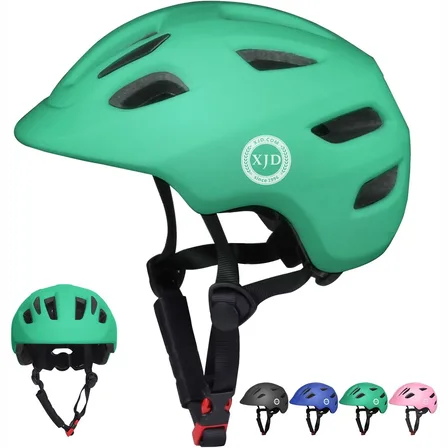
Green XJD Toddler Bike Helmet with Adjustable Fit, XS (46–51 cm)
The XJD toddler bike helmet in Green is built for the youngest riders — the size…$20.39
$23.99 -

Kids Bike Helmet by XJD for Boys & Girls – Black, Blue, Green, Pink, Purple
The XJD Kids Bike Helmet covers a wide 2-to-8-year age range thanks to two head-…$59.99
-

Kids Bike Helmet by XJD for Girls – Pink
The XJD Kids Bike Helmet in Pink is a lightweight multi-sport helmet for girls r…$59.99
$99