

What size should of bike for a 5 boy
For a 5-year-old boy, start by measuring his height: 14-, 16-, or 18-inch wheels may fit, but only an individual fit check can decide.
Use height before age
Age five falls within several overlapping XBikes starting ranges. Compare his measured standing height with these figures, then check how he actually sits, stands, reaches, steers and brakes on the bicycle. Being five does not automatically make one wheel size correct.
| Wheel size | XBikes age starting point | Rider-height starting point |
|---|---|---|
| 12 Inch | Ages 3–4 | 34–40 in / 86–102 cm |
| 14 Inch | Ages 3–6 | 37–45 in / 94–114 cm |
| 16 Inch | Ages 4–7 | 40–48 in / 102–122 cm |
| 18 Inch | Ages 5–9 | 43–52 in / 109–132 cm |
Most five-year-olds will therefore begin their comparison at 14, 16 or 18 inches, depending on height. A particularly short child may still need a 12-inch bicycle. These ranges overlap intentionally: they narrow the options but do not replace trying the bicycle.
Measure height and inseam
Measure him without shoes on a firm, level floor. For height, have him stand straight against a wall, looking ahead, and mark the top of his head. Measure from the floor to the mark.
For inseam, place a firm, thin book between his legs and raise it gently to simulate a saddle. Keep the book level and measure from the floor to its top edge. Record both measurements in inches or centimetres.
Use standing height to select the wheel sizes worth trying. Then use the inseam during the physical fit check: the bicycle must provide comfortable stand-over clearance rather than pressing into him when he straddles it. Bicycle frame shapes vary, so wheel diameter alone cannot confirm clearance.
Check the bicycle with him on it
Have the child try each realistic candidate instead of buying an oversized bicycle for future growth. With an adult stabilizing the bicycle, check the following:
- He can straddle the frame comfortably with both feet on the ground.
- He can reach the handlebars without stretching, locking his elbows or leaning excessively.
- He can turn the bars while remaining balanced and in control.
- His hands can reach and operate the fitted brake controls confidently.
- He can start, stop and place a foot down without panic or a sudden loss of control.
Current confidence matters alongside body measurements. If a larger option makes starting, steering or stopping hesitant, it is not the right choice merely because he could grow into it.
How the supplied BMX options help
The catalog provides one relevant comparison product: the XJD Boys & Girls BMX Bike with Training Wheels, 12/14/16" – Blue, categorized as a Kids' BMX Bike and offered with 12 Inch, 14 Inch and 16 Inch SKU labels. Those three choices let a parent compare adjacent sizes for a shorter or average-height five-year-old; the height and hands-on checks above still determine fit.

The 14-inch option corresponds to the 37–45 in / 94–114 cm starting range, while the 16-inch option corresponds to 40–48 in / 102–122 cm. The 12-inch option is primarily an ages 3–4 starting point at 34–40 in / 86–102 cm, but measurement—not the age label—decides whether it remains worth trying.
This product does not offer an 18 Inch SKU in the supplied catalog facts. If the boy measures within the 18-inch starting range of 43–52 in / 109–132 cm, treat the listed 16-inch model only as a comparison point, not an equal substitute for an 18-inch bicycle.
Do the final control and safety checks
Repeat the fit check after any permitted adjustments because saddle or handlebar positioning can change his posture and control. Follow the exact product manual for assembly, adjustment, maintenance, compatibility, load limits and torque. If anything is unclear or difficult to secure, use a qualified bicycle mechanic rather than guessing.
Add a properly fitting bicycle helmet. It should sit level and its straps should be adjusted according to the helmet manufacturer's instructions. A helmet does not correct an oversized or poorly controlled bicycle, so confirm both helmet fit and bicycle fit separately.
Make the size decision
Measure his height and inseam now, shortlist only the matching wheel ranges, and have him try those sizes. Choose the bicycle on which this particular five-year-old can stand over comfortably, reach naturally, steer steadily and operate the brakes—not the largest size intended to last longer.
Bikes for your next adventure
-
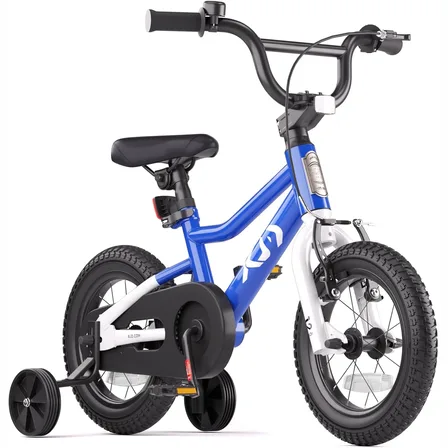
XJD Boys & Girls BMX Bike with Training Wheels, 12/14/16" – Blue
The XJD Boys & Girls BMX Bike in Blue is a first pedal bike for kids roughly age…$99.99
$119.99 -

Black XJD Kids Bike for Boys – 12, 14 & 16 Inch Sizes
For a son between roughly 3 and 8 years old, the XJD Kids Bike in Black covers t…$169
$199 -

XJD Boys 12/14/16" Training Wheel Bike – Blue
The XJD Boys Bike in Blue is a training wheel bike for riders 71–122 cm tall—rou…$169
$199