

A bicycle for kids
A bicycle for kids should match the child’s measured height and inseam, allow comfortable reach and brake control, and suit their current confidence—not leave room to grow.
Measure the rider before choosing
Start with the child standing in shoes on a level floor. Measure total height, then inseam from the floor to the crotch. Use height to identify a likely wheel size, but treat that result only as a starting point.
The child must try the bicycle. When standing over it, they need comfortable clearance rather than contact with the frame. Seated, they should reach the handlebars without stretching or locking their arms. They must also be able to operate the brakes confidently. If any of these checks fail, compare another size or model.
Do not choose an oversized bicycle simply to extend its useful life. A bike that is too large can make starting, stopping, steering and dismounting harder now.
Compare wheel-size starting points
| Wheel size | Age guide | Rider height |
|---|---|---|
| 12 Inch | 3–4 | 34–40 in / 86–102 cm |
| 14 Inch | 3–6 | 37–45 in / 94–114 cm |
| 16 Inch | 4–7 | 40–48 in / 102–122 cm |
| 18 Inch | 5–9 | 43–52 in / 109–132 cm |
| 20 Inch | 7–12 | 48–60 in / 122–152 cm |
| 24 Inch | 10–14 | 54–64 in / 137–163 cm |
| 26 Inch | Youth and adults | Over 60 in / 153 cm |
Overlapping ranges are intentional: two children of the same age may need different bicycles. Prioritize measured height, inseam, reach, brake control and confidence over the age column. If a measurement sits near a boundary, have the child try both neighboring sizes rather than automatically sizing up.
Decide whether training wheels are relevant
The supplied XBikes choices are training-wheel bikes, so they are relevant when a child is not yet ready to balance independently and their measurements point to an offered size. Training wheels should not substitute for correct frame fit, manageable reach or brake control.
They may be less relevant for a confident independent rider, a child who does not fit the available 12-, 14-, 16- or 20-inch choices, or a family specifically seeking an 18-, 24- or 26-inch bicycle. In those cases, compare bicycles in the appropriate wheel-size range and repeat the individual fit check.
How the three catalog options compare
These particular catalog options help answer “A bicycle for kids” because each offers training wheels and clearly labeled wheel sizes, making it possible to narrow the choice from the child’s measurements before arranging a real fit check.
 Light Pink XJD Girls' Bicycle with Basket & Training Wheels
A training-wheel option in 12, 14, 16 and 20 Inch labels. It is the only supplied product extending to 20 Inch, and its exact title also identifies a basket.
 Blue XJD Girls Bike with Training Wheels – 12/14/16 Inch
A blue training-wheel bicycle offered in 12, 14 and 16 Inch labels. It is relevant when the rider’s measurements indicate one of those starting sizes and the exact bike passes a fit check.
 XJD Boys 12/14/16" Training Wheel Bike – Blue
A blue training-wheel bicycle offered in 12, 14 and 16 Inch labels. Treat the “Boys” wording as a catalog label; individual measurements, control and preference should determine relevance.
- Light Pink XJD Girls' Bicycle with Basket & Training Wheels is offered in 12 Inch, 14 Inch, 16 Inch and 20 Inch labels. It is the only supplied option extending to 20 Inch and the only title that identifies a basket.
- Blue XJD Girls Bike with Training Wheels – 12/14/16 Inch is offered in 12 Inch, 14 Inch and 16 Inch labels.
- XJD Boys 12/14/16" Training Wheel Bike – Blue is also offered in 12 Inch, 14 Inch and 16 Inch labels.
The “Girls” and “Boys” wording is part of the catalog titles, not evidence of fit. Choose according to the individual rider’s measurements, physical control and preference. The shared size label also does not prove that two models feel identical, so the child should try the exact bicycle being considered.
Run a hands-on fit and control check
- Confirm the wheel-size label falls within the rider-height starting range.
- Have the child stand over the bicycle and check for comfortable clearance.
- Seat the child and check that the handlebars are reachable without an awkward stretch.
- Confirm the child can operate the brakes and steer while remaining in control.
- Let the child start, stop and dismount in a suitable supervised area before deciding.
If assembly, adjustment or maintenance is needed, follow the manual for that exact product. Use a qualified bicycle mechanic whenever the instructions are unclear or the bicycle cannot be set up so the child controls it comfortably. Do not guess at compatibility, torque settings or load limits.
Finish the choice with helmet fit
A bicycle decision is incomplete without a properly fitting bicycle helmet. It should sit level and be secured with its straps according to the helmet manufacturer’s instructions. Recheck the fit rather than assuming an existing helmet still fits.
The next step is simple: measure the child, shortlist only the offered wheel sizes matching that height, and arrange a try-on. Choose one of these three training-wheel bicycles only if the exact model passes the stand-over, reach, brake-control and confidence checks today.
Bikes for your next adventure
-

XJD Girls Bike for Kids Ages 3-8, 12/14/16 Inch with Training Wheels – Purple
The XJD Girls Bike in Purple is a training-wheel bicycle for kids ages 3 to 8, f…$149
$169 -
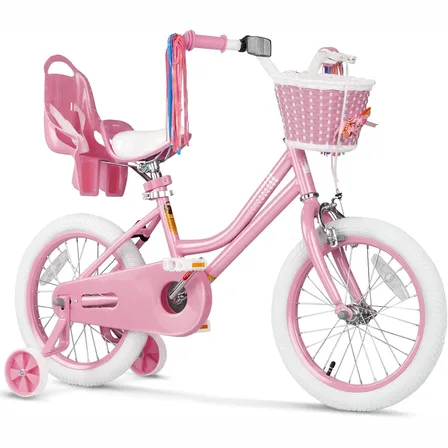
XJD Pink Girls' Bike – Kids 12/14/16 Inch Training Wheel Bicycle
The XJD Pink Girls' Bike is a training-wheel bicycle for girls ages 3 to 8 (ride…$149
$169 -
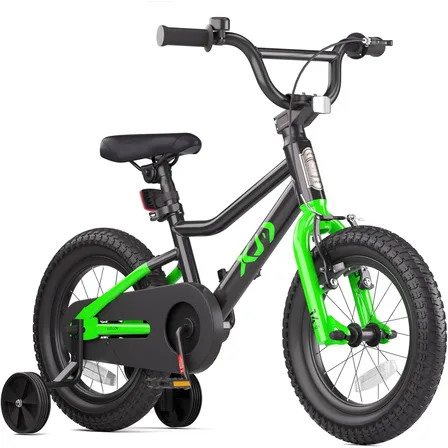
Black XJD Kids' BMX Bicycle with Training Wheels
The XJD Kids' BMX Bicycle with Training Wheels is built for children roughly 3 t…$99.99
$119.99