

Are bike trailers for kids a safe option
Yes—bike trailers can be a safe option for children when the trailer fits its passengers, connects correctly, and is used on suitable routes.
Decide whether your child and bicycle are ready
Start with the trailer manufacturer’s exact manual. Confirm the permitted passenger age or developmental stage, seating arrangement, load limit, and towing-bicycle compatibility. Do not guess from the trailer’s appearance or use another model’s instructions. If the manual’s requirements are missing or unclear, ask the manufacturer or a qualified bicycle mechanic before riding.
Measure each child’s current weight and seated height, then compare those measurements with the manual. Check that the child can sit in the intended position without crowding the enclosure and that the restraint can be adjusted as directed. A child who cannot maintain the posture required by the manufacturer is not ready for that trailer.
Also inspect the towing bicycle. It must fit and be controllable by the adult while carrying the additional towing load. The rider should be able to start, steer, brake and stop confidently before adding passengers.
Compare the safety-critical details
| Check | What to verify |
|---|---|
| Hitch | The hitch is approved for the specific trailer and compatible with the bicycle according to both manuals. |
| Passenger fit | Each child is within the stated limits and can use the complete restraint system correctly. |
| Wheels and frame | Wheels are secure, tires are serviceable, and no structural part is loose, bent or damaged. |
| Visibility | Required reflectors, flag or other visibility equipment specified by the manufacturer is present and unobstructed. |
| Protection | The enclosure is closed as directed so hands, clothing and objects remain away from moving parts. |
Use the specified backup retention device if the trailer includes one. For assembly, tire pressure, fasteners, maintenance intervals and torque, follow the exact manuals or use a qualified bicycle mechanic; those details are model-specific.
Fit the child’s helmet and restraint
The U.S. Consumer Product Safety Commission advises that a bicycle helmet should fit properly, sit level and have its straps adjusted according to the helmet manufacturer’s instructions. Confirm that the helmet can be worn in the trailer without being pushed forward by the seat or enclosure. Follow the trailer maker’s helmet guidance and applicable local rules.
Buckle every part of the passenger restraint exactly as directed, even for a short trip. Remove loose scarves, dangling cords and unsecured items. Before moving, check that passengers are comfortable, centered in their designated seats and unable to reach the wheels.
Choose conditions that leave room for error
A trailer changes a bicycle’s width, length, turning path, acceleration and stopping behavior. Practice first without children in a quiet, open area. Add only the permitted load and repeat starts, controlled stops, turns and obstacle avoidance until handling feels predictable.
Prefer smooth, low-traffic routes with enough width for the complete trailer. Avoid situations where drivers may not see the lower trailer, narrow gaps, abrupt curbs, unstable surfaces, steep descents or weather that reduces grip and visibility. Ride more slowly, allow greater stopping distance and never assume the trailer will follow the bicycle’s exact wheel path.
Where the supplied kids’ bikes are relevant
The supplied products are not bike trailers, trailer accessories or proof that a child is ready to leave a trailer. They are training-wheel bicycles offered in 12 Inch, 14 Inch and 16 Inch SKU labels, so they are relevant only when comparing continued passenger travel with supervised independent riding.
XJD Boys 12/14/16" Training Wheel Bike – Blue, Black XJD Kids Bike for Boys – 12, 14 & 16 Inch Sizes, and XJD Kids' Training Wheel Bike for Boys & Girls, 12/14/16 Inch – White provide the same three listed wheel-size choices. These particular catalog options help answer the title by giving families fit-based comparison points for a different activity—not substitutes for a compatible child trailer.
 XJD Boys 12/14/16" Training Wheel Bike – Blue
A training-wheel bicycle offered in 12 Inch, 14 Inch and 16 Inch labels. It is relevant only as a fit-checked independent-riding comparison, not as a trailer or trailer substitute.
 Black XJD Kids Bike for Boys – 12, 14 & 16 Inch Sizes
This training-wheel bicycle has listed 12 Inch, 14 Inch and 16 Inch choices. Compare the rider’s measurements and control on the actual bike; it does not establish trailer readiness.
 XJD Kids' Training Wheel Bike for Boys & Girls, 12/14/16 Inch – White
Offered as a training-wheel bicycle in 12 Inch, 14 Inch and 16 Inch SKU labels. It may inform a separate independent-riding decision but provides no trailer compatibility or safety evidence.
XBikes’ starting points are 12 Inch for ages 3–4 and heights 34–40 in (86–102 cm), 14 Inch for ages 3–6 and heights 37–45 in (94–114 cm), and 16 Inch for ages 4–7 and heights 40–48 in (102–122 cm). Overlapping ranges do not make sizes interchangeable. Measure the child’s height and inseam, then check stand-over, reach, brake control and confidence on the actual bicycle. The American Academy of Pediatrics advises having the child try the bike and not buying an oversized bicycle merely for growth.
Make the go-or-no-go decision
Use the trailer only if its manual confirms the child, load, bicycle and hitch are compatible; every restraint and safety component works; the adult can control the complete setup; and the route is appropriate. Delay the ride if any fit, limit, attachment or handling question remains unresolved. If considering one of the three catalog bicycles instead, perform an individual fit check rather than treating age or wheel size alone as evidence of readiness.
Bikes for your next adventure
-
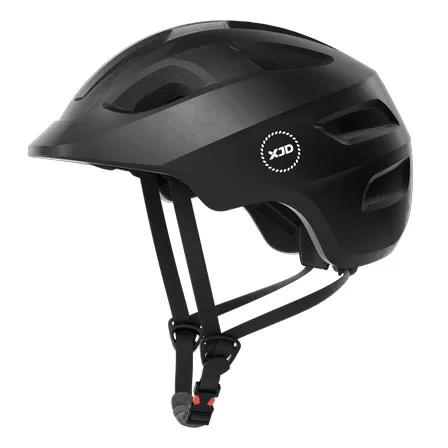
Kids Multi-Sport Bike Helmet by XJD – Black
7 reviews
The XJD Kids Multi-Sport Bike Helmet in Black is a lightweight, adjustable helme…$59.99
$49 -

Kids Bike Helmet by XJD for Girls – Pink
The XJD Kids Bike Helmet in Pink is a lightweight multi-sport helmet for girls r…$59.99
$99 -

Blue XJD Kids Bike Helmet for Boys & Girls
The Blue XJD Kids Bike Helmet is a lightweight, adjustable multi-sport helmet fo…$59.99
$99