

Can child ride bike without bike seat
No—a child should not ride a conventional bicycle with the rider’s seat removed. If “without a bike seat” means without a passenger seat on an adult’s bike, the child may ride a correctly fitted bicycle independently, but should not be carried unsecured.
First identify which seat you mean
The rider’s seat, or saddle, is part of the bicycle’s intended riding position. Removing it changes the child’s support, control and ability to start and stop. A child who is not ready to use the saddle confidently needs a more suitable learning setup, not an ordinary bicycle with a missing component.
A child passenger seat is different. A child does not need one when riding an appropriately sized bicycle independently. However, carrying a child on another bicycle requires a purpose-designed child-carrying system that is compatible with that bicycle and child. Check its exact manual, applicable local rules and load limits; if compatibility is uncertain, ask a qualified bicycle mechanic.
Measure the child before choosing a bicycle
Measure the child’s standing height without shoes. Measure inseam from the floor to the crotch while the child stands upright with feet slightly apart. Record both measurements rather than relying on age or clothing size.
Then have the child try the assembled bicycle. Compare the inseam with the bicycle’s stand-over height and confirm that the child can straddle the frame without uncomfortable contact. Check that the child can reach the handlebar without stretching, steer through turns, operate the brakes, mount and stop under control, and use the saddle in its permitted adjustment range.
The American Academy of Pediatrics advises trying the bicycle rather than buying an oversized model for future growth. If the child cannot control the bicycle now, a larger wheel is not an acceptable substitute for correct current fit.
Use wheel size only as a starting point
| Wheel size | XBikes starting range |
|---|---|
| 12 Inch | Ages 3–4; 34–40 in / 86–102 cm |
| 14 Inch | Ages 3–6; 37–45 in / 94–114 cm |
| 16 Inch | Ages 4–7; 40–48 in / 102–122 cm |
| 18 Inch | Ages 5–9; 43–52 in / 109–132 cm |
| 20 Inch | Ages 7–12; 48–60 in / 122–152 cm |
| 24 Inch | Ages 10–14; 54–64 in / 137–163 cm |
| 26 Inch | Youth and adults over 60 in / 153 cm |
These overlapping ranges are screening points, not guarantees. Prioritize measured height, inseam, reach, brake control and current confidence. Where two sizes overlap, have the child try both; choose only a bicycle the child can control without stretching or relying on an unsafe saddle position.
How the supplied bikes help with this decision
The supplied catalog options are relevant because they provide several wheel sizes for an individual fit comparison, and all are categorized as Training Wheel Bikes. Training wheels do not make a poor fit acceptable, and the catalog facts do not establish whether they should be fitted, adjusted or removed for a particular child. Follow the exact product manual or consult a qualified bicycle mechanic.
Pink Girls' 12/14/16" Bike by XJD – Basket & Doll Seat is offered in 12 Inch, 14 Inch and 16 Inch labels. Its title specifies a doll seat; that is not evidence of a child-passenger seat and should not be treated as one. Light Pink XJD Girls' Bicycle with Basket & Training Wheels offers 12 Inch, 14 Inch, 16 Inch and 20 Inch labels, providing the broadest supplied size comparison. Blue XJD Girls Bike with Training Wheels – 12/14/16 Inch offers 12 Inch, 14 Inch and 16 Inch labels. No supplied facts establish dimensions beyond those wheel-size labels, so an actual fit check remains necessary.
 Pink Girls' 12/14/16" Bike by XJD – Basket & Doll Seat
Available in 12 Inch, 14 Inch and 16 Inch labels for fit comparison. The catalog title names a doll seat, which should not be interpreted as a child-passenger seat.
 Light Pink XJD Girls' Bicycle with Basket & Training Wheels
A Training Wheel Bike offered in 12 Inch, 14 Inch, 16 Inch and 20 Inch labels, making it relevant when comparing supplied wheel-size starting points against the child's measurements.
 Blue XJD Girls Bike with Training Wheels – 12/14/16 Inch
A Training Wheel Bike available in 12 Inch, 14 Inch and 16 Inch labels. Use measured height, inseam, reach, brake control and an individual trial to select among them.
Check control and protective equipment
- Confirm the rider’s seat is present, secure and adjusted only as the product manual permits.
- Have the child demonstrate controlled starts, steering, braking and stops in a traffic-free area under close adult supervision.
- Use a properly fitting bicycle helmet. The U.S. Consumer Product Safety Commission advises that it sit level and that its straps be used according to the helmet manufacturer’s instructions.
- Do not improvise a saddle, passenger perch or attachment. For missing parts, assembly, compatibility, torque or load limits, use the exact manual or a qualified bicycle mechanic.
What to do next
If the saddle is missing or cannot be adjusted to a controlled riding position, do not let the child ride that bicycle. Measure height and inseam, shortlist the matching wheel-size starting points, and conduct an in-person stand-over, reach and brake-control check. If the question concerns carrying the child, use a verified compatible child-carrying system—not a doll seat, basket, frame or unsecured position.
Bikes for your next adventure
-

Pink 12/14/16/20" XJD Girls Bike with Training Wheels & Basket
The Pink XJD Girls Bike with Training Wheels & Basket is a first-bike pick f…$65.99
$75.99 -
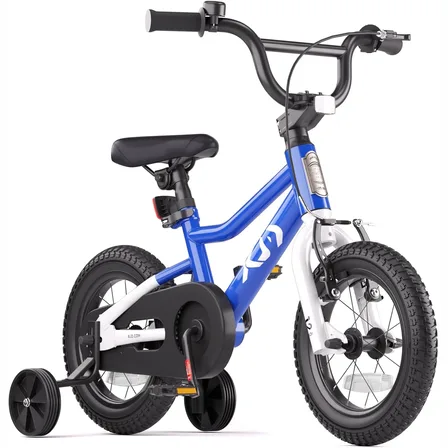
XJD Boys & Girls BMX Bike with Training Wheels, 12/14/16" – Blue
The XJD Boys & Girls BMX Bike in Blue is a first pedal bike for kids roughly age…$99.99
$119.99 -

Blue XJD Girls Bike with Training Wheels – 12/14/16 Inch
If you're shopping for a first pedal bike for a daughter roughly 3 to 8 years ol…$149
$169