

Can i put 14 wheels on a 16 kids bike
Usually, no: do not put 14-inch wheels on a 16-inch kids’ bike unless the exact bike manufacturer’s manual explicitly approves that conversion. Smaller wheels can alter brake alignment, pedal clearance, handling and the bike’s intended geometry. A purpose-built 14-inch bike is the better option when a properly fitted 16-inch bike is too large.
Why a 14-inch wheel swap is not a simple size change
The wheel-size label describes more than the wheel alone. A 16-inch frame, fork, brakes and other components are designed around a particular wheel and tyre combination. Installing smaller wheels lowers the bicycle and can change how it steers and balances.
The brakes are a critical compatibility point. Their pads or braking surfaces must align exactly as the bicycle was designed to use them. Smaller wheels may put those surfaces in the wrong place. Pedals can also sit closer to the ground, increasing the chance of a pedal touching down during a turn.
Do not try to solve those issues by improvising adapters or repositioning parts beyond what the exact product manual permits. Compatibility, assembly and torque requirements must come from that manual; if they are unavailable or unclear, ask a qualified bicycle mechanic to inspect the complete bike.
First check whether the 16-inch bike actually fits
Before changing anything, measure the child’s standing height and inseam without shoes. Then have the child try the assembled bicycle in a controlled area. Age is only a starting point: leg clearance, reach, brake operation and confidence determine whether the fit works.
| Wheel size | XBikes age starting point | XBikes rider-height starting point |
|---|---|---|
| 14 Inch | Ages 3–6 | 37–45 in / 94–114 cm |
| 16 Inch | Ages 4–7 | 40–48 in / 102–122 cm |
These ranges overlap, so height alone does not settle the choice. On the actual bike, check that the child can stand over it with comfortable clearance, reach the handlebars without stretching, turn them while remaining balanced, and operate the brakes confidently. The child also needs to start, stop and put a foot down without losing control.
If the 16-inch bicycle fails those checks, do not keep it in use simply because the child may grow into it. Guidance from the American Academy of Pediatrics emphasizes trying the bike, avoiding an oversized bicycle bought for growth, and checking stand-over clearance, control and brake reach.
What to compare before choosing 14 or 16 inches
- Measure the rider: record current standing height and inseam rather than relying on age.
- Try both complete sizes: compare purpose-built 14-inch and 16-inch bicycles if possible, with the seat adjusted only as their manuals permit.
- Check control: observe stand-over clearance, handlebar reach, turning, brake reach, starting, stopping and putting a foot down.
- Choose the complete bike that fits now: do not treat smaller replacement wheels as equivalent to a correctly designed smaller bicycle.
How the supplied XBikes options help
The supplied catalog choices help because each is offered in separate 14 Inch and 16 Inch SKU labels. That lets you compare complete, purpose-sized options instead of assuming that a 14-inch wheel converts a 16-inch bicycle into the same thing as a 14-inch model.
 XJD Boys 12/14/16" Training Wheel Bike – Blue
Offered with separate 14 Inch and 16 Inch SKU labels, this Training Wheel Bike provides a relevant complete-bike size comparison rather than evidence that wheels are interchangeable.
 Black XJD Kids Bike for Boys – 12, 14 & 16 Inch Sizes
This Training Wheel Bike is available under both 14 Inch and 16 Inch SKU labels, making it useful for comparing purpose-sized bicycles after measuring and checking the rider’s fit.
 XJD Kids' Training Wheel Bike for Boys & Girls, 12/14/16 Inch – White
Its supplied 14 Inch and 16 Inch SKU labels make this Training Wheel Bike relevant when choosing a complete fitted size; they do not establish wheel-conversion compatibility.
The XJD Boys 12/14/16" Training Wheel Bike – Blue, Black XJD Kids Bike for Boys – 12, 14 & 16 Inch Sizes, and XJD Kids' Training Wheel Bike for Boys & Girls, 12/14/16 Inch – White are all cataloged as Training Wheel Bikes with 12 Inch, 14 Inch and 16 Inch size labels. Their relevance here is the direct 14-versus-16 size comparison.
Those labels do not establish interchangeability between their wheels or between different bicycles. They also do not replace an individual fit check. Select the relevant complete size first, then consult that exact model’s manual for assembly, maintenance, component compatibility, load limits and torque information.
When a wheel change may be considered
Proceed only if the manufacturer’s documentation for the exact 16-inch bicycle explicitly identifies a compatible 14-inch wheel setup and gives all required component and assembly instructions. Every affected part—including wheels, tyres, brakes, fork and frame clearances—must match that approved configuration.
If the manual does not clearly authorize it, treat the conversion as unsupported. A mechanic can check the bicycle, but should not replace missing manufacturer compatibility information with guesswork. If the child fits a 14-inch model and not a 16-inch one, choose a complete 14-inch bicycle rather than modifying the larger bike.
Make the title-specific decision
Measure the child, test stand-over, reach, braking and confidence, and compare complete 14-inch and 16-inch bikes. Keep the 16-inch wheels unless its exact manual expressly permits 14-inch wheels; otherwise, move to a purpose-built 14-inch model. For every ride, use a properly fitting bicycle helmet that sits level and has its straps adjusted according to the helmet manufacturer’s instructions.
Bikes for your next adventure
-

Kids Bike Helmet by XJD for Boys & Girls – Black, Blue, Green, Pink, Purple
The XJD Kids Bike Helmet covers a wide 2-to-8-year age range thanks to two head-…$59.99
-
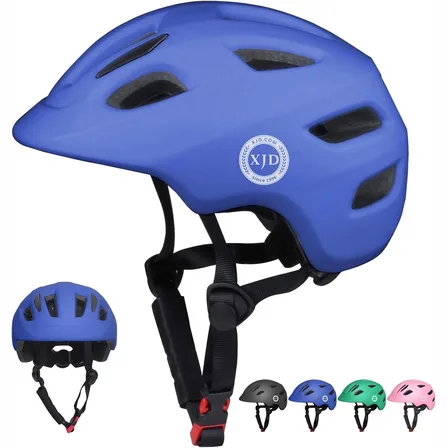
Blue XJD Kids' Bike Helmet, Adjustable Fit – Sizes XS & S
The Blue XJD Kids' Bike Helmet is a lightweight, adjustable helmet for toddlers …$20.39
-

Kids Bike Helmet by XJD for Girls – Pink
The XJD Kids Bike Helmet in Pink is a lightweight multi-sport helmet for girls r…$59.99
$99