

Do child bike seats fit all bikes
No. Child bike seats do not fit all bikes. Compatibility depends on the seat’s mounting system, the bicycle’s frame or rack, available clearance, and both manufacturers’ limits.
Why a child seat may not fit
A child bike seat normally attaches to the bicycle frame, a compatible rear rack, or the handlebar or steering area. Each design needs specific mounting points and clear space. A bicycle can look suitable yet still be incompatible because of its frame shape, cable routing, moving parts, wheel clearance, or rack construction.
Do not assume that a rear rack automatically accepts a child seat. The rack and seat must be approved for use together, and every stated load and compatibility requirement must be satisfied. If the documentation is missing or ambiguous, ask the seat manufacturer or a qualified bicycle mechanic before carrying a child.
What to measure and inspect
Identify the exact bicycle model and seat model first, then compare their manuals. With the bicycle standing securely, check:
- Mounting location: Find the precise frame tube, rack, handlebar, or steering-area attachment required by the seat.
- Tube or rack dimensions: Measure the relevant parts exactly where the mount will sit, then compare those measurements with the seat manual.
- Clearance: Confirm that the seat, mounting bracket, child’s legs, and foot supports will remain clear of the tire, spokes, brakes, cables, pedals, suspension, and steering throughout their movement.
- Rack compatibility: For a rack-mounted seat, verify the rack type and its permitted use in both manuals. A rack’s presence alone proves nothing.
- Load limits: Compare the child’s current weight and the seat’s weight with every applicable limit for the seat, mount, rack, and bicycle. Follow the lowest relevant limit.
- Rider space: Make sure the adult can mount, pedal, steer, brake, and put a foot down without interference.
Use the exact product instructions for assembly, fastener placement, maintenance, load limits, and torque. Those details vary; guessing or copying settings from another model is not appropriate.
Make a compatibility decision
- Locate the bicycle, rack if present, and child-seat manuals.
- Match the seat’s required mount to the bicycle’s actual mounting area.
- Compare your measurements and all stated restrictions.
- Check clearance through steering, pedaling, braking, and any suspension movement.
- If every requirement matches, install and inspect the seat exactly as directed. If one requirement fails—or cannot be verified—do not use that seat on that bicycle.
A qualified bicycle mechanic can inspect the physical fit, but the manuals remain decisive. A homemade adapter, an unapproved rack, or a mount that is merely “close enough” does not establish compatibility.
Where the supplied XBikes products are relevant
The supplied catalog items are children’s bicycles, not child passenger seats, so their wheel sizes do not show whether a separate seat fits an adult bicycle. They are relevant only as comparison points when deciding whether a child may be ready for an individually fitted bike instead of riding in a passenger seat.
The three catalog options below help answer the title by separating two decisions: passenger-seat compatibility must be checked against the host bicycle and seat manuals, while an independent child’s bicycle must be selected by rider fit and control.
 XJD Boys & Girls BMX Bike with Training Wheels, 12/14/16" – Blue
A children’s BMX bicycle offered in 12 Inch, 14 Inch, and 16 Inch labels. It is relevant as an independent-riding comparison, not as evidence that a passenger seat fits another bicycle.
 XJD Pink Beach Cruiser for Girls – Rear Rack & V-Brake
Offered in 20 Inch, 24 Inch, and 26 Inch labels. Its title mentions a rear rack, but the supplied facts do not establish that the rack accepts a child passenger seat.
 Girls' Training Wheel Bike by XJD with Basket – Purple
A training-wheel bicycle offered in 14 Inch, 16 Inch, and 20 Inch labels. Consider it only when assessing an independently riding child’s individual fit; it does not answer host-bike seat compatibility.
The XJD Boys & Girls BMX Bike with Training Wheels, 12/14/16" – Blue is offered in 12 Inch, 14 Inch, and 16 Inch labels. The Girls' Training Wheel Bike by XJD with Basket – Purple is offered in 14 Inch, 16 Inch, and 20 Inch labels. These are independent children’s-bike choices, not evidence of passenger-seat compatibility.
The XJD Pink Beach Cruiser for Girls – Rear Rack & V-Brake is offered in 20 Inch, 24 Inch, and 26 Inch labels. Although its title states “Rear Rack,” the supplied catalog facts do not say that the rack accepts a child seat or identify a load limit. Do not treat that feature as compatibility approval.
If considering a child’s own bicycle
XBikes uses these wheel-size starting points: 12 Inch for 34–40 in / 86–102 cm; 14 Inch for 37–45 in / 94–114 cm; 16 Inch for 40–48 in / 102–122 cm; 20 Inch for 48–60 in / 122–152 cm; 24 Inch for 54–64 in / 137–163 cm; and 26 Inch for youth and adults over 60 in / 153 cm.
These ranges are starting points, not proof of fit. Measure the child’s height and inseam, have the child try the bicycle, and check stand-over clearance, reach, brake control, and current confidence. Do not buy an oversized bicycle solely for growth. Any age wording in a product name is only a catalog label, not fit evidence.
Before the first ride
Whether the child rides as a passenger or independently, use a bicycle helmet that fits properly, sits level, and has straps adjusted according to its manufacturer’s instructions. Recheck the seat mount as its manual directs and stop using it if anything loosens, interferes with moving parts, or no longer meets a limit.
The decision is simple: use a child bike seat only when the exact seat, mount, rack if applicable, and host bicycle are explicitly compatible. Otherwise, choose another approved seat-and-bike combination—or assess an independent children’s bike by the child’s measured fit.
Bikes for your next adventure
-

XJD Pink Beach Cruiser for Girls – Rear Rack & V-Brake
The XJD Pink Beach Cruiser for girls is the step-up bike for riders who've outgr…$179.99
$209.99 -
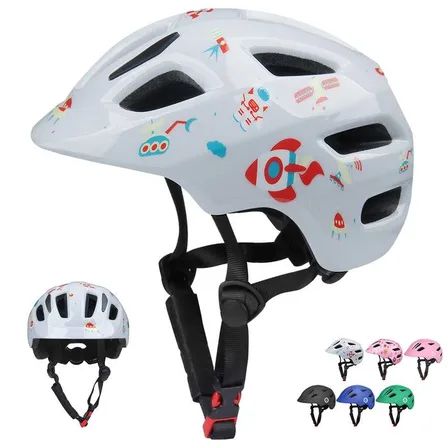
White Astronaut Bike Helmet for Kids by XJD – Toddler to Youth Sizes
4 reviews
The XJD White Astronaut kids' bike helmet is made for toddlers through younger e…$59.99
-

XJD Girls BMX Bike 12/14/16 Inch with Training Wheels – Pink Blue
The XJD Girls BMX Bike in Pink/Blue is built as a first pedal bike for kids roug…$99.99
$119.99