

Do little universal kids front facing bike seat
A little universal kids front-facing bike seat is not automatically universal: confirm the seat, bicycle, child, and rider all meet the manufacturer’s compatibility and fit requirements before buying or riding.
What “universal” should mean in practice
Treat “universal” as a catalog description, not proof that a seat fits every bicycle. Front-facing child seats can differ in where and how they attach, what bicycle shapes they accept, and how much room they require around the adult rider.
Find the exact seat manual and compare its compatibility instructions with the bicycle manufacturer’s guidance. Confirm that the bicycle’s frame, steering area, cables, controls, and other components are permitted to work with that mounting system. If either manual is missing or unclear, ask the seat manufacturer or a qualified bicycle mechanic rather than improvising an attachment.
Measure before choosing a seat
Record the bicycle’s make, model, and size, then measure only the points identified in the prospective seat’s manual. Depending on its design, that may include the relevant tube dimensions, available mounting space, and clearances around the handlebar, stem, cables, knees, and pedals. Do not assume that a visually similar bicycle has identical dimensions.
- Mounting area: Check that the designated attachment point exists, is unobstructed, and is approved by both manufacturers.
- Adult clearance: Make sure the seat will not prevent comfortable steering, pedalling, mounting, or dismounting.
- Child fit: Compare the child’s current measurements with every fit and load requirement in the exact seat manual.
- Control check: With the bicycle stationary, verify that the adult can fully operate the handlebar, brakes, and other controls without interference.
Never invent a spacer, fastening method, torque setting, or load limit. Use only the supplied hardware and the instructions for that exact model. Have uncertain installation or compatibility checked by a qualified bicycle mechanic.
Compare the child, bicycle, and riding position
A seat can attach to a bicycle yet still be unsuitable for the intended rider combination. The child must fit the restraint and support system exactly as its manual describes. The adult must remain able to balance the bicycle, see ahead, turn freely, brake confidently, and place themselves securely when stopping.
Before carrying a child, complete the manufacturer’s installation checks and test bicycle control without the child in a quiet, traffic-free setting. Stop if the mount shifts, steering is restricted, cables are pinched, the adult’s knees contact the seat, or the bicycle no longer feels controllable. Follow the manuals for inspection frequency, maintenance, permitted use, and replacement of worn or damaged parts.
Helmet and pre-ride checks
Use a bicycle helmet that fits the child properly, sits level, and has its straps adjusted according to the helmet manufacturer’s instructions. The adult rider should also use suitable protective equipment and follow applicable local riding rules.
Before every ride, check the seat and mount as directed by the product manual. Confirm that restraints and supports are correctly positioned, clothing or loose items cannot reach moving parts, and nothing interferes with steering, pedalling, or braking. Do not ride when any required component is loose, damaged, missing, or incorrectly fitted.
Are the supplied XBikes products relevant?
Purple XJD Girls' Bike with Doll Seat & Basket and Pink Girls' 12/14/16" Bike by XJD – Basket & Doll Seat are Training Wheel Bikes offered in 12 Inch, 14 Inch, and 16 Inch variants. They do not establish compatibility for a child passenger seat and should not be mistaken for front-facing seat products. They are relevant only as own-bike comparison options if the child is ready to ride independently; their doll seats are not evidence of a child-carrying function.
 Purple XJD Girls' Bike with Doll Seat & Basket
A Training Wheel Bike available in 12 Inch, 14 Inch, and 16 Inch variants. It is relevant as an own-bike fit comparison, not as a front-facing child passenger seat.
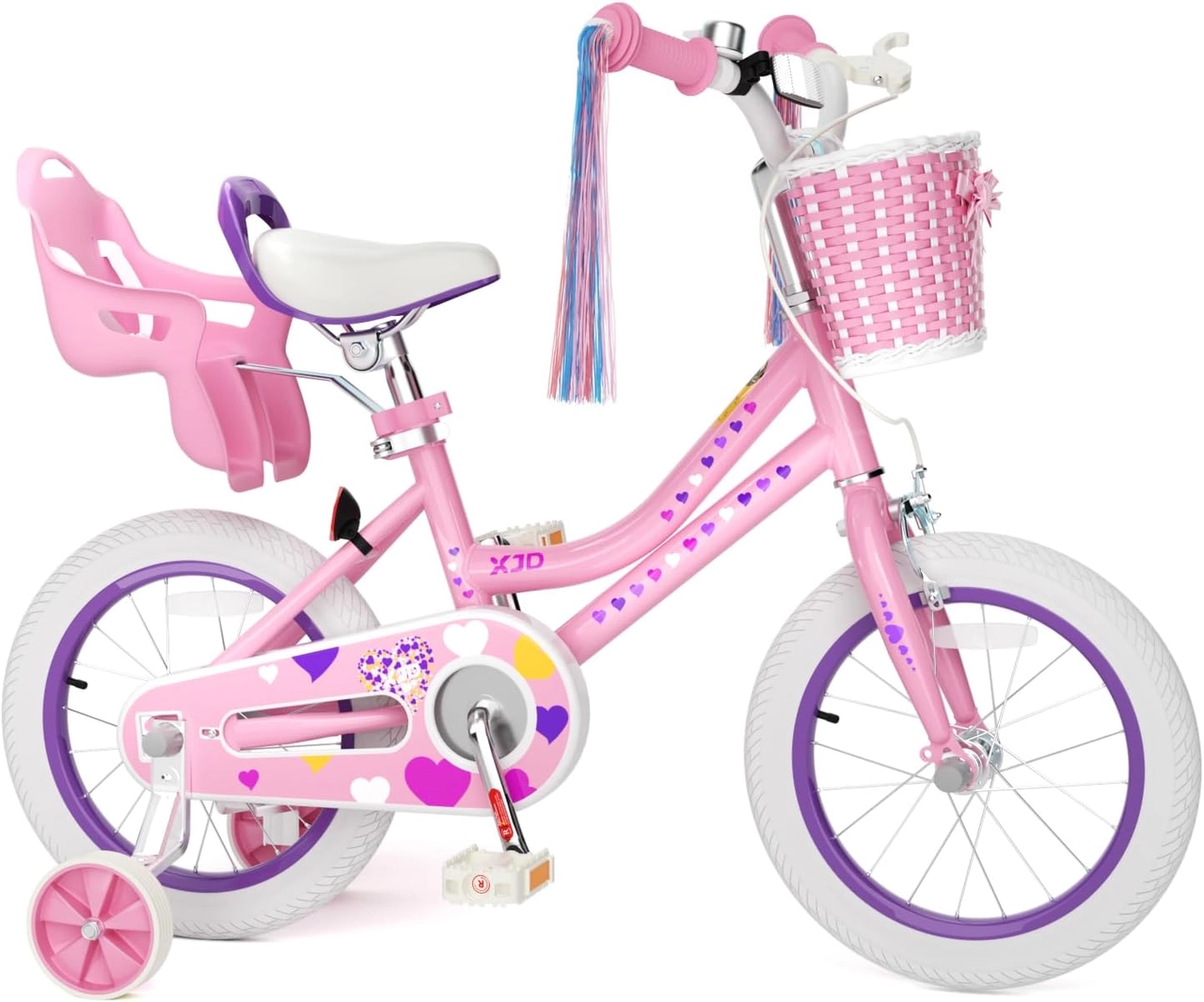 Pink Girls' 12/14/16" Bike by XJD – Basket & Doll Seat
Offered as a Training Wheel Bike in 12 Inch, 14 Inch, and 16 Inch variants. Its basket and doll seat do not establish any child-passenger-seat compatibility.
If an own bike is the real next step
For either supplied bicycle, use measured height as the starting point: 12 Inch corresponds to 34–40 in / 86–102 cm, 14 Inch to 37–45 in / 94–114 cm, and 16 Inch to 40–48 in / 102–122 cm. The associated starting ages are 3–4, 3–6, and 4–7 respectively, but age alone does not determine fit.
Have the child try the bicycle. Check stand-over clearance, reach, brake control, and current confidence, and do not choose an oversized bicycle merely to allow room for growth. Because both catalog options offer the same three wheel-size labels, the supplied facts support comparison by color and the exact catalog description—not by unlisted equipment, materials, price, or performance.
Your next decision
If you need to carry a child facing forward, shortlist only seats whose exact manuals approve both the child’s measurements and your specific bicycle, then verify the installation and adult control. If the child is instead ready for an individual bicycle, measure height and arrange a hands-on fit check before selecting a 12, 14, or 16 Inch XBikes option.
Bikes for your next adventure
-

Kids Bike Helmet by XJD for Boys & Girls – Black, Blue, Green, Pink, Purple
The XJD Kids Bike Helmet covers a wide 2-to-8-year age range thanks to two head-…$59.99
-

Kids Bike Helmet by XJD for Girls – Pink
The XJD Kids Bike Helmet in Pink is a lightweight multi-sport helmet for girls r…$59.99
$99 -

XJD Kids Bike for Girls – Pink, 12/14/16/20 Inch with Training Wheels
The XJD Kids Bike for Girls in Pink is a training-wheel bike built to carry your…$139
$159