

How big bike for a 5 year old
For most 5-year-olds, start by comparing 14 Inch, 16 Inch and 18 Inch bikes. Choose by measured height and fit—not age—and never size up just for growth.
Which wheel size should you check first?
A child’s fifth birthday does not identify one correct bike size. Under the XBikes starting points, three sizes overlap this age:
| Wheel size | XBikes starting range | When to consider it |
|---|---|---|
| 14 Inch | Ages 3–6; 37–45 in / 94–114 cm | Compare it when the rider falls within this height range. |
| 16 Inch | Ages 4–7; 40–48 in / 102–122 cm | Often the next comparison when the child is at least 40 in / 102 cm tall. |
| 18 Inch | Ages 5–9; 43–52 in / 109–132 cm | Consider it only when the child’s height and hands-on fit support it. |
A shorter 5-year-old may fit a 14 Inch bike, while a taller child may need a 16 Inch or 18 Inch model. Where ranges overlap, the better choice is the bike the child can comfortably stand over, reach, steer and stop.
Measure before comparing bikes
Measure the child’s standing height without relying on an old growth record. Then measure inseam from the floor to the crotch while the child stands upright. Use those measurements to narrow the wheel sizes, but do not treat the chart as a complete fit test.
Take the child to try the actual bicycle whenever possible. Clothing and footwear should allow a natural riding position. Frame shape, saddle position and handlebar reach can differ even among bicycles with the same wheel-size label.
What a correct fit should look like
Ask the child to stand over the bicycle and confirm that the frame does not prevent a comfortable, controlled stance. Seated, the child should be able to reach the handlebars without an exaggerated stretch or cramped posture.
Next, check the controls. The child must be able to reach and operate the brakes provided on the bicycle with confidence. Have them demonstrate starting, steering, stopping and getting off in a controlled setting. If they cannot manage those actions, the bicycle is not a suitable fit merely because its wheel size matches the chart.
Current confidence matters too. Two children of identical height may need different setups because one is still learning balance or control. Do not buy an oversized bicycle for future growth; immediate control is more important than extending the time before the next size.
How the supplied XBikes options compare
The supplied catalog options are relevant because each offers sizes that overlap common starting points for a 5-year-old, and each is categorized as a training-wheel bike. They let you compare 14 Inch and 16 Inch choices after measuring the rider; one also lists 12 Inch and 20 Inch variants, which should be judged against the same fit rules.
 Light Pink XJD Girls' Bicycle with Basket & Training Wheels
Available in 12 Inch, 14 Inch, 16 Inch and 20 Inch labels. Its 14 Inch and 16 Inch options directly overlap XBikes starting ranges for age five, but measured fit must decide.
 Blue XJD Girls Bike with Training Wheels – 12/14/16 Inch
This training-wheel bike has 12 Inch, 14 Inch and 16 Inch labels. For a 5-year-old, compare its 14 Inch and 16 Inch options using height and a hands-on fit check.
 XJD Boys 12/14/16" Training Wheel Bike – Blue
Offered with 12 Inch, 14 Inch and 16 Inch labels in the supplied catalog. The 14 Inch and 16 Inch versions may be relevant after checking the child’s measurements, reach and control.
- Light Pink XJD Girls' Bicycle with Basket & Training Wheels has 12 Inch, 14 Inch, 16 Inch and 20 Inch SKU labels. For this question, its 14 Inch and 16 Inch options are the most direct chart comparisons. Its 12 Inch or 20 Inch label should not override the rider’s measurements.
- Blue XJD Girls Bike with Training Wheels – 12/14/16 Inch has 12 Inch, 14 Inch and 16 Inch SKU labels. Compare the 14 Inch and 16 Inch versions according to height, inseam, reach, brake control and confidence.
- XJD Boys 12/14/16" Training Wheel Bike – Blue likewise has 12 Inch, 14 Inch and 16 Inch SKU labels. The numbers in its title describe catalog sizes; they do not prove which version fits an individual child.
None of the supplied products has an 18 Inch SKU label. If the child measures into the 18 Inch range and fits that size better in person, these particular options may not be relevant. A 20 Inch version is also not automatically appropriate: the XBikes starting point for 20 Inch is ages 7–12 and 48–60 in / 122–152 cm, followed by an individual fit check.
Do training wheels decide the size?
No. Training wheels describe the type of these catalog options, not permission to choose a frame the child cannot control. First select a bicycle that fits the rider; then decide whether training wheels suit the child’s present balance and confidence.
For correct assembly, adjustment, maintenance, compatibility, load limits and torque requirements, follow the exact product manual or use a qualified bicycle mechanic. Do not improvise settings that the supplied catalog information does not specify.
Complete the safety check
Before riding, provide a properly fitting bicycle helmet. It should sit level and its straps should be used according to the helmet manufacturer’s instructions. Recheck bicycle fit after adjustments and as the child grows.
Begin practice in a controlled area away from traffic and hazards, with close adult supervision. Confirm that the child can start, steer, brake and dismount before moving to a more demanding place.
Your next decision
Measure height and inseam now, shortlist 14 Inch, 16 Inch or 18 Inch from the chart, and have the child try the shortlisted size. Choose only the bicycle they can stand over, reach, steer and stop confidently today—even if a larger one appears to offer more growing room.
Bikes for your next adventure
-

26-Inch XJD Beach Cruiser Bike for Girls – Purple, V-Brake
This XJD 26-inch purple beach cruiser is sized for big kids and teens — suggeste…$218.49
$229.99 -

Light Pink XJD Girls' Bicycle with Basket & Training Wheels
The Light Pink XJD Girls' Bicycle with Basket & Training Wheels is a retro-style…$109.99
$129.99 -
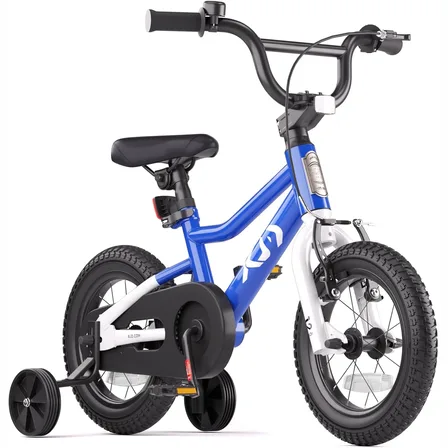
XJD Boys & Girls BMX Bike with Training Wheels, 12/14/16" – Blue
The XJD Boys & Girls BMX Bike in Blue is a first pedal bike for kids roughly age…$99.99
$119.99