

How big is a 16 in bike
A 16-inch bike has 16-inch wheels; it is not 16 inches tall. XBikes uses this size as a starting point for riders 40–48 in (102–122 cm) tall, usually ages 4–7, but the child must still try the bike for fit and control.
What “16-inch bike” actually measures
The 16-inch label refers to the approximate wheel diameter, not the frame height, seat height or total length. Two bicycles with the same wheel label can therefore feel different because their frame shape, saddle position, handlebars and controls may place the rider differently.
That also means measuring a bicycle from the floor to the saddle will not confirm its wheel size. Check the size marking supplied with the bicycle or in its exact product information, then evaluate whether the complete bike fits the child.
Who is a 16-inch bike likely to fit?
For XBikes, the useful starting range is:
| Wheel size | Typical age | Rider height |
|---|---|---|
| 14 Inch | 3–6 | 37–45 in / 94–114 cm |
| 16 Inch | 4–7 | 40–48 in / 102–122 cm |
| 20 Inch | 7–12 | 48–60 in / 122–152 cm |
Age is only a rough reference. Measure the rider’s current standing height and compare it with the height range first. Children of the same age can have different leg lengths, arm lengths and confidence, so the final decision must come from an individual fit check.
What to measure and check
Measure height without shoes, with the child standing straight against a wall. Then measure inseam from the floor to the crotch using the footwear the child will normally wear while riding. The inseam helps you assess clearance over the bicycle and whether the child can reach the ground appropriately when seated.
Have the child try the exact bicycle and check these points:
- Stand-over: the child can straddle the bike without the frame pressing into the body.
- Starting and stopping: the child can get on, set off and stop without the bicycle overwhelming them.
- Reach: the handlebars are reachable without an extreme stretch or cramped posture.
- Brake control: the child can reach and operate the supplied braking controls confidently.
- Steering: the child can turn the bars while remaining balanced and in control.
The American Academy of Pediatrics advises having the child try the bicycle, checking stand-over and control, and avoiding an oversized bike bought merely for future growth. If the rider cannot manage the bike now, expected growth does not make it a suitable current fit.
How the supplied 16-inch options compare
Both supplied catalog products include a 16 Inch SKU, so they are directly relevant examples rather than nearest-size substitutes. Their other size labels also make them useful when a measured child falls outside, or near an edge of, the 16-inch height starting range.
 Girls' Training Wheel Bike by XJD with Basket – Purple
This Training Wheel Bikes model has 14 Inch, 16 Inch and 20 Inch SKU labels, making its 16 Inch version directly relevant and its adjacent labels useful for size comparison after measuring and trying the bike.
 Flower Pink XJD Girls Bike with Doll Seat & Basket
This Training Wheel Bikes model is available in 12 Inch, 14 Inch and 16 Inch labels. Its 16 Inch SKU directly matches the requested wheel size, but individual height, inseam, reach and control still determine fit.
Girls' Training Wheel Bike by XJD with Basket – Purple is listed under Training Wheel Bikes and is offered in 14 Inch, 16 Inch and 20 Inch labels. Flower Pink XJD Girls Bike with Doll Seat & Basket is also listed under Training Wheel Bikes and is offered in 12 Inch, 14 Inch and 16 Inch labels.
Those catalog labels establish the available wheel-size choices only. They do not prove that either bicycle fits a particular rider, and the product titles do not supply fit evidence. Choose the size after measuring and trying the exact bike rather than choosing by color, accessories or age alone.
When a 16-inch bike is not the right size
Consider a different size if the rider is outside the 40–48 in (102–122 cm) starting range, but do not switch sizes from height alone. A rider near either boundary may need to compare adjacent sizes in person because inseam, reach and control can change the outcome.
A 14-inch bike starts at 37–45 in (94–114 cm), while a 20-inch bike starts at 48–60 in (122–152 cm). Overlapping or touching ranges are comparison prompts, not proof that sizes are interchangeable. The child should be able to handle the selected bicycle comfortably today.
Make the final decision
First measure the child’s height and inseam. If height is within the 16-inch starting range, arrange a trial of the exact 16-inch model and check stand-over, reach, steering, braking, starting and stopping. If any control is strained, compare the appropriate adjacent size instead of assuming an adjustment will solve it.
Before riding, use a properly fitting bicycle helmet that sits level, with straps secured according to the helmet manufacturer’s instructions, as advised by the U.S. Consumer Product Safety Commission. For assembly, adjustments, maintenance, compatibility, load limits or torque requirements, follow the exact bicycle manual or consult a qualified bicycle mechanic.
The practical answer is simple: treat “16 inch” as the wheel size, measure the rider against the 40–48 in range, and buy only if the child can confidently control that exact bicycle now.
Bikes for your next adventure
-

26-Inch XJD Beach Cruiser Bike for Girls – Purple, V-Brake
This XJD 26-inch purple beach cruiser is sized for big kids and teens — suggeste…$218.49
$229.99 -
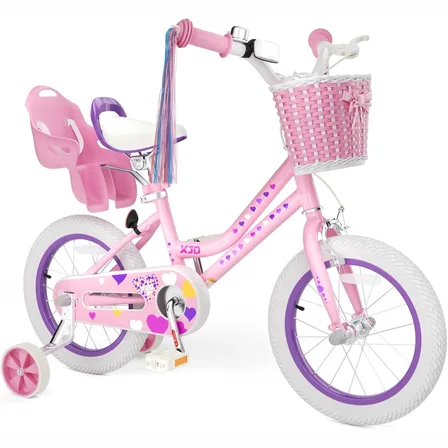
Light Pink XJD Girls' Bicycle with Basket & Training Wheels
The Light Pink XJD Girls' Bicycle with Basket & Training Wheels is a retro-style…$109.99
$129.99 -
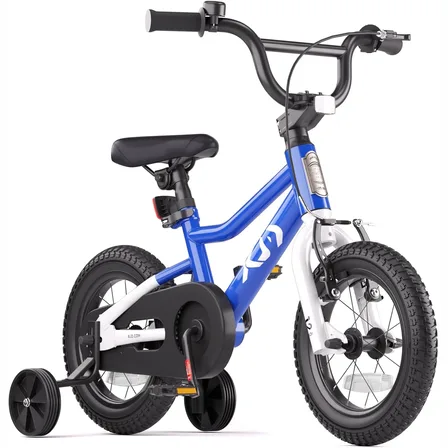
XJD Boys & Girls BMX Bike with Training Wheels, 12/14/16" – Blue
The XJD Boys & Girls BMX Bike in Blue is a first pedal bike for kids roughly age…$99.99
$119.99