

How big of a bike for 6 year old
For most 6-year-olds, start by comparing 14-, 16-, and 18-inch bikes. Measure the child’s height first: 14-inch fits 37–45 in, 16-inch fits 40–48 in, and 18-inch fits 43–52 in. Age alone cannot confirm the right size.
Choose the starting size by measured height
Use the child’s current height without shoes as the first filter. At age six, several wheel sizes overlap, so there is no single correct size for every rider.
| Wheel size | XBikes age starting point | Rider height |
|---|---|---|
| 14 Inch | Ages 3–6 | 37–45 in / 94–114 cm |
| 16 Inch | Ages 4–7 | 40–48 in / 102–122 cm |
| 18 Inch | Ages 5–9 | 43–52 in / 109–132 cm |
| 20 Inch | Ages 7–12 | 48–60 in / 122–152 cm |
A child under 40 in should begin with the 14-inch range. From 40 to 45 in, compare 14 and 16 inches in person. From 43 to 48 in, an 18-inch bike also enters the comparison. A 20-inch bike becomes a starting point at 48 in, but its age range begins at seven; it still requires a complete individual fit check.
Measure height and inseam before shopping
For height, have the child stand straight against a wall without shoes and measure from the floor to the top of the head. For inseam, place a book firmly between the legs to represent the saddle and measure vertically from the floor to the book’s top edge.
Compare height with the table, then use inseam during the actual stand-over and saddle checks. Wheel labels do not reveal the bike’s complete geometry, so two bikes with the same wheel size may not feel identical.
Check the child on the actual bicycle
The American Academy of Pediatrics advises having the child try the bicycle and avoiding an oversized bike bought merely for future growth. During the trial, check whether the child can:
- Stand over the bicycle comfortably rather than being forced onto tiptoes.
- Get on and off without struggling or losing balance.
- Reach the handlebar without stretching, locking the elbows, or crowding the knees.
- Turn the handlebar while remaining balanced and in control.
- Reach and operate the brakes confidently with their hands in a normal riding position.
- Start, stop, and place a foot down predictably.
If a larger candidate makes any of these actions difficult, choose the smaller properly fitting bike. Extra growing room does not compensate for poor control.
How confidence changes the decision
Measured height narrows the choices, but current riding ability settles an overlap. A new or cautious rider may handle a smaller fitting option more confidently. A practiced rider can compare the next overlapping size, but only if stand-over, reach, steering, braking, starting, and stopping remain controlled.
Training wheels do not make an oversized frame appropriate. They may support balance practice, but the child must still fit the bicycle and operate its controls. If the rider cannot comfortably reach the brakes or manage the bike while mounting and stopping, reject that size.
How the supplied XBikes options relate
XJD Girls' Bike with Training Wheels, 12/14/16/20 Inch – Purple and XJD Kids Bike for Girls – Pink, 12/14/16/20 Inch with Training Wheels both provide 12-, 14-, 16-, and 20-inch SKU labels. Their 14- and 16-inch versions are directly relevant comparison points for many six-year-olds. Their 20-inch versions are relevant only when the rider is at least 48 in tall and passes the individual fit checks. Neither product has a supplied 18-inch option, so these products cannot substitute for an 18-inch bike when that is the size that fits.
 XJD Girls' Bike with Training Wheels, 12/14/16/20 Inch – Purple
Available in 12-, 14-, 16-, and 20-inch labels with training wheels. Its 14- and 16-inch versions are useful fit comparisons for many six-year-olds; the 20-inch version starts at 48 inches of rider height and still requires a trial.
 XJD Kids Bike for Girls – Pink, 12/14/16/20 Inch with Training Wheels
This pink training-wheel bike has 12-, 14-, 16-, and 20-inch labels. Compare its 14- and 16-inch versions against the child’s measurements and control; it offers no supplied 18-inch option, and its 20-inch version is relevant from 48 inches tall.
The supplied facts do not establish brake type, materials, weight, load limits, assembly details, or compatibility. Check the exact product manual for those details, and use a qualified bicycle mechanic when assembly, adjustment, maintenance, or torque guidance is unclear.
Make the final size decision
- Measure the child’s height and inseam without shoes.
- Use height to shortlist 14, 16, or 18 inches; consider 20 inches only from 48 in.
- Have the child try each shortlisted bike and compare stand-over, reach, brake operation, mounting, steering, stopping, and confidence.
- Choose the size the child controls now, not a larger bike intended mainly for growth.
Before riding, add a properly fitting bicycle helmet. U.S. Consumer Product Safety Commission guidance says the helmet should sit level and its straps should be used according to the manufacturer’s instructions. For a six-year-old, the next step is simple: measure height today, shortlist only the matching wheel ranges, and let the child’s real fit and control decide.
Bikes for your next adventure
-

26-Inch XJD Beach Cruiser Bike for Girls – Purple, V-Brake
This XJD 26-inch purple beach cruiser is sized for big kids and teens — suggeste…$218.49
$229.99 -

Light Pink XJD Girls' Bicycle with Basket & Training Wheels
The Light Pink XJD Girls' Bicycle with Basket & Training Wheels is a retro-style…$109.99
$129.99 -
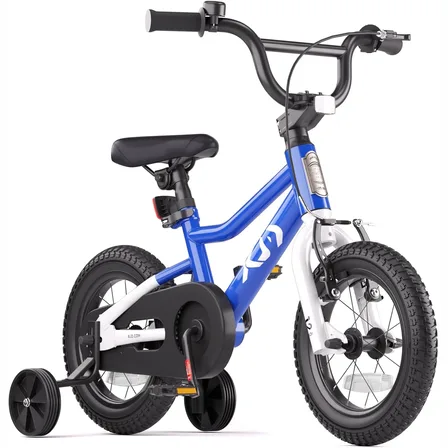
XJD Boys & Girls BMX Bike with Training Wheels, 12/14/16" – Blue
The XJD Boys & Girls BMX Bike in Blue is a first pedal bike for kids roughly age…$99.99
$119.99