

How many children die from bicycles each year
In the United States, about 90 children under 18 died in non-powered bicycle-riding incidents per year, based on 180 deaths reported for 2022–2023.
What that number means
The U.S. Consumer Product Safety Commission recorded 14 deaths among children younger than 5 and 166 among ages 5–17 across those two years. Dividing the combined 180 deaths by two gives an annual average of 90.
This is not a worldwide total, and it should not be treated as an unchanging prediction for every year. Definitions also matter: these figures cover reported U.S. fatalities associated with riding non-powered bicycles. They do not mean that a particular bicycle caused a death or reveal an individual child’s risk.
The same report found that motor-vehicle collisions were associated with 71% of bicycle-riding fatalities across all ages. For a parent, the practical response is to examine the rider, bicycle and riding environment together—not to judge safety from wheel size or product category alone.
Measure before choosing a bicycle
Measure the child’s standing height and inseam without shoes. Then have the child try the bicycle. Check that there is suitable stand-over clearance, the child can reach the handlebar without stretching, and the controls can be operated while maintaining a stable grip. Brake reach and control must be checked on the actual bicycle.
Use these XBikes ranges only as starting points:
| Wheel size | Age starting point | Rider height |
|---|---|---|
| 12 Inch | 3–4 | 34–40 in / 86–102 cm |
| 14 Inch | 3–6 | 37–45 in / 94–114 cm |
| 16 Inch | 4–7 | 40–48 in / 102–122 cm |
| 18 Inch | 5–9 | 43–52 in / 109–132 cm |
| 20 Inch | 7–12 | 48–60 in / 122–152 cm |
| 24 Inch | 10–14 | 54–64 in / 137–163 cm |
| 26 Inch | Youth and adults | Over 60 in / 153 cm |
Height, inseam, reach, brake control and present confidence take priority over age. The American Academy of Pediatrics advises having the child try the bicycle and not buying an oversized model merely for future growth.
Compare control, not just wheel diameter
During a supervised fit check, ask whether the child can:
- mount and dismount without being caught by the frame;
- start, steer and stop without losing control;
- reach and operate the brakes comfortably;
- look ahead while maintaining a balanced riding position.
If any answer is no, do not assume the child will simply adapt. Compare a different size or configuration. Training wheels may support an early learning stage, but their presence does not prove correct fit or make traffic exposure appropriate.
Where the catalog options are relevant
These products provide concrete comparison points across 12-, 14-, 16-, 20-, 24- and 26-inch labels. They are relevant only after measurements narrow the range; none can establish safety from a catalog title alone.
 Pink 12/14/16/20" XJD Girls Bike with Training Wheels & Basket
Its 12-, 14-, 16- and 20-inch SKU labels provide comparison points for measured younger riders; training wheels do not replace an individual fit, reach, brake-control and confidence check.
 26-Inch XJD Beach Cruiser Bike for Girls – Purple, V-Brake
Its supplied 20-, 24- and 26-inch SKU labels make it relevant for comparing taller-rider sizes after height, inseam, reach and control are checked on the actual bicycle.
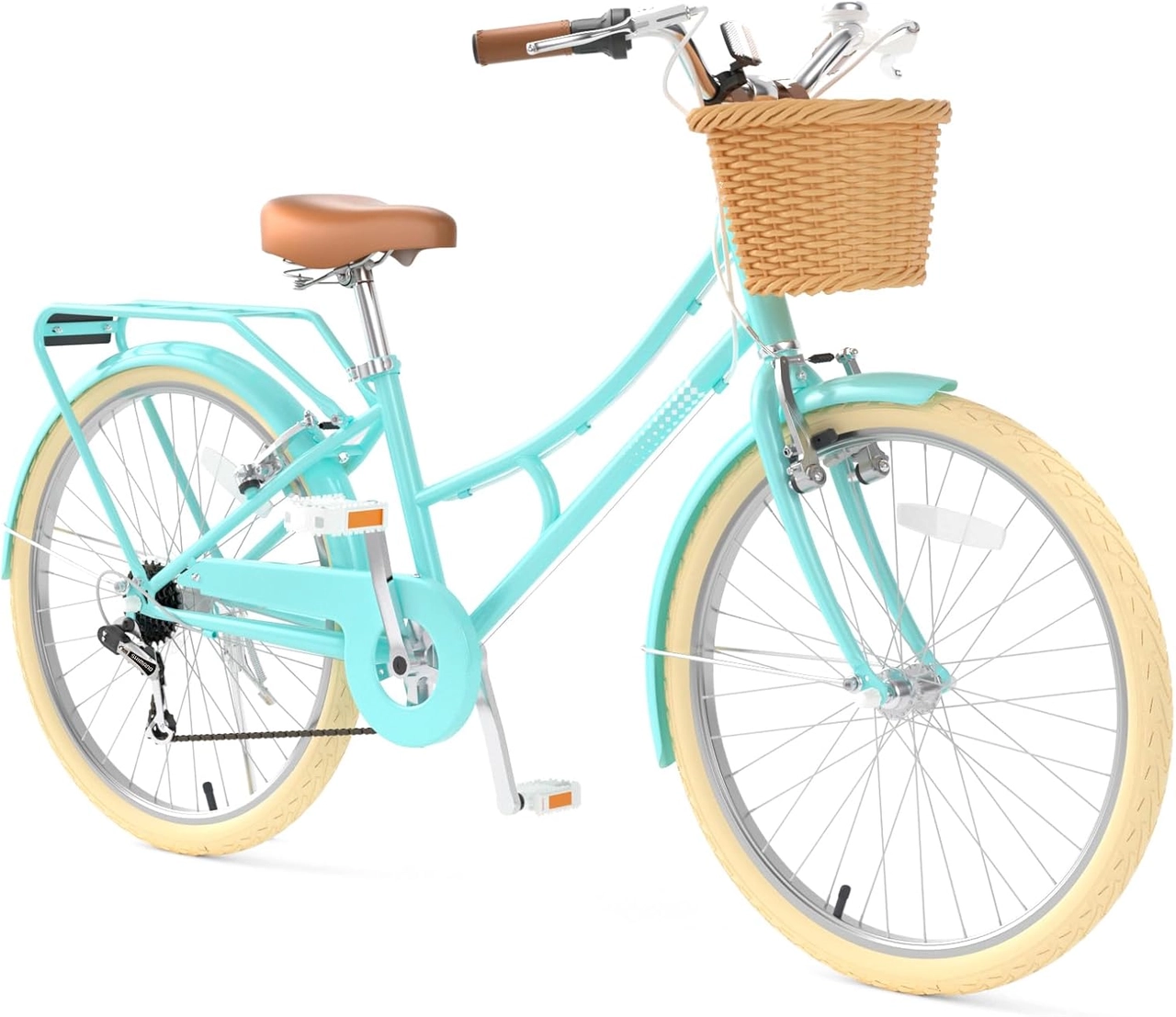 XJD 24-Inch Green Beach Cruiser Bike with U-Brake
Its 24- and 26-inch SKU labels are relevant to taller riders who meet the corresponding height starting points and can demonstrate suitable stand-over, reach and brake control.
The Pink 12/14/16/20" XJD Girls Bike with Training Wheels & Basket offers 12 Inch, 14 Inch, 16 Inch and 20 Inch SKU labels in the Training Wheel Bikes category. Compare only the size matching the child’s measurements and successful fit check.
The 26-Inch XJD Beach Cruiser Bike for Girls – Purple, V-Brake has 20-, 24- and 26-inch SKU labels in several supplied color combinations. The XJD 24-Inch Green Beach Cruiser Bike with U-Brake has 24- and 26-inch labels. These beach-cruiser options are comparison points for taller riders; a 26-inch label starts above 60 inches / 153 cm, while a 24-inch label starts at 54–64 inches / 137–163 cm. They are not substitutes for a smaller required size.
What to do before the next ride
- Complete the individual fit and control check rather than relying on age.
- Use a properly fitting bicycle helmet. It should sit level, with straps adjusted according to the helmet manufacturer’s instructions.
- Choose a riding setting appropriate to the child’s current control and confidence, with active adult supervision where needed.
- Check the bicycle before riding. For assembly, maintenance, compatibility or torque instructions, follow the exact product manual or use a qualified bicycle mechanic.
The title’s annual figure is about 90 U.S. children under 18, but the useful decision today is personal: measure the rider, verify complete control on the exact bicycle, fit the helmet correctly, and postpone the ride or choose another size if any check fails.
Bikes for your next adventure
-

Kids Bike Helmet by XJD for Boys & Girls – Black, Blue, Green, Pink, Purple
The XJD Kids Bike Helmet covers a wide 2-to-8-year age range thanks to two head-…$59.99
-

Kids Bike Helmet by XJD for Girls – Pink
The XJD Kids Bike Helmet in Pink is a lightweight multi-sport helmet for girls r…$59.99
$99 -

XJD Kids Bike for Girls – Pink, 12/14/16/20 Inch with Training Wheels
The XJD Kids Bike for Girls in Pink is a training-wheel bike built to carry your…$139
$159