

How many children killed on bicycles last year
In the United States, a finalized 2025 count is not yet available. The latest complete federal data show that 56 children age 14 or younger were killed as pedalcyclists in motor-vehicle traffic crashes during 2024.
What that number includes
The 56 deaths comprise 6 children younger than 5, 19 ages 5–9 and 31 ages 10–14. Federal reporting uses “pedalcyclist,” a category covering riders of pedal-powered cycles and, since 2022, certain motorized bicycles.
This is not a count of every child who died while riding a bicycle. The federal Fatality Analysis Reporting System covers crashes involving a motor vehicle on a public roadway. It does not provide a complete national count of fatal falls, driveway incidents or crashes away from public roads that involved no motor vehicle. Accordingly, the precise answer depends on the definition: 56 is the 2024 U.S. public-road motor-vehicle crash count for pedalcyclists age 14 or younger.
Because it is now 2026, “last year” literally means 2025. Until finalized 2025 records are released, 2024 is the latest complete year suitable for this comparison. Avoid treating an early estimate as a settled child-specific total.
What parents should do with the statistic
The total describes population-level harm; it cannot predict one child’s risk or identify an appropriate bicycle. Use it as a reason to make several concrete checks before every ride:
- Choose a riding area appropriate to the child’s present ability, with close supervision and separation from motor traffic where practical.
- Check that the child can start, steer, stop and look around without losing control.
- Use a bicycle helmet that fits properly, sits level and has straps adjusted according to its manufacturer’s instructions.
- Inspect the bicycle before riding. For maintenance procedures, fastener torque and assembly questions, follow the exact product manual or ask a qualified bicycle mechanic.
A helmet is important, but it does not replace a correctly fitting bicycle, active supervision, controlled practice or thoughtful route selection.
Measure fit instead of buying for growth
Measure the child’s standing height and inseam, then have the child try the actual bicycle. Check stand-over clearance, comfortable reach to the handlebar, reliable access to the brakes and the ability to put a foot down and control the bike. The American Academy of Pediatrics advises against buying an oversized bicycle merely so a child can grow into it.
Use XBikes wheel-size ranges only as starting points:
| Wheel size | Starting age | Rider height |
|---|---|---|
| 12 Inch | 3–4 | 34–40 in / 86–102 cm |
| 14 Inch | 3–6 | 37–45 in / 94–114 cm |
| 16 Inch | 4–7 | 40–48 in / 102–122 cm |
| 18 Inch | 5–9 | 43–52 in / 109–132 cm |
| 20 Inch | 7–12 | 48–60 in / 122–152 cm |
| 24 Inch | 10–14 | 54–64 in / 137–163 cm |
| 26 Inch | Youth and adults | Over 60 in / 153 cm |
Overlapping ranges are intentional: age alone does not settle the choice. Prioritize measured height, inseam, reach, brake control and current confidence. If the child is between options or cannot operate the bicycle comfortably, compare the actual bicycles in person rather than moving automatically to the larger wheel.
How the supplied bike helps with comparison
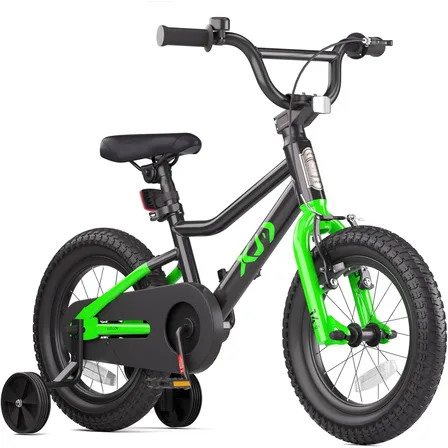
The Black XJD Kids Bike for Boys – 12, 14 & 16 Inch Sizes is a training-wheel bike offered with 12 Inch, 14 Inch and 16 Inch SKU labels. Those three options create useful comparison points for children whose measurements fall within the corresponding starting ranges above. The title’s “for Boys” wording is a catalog label, not evidence that fit depends on gender.
These particular catalog options help answer the practical question behind the fatality statistic by letting a parent compare adjacent early-childhood wheel sizes while still requiring an individual fit and control check.

This product is relevant when the child’s measurements and demonstrated control point toward 12, 14 or 16 Inch wheels and a training-wheel bike is appropriate to the child’s current confidence. It is not relevant when measurements point to 18 Inch or larger wheels, and its smaller sizes must not be treated as equivalent substitutes. The supplied facts do not establish brake type, weight, load limit, assembly details or certification; consult the exact manual or a qualified bicycle mechanic for those matters.
The decision to make now
Record the child’s height and inseam, identify the starting wheel-size range, and arrange a real fit check. Choose only a bicycle on which the child can stand over, reach, steer and brake with control; then fit the helmet level and plan the first rides away from motor traffic. The 2024 total is 56, but today’s actionable decision is whether this child, this bicycle and this riding place are ready for one another.
Bikes for your next adventure
-

Flower Pink XJD Girls Bike with Doll Seat & Basket
The XJD Flower Pink girls' bike is made for riders 71–122 cm tall (roughly ages …$69.99
-
Black XJD Kids' BMX Bicycle with Training Wheels
The XJD Kids' BMX Bicycle with Training Wheels is built for children roughly 3 t…$99.99
$119.99 -

Kids Bike Helmet by XJD for Boys & Girls – Black, Blue, Green, Pink, Purple
The XJD Kids Bike Helmet covers a wide 2-to-8-year age range thanks to two head-…$59.99