

How many inch bicycle for 5 year old
For most 5-year-olds, start by comparing 14-, 16-, and 18-inch bicycles. Measure your child first: height and actual fit matter more than age.
Which wheel size should you start with?
Use the child’s measured standing height to narrow the choice. At age 5, the XBikes starting ranges overlap, so age alone cannot identify one correct wheel size.
| Wheel size | XBikes age starting point | Rider-height starting point |
|---|---|---|
| 14 Inch | Ages 3–6 | 37–45 in / 94–114 cm |
| 16 Inch | Ages 4–7 | 40–48 in / 102–122 cm |
| 18 Inch | Ages 5–9 | 43–52 in / 109–132 cm |
A child measuring 39 inches, for example, falls within the 14-inch starting range but not the 16-inch range. A child measuring 44 inches falls within all three ranges, making an in-person fit and control check especially important. These ranges are screening tools, not guarantees.
Measure height and inseam before choosing
Measure height with the child standing straight, without shoes, against a wall. Record the distance from the floor to the top of the head. Then measure inseam from the floor to the crotch while the child stands naturally. Compare height with the table first; keep the inseam measurement for checking stand-over clearance on the actual bicycle.
Do not select a larger wheel merely because the child may grow into it. An oversized bicycle can make starting, stopping, turning, and putting a foot down harder. The child should try the specific bicycle because frame geometry can differ even when two bicycles share the same wheel-size label.
Check the bicycle with your child on it
Once height has narrowed the options, have the child perform a practical fit check. Everyday clothes and secure, closed-toe shoes make the trial more representative.
- Stand-over: With the child straddling the bicycle, confirm there is comfortable clearance rather than contact with the frame.
- Ground access: Make sure the child can get on, get off, and place a foot down without the bicycle forcing an awkward lean.
- Reach: The child should hold the handlebar and steer without stretching, locking the elbows, or losing a stable seated position.
- Brake control: Confirm the child can reach and operate the bicycle’s brakes reliably. Do not assume wheel size proves adequate brake reach.
- Confidence: Watch for controlled starts, turns, and stops. If the bicycle feels intimidating or difficult to control, try a smaller appropriate option.
How the supplied XBikes options compare
The catalog choices provide useful 14- and 16-inch comparison points for many 5-year-olds. One also includes a 12-inch option, while the other includes a 20-inch option, allowing parents to rule sizes in or out against the measured-height ranges and an individual fit check.
 XJD Boys & Girls BMX Bike with Training Wheels, 12/14/16" – Blue
Available in 12, 14, and 16 Inch versions. The 14- and 16-inch options are relevant comparison points for a 5-year-old, subject to measured height and an individual fit check.
 Girls' Training Wheel Bike by XJD with Basket – Purple
Available in 14, 16, and 20 Inch versions. Its 14- and 16-inch choices overlap age-five starting points; consider the 20-inch version only when measured height and hands-on fit support it.
The XJD Boys & Girls BMX Bike with Training Wheels, 12/14/16" – Blue is listed in 12 Inch, 14 Inch, and 16 Inch sizes. For a 5-year-old, compare its 14- and 16-inch versions with the child’s height and control. Its 12-inch version has an XBikes starting range of ages 3–4 and 34–40 inches / 86–102 cm, so it is relevant only when the child’s measurements and actual fit support it.
The Girls' Training Wheel Bike by XJD with Basket – Purple is listed in 14 Inch, 16 Inch, and 20 Inch sizes. Its 14- and 16-inch versions overlap the age-five starting points. The 20-inch starting range is ages 7–12 and 48–60 inches / 122–152 cm, so do not choose it for growth or treat it as equivalent to a smaller bicycle; consider it only if the rider’s measured height and hands-on fit support that size.
Neither supplied product is available in an 18 Inch SKU. If measurement points toward 18 inches, these products are nearest-size comparison points, not substitutes for an 18-inch bicycle.
Training wheels do not correct poor fit
Both catalog titles identify training-wheel bicycles, but training wheels do not make an oversized or poorly controlled bicycle fit correctly. Current confidence still matters: consider how steadily the child steers, starts, stops, and follows instructions. Follow the exact product manual for assembly, adjustment, maintenance, compatibility, load limits, and torque. If anything is uncertain, use a qualified bicycle mechanic.
Make the final decision
Measure the child, shortlist every wheel size whose XBikes height range includes that measurement, and then try those bicycles. Choose the size on which the child has suitable stand-over clearance, relaxed reach, reliable brake control, and confident handling today. Finish by fitting a bicycle helmet that sits level and uses its straps according to the helmet manufacturer’s instructions. For a 5-year-old, that process—not the birthday alone—decides whether 14, 16, or 18 inches is appropriate.
Bikes for your next adventure
-
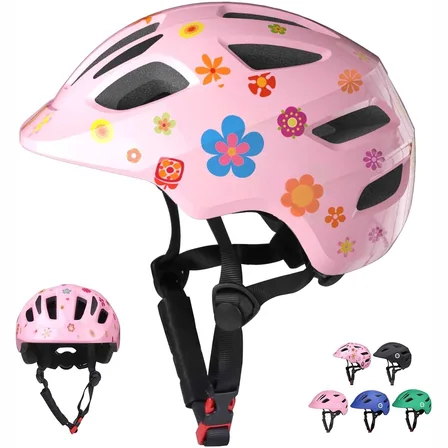
XJD Kids Bike Helmet for Girls, Pink Flowers, Adjustable (XS–S)
The XJD Kids Bike Helmet in Pink Flowers is an adjustable toddler-and-kids helme…$21.24
$24.99 -

Kids Bike Helmet by XJD for Boys & Girls – Black, Blue, Green, Pink, Purple
The XJD Kids Bike Helmet covers a wide 2-to-8-year age range thanks to two head-…$59.99
-

Kids Bike Helmet by XJD for Girls – Pink
The XJD Kids Bike Helmet in Pink is a lightweight multi-sport helmet for girls r…$59.99
$99