

How many inch bike for 13 yr old
Most 13-year-olds should start by trying a 24-inch bike; riders over 60 inches (153 cm) should also compare a 26-inch bike. Measure first, because age alone cannot determine fit.
Choose the starting size from measured height
Have the rider stand straight without shoes and measure from the floor to the top of the head. Compare that result with the XBikes starting points below. Wheel size describes the wheels, not every dimension of the bicycle, so two bikes with the same wheel size can still feel different.
| Wheel size | XBikes starting range | What it means at age 13 |
|---|---|---|
| 20 Inch | Ages 7–12; 48–60 in (122–152 cm) | Consider only if the rider's measurements and individual fit support it; age 13 is outside the starting age range. |
| 24 Inch | Ages 10–14; 54–64 in (137–163 cm) | The usual first size to try when the rider is within this height range. |
| 26 Inch | Youth and adults over 60 in (153 cm) | Worth comparing when the rider is over 60 inches tall and can control it confidently. |
A rider between 60 and 64 inches falls within the supplied starting points for both 24-inch and 26-inch wheels. That overlap is a signal to try both sizes, not proof that either one automatically fits.
Measure inseam as well as height
Measure inseam with the rider standing in socks against a wall. Place a firm, level book between the legs to represent the saddle, then measure from the floor to the top edge of the book. Use this measurement during an actual stand-over check; do not infer clearance from wheel diameter alone.
With the bicycle upright, the rider should be able to straddle it without being pressed against the frame. Exact clearance and adjustment procedures depend on the bicycle, so follow its product manual or ask a qualified bicycle mechanic rather than relying on an invented universal number.
Perform the fit check before choosing
A suitable wheel-size range is only the beginning. Have the 13-year-old try the exact bicycle and check these points:
- Stand-over: The rider can straddle the bicycle comfortably and dismount without getting caught on the frame.
- Reach: The handlebars can be held without excessive stretching, locked elbows or an awkwardly hunched position.
- Brake control: The rider can reach and operate the brake controls while maintaining a secure grip.
- Low-speed control: Starting, steering, stopping and putting a foot down feel controlled rather than intimidating.
- Confidence: The rider can look ahead and maneuver naturally instead of concentrating on managing an oversized bicycle.
Do not choose a larger bike merely to allow room for growth. If a 26-inch bike compromises stand-over, reach, braking or confidence, choose the better-fitting smaller option even when the rider is tall enough to compare both.
How the supplied 24-inch and 26-inch bikes help
The two catalog options are useful because each offers the sizes most likely to be compared for a 13-year-old. The XJD 24-Inch Green Beach Cruiser Bike with U-Brake has Green / 24 Inch, Pink / 24 Inch and Pink / 26 Inch SKU labels. The Pink XJD Beach Cruiser Bike, 24"/26", U-Brake has 24 Inch and 26 Inch SKU labels. Both are categorized as Beach Cruiser Bikes and both product titles specify a U-brake.
 XJD 24-Inch Green Beach Cruiser Bike with U-Brake
A beach cruiser comparison option with Green / 24 Inch, Pink / 24 Inch and Pink / 26 Inch SKU labels. Its two wheel sizes are relevant when checking a 13-year-old’s measured fit.
 Pink XJD Beach Cruiser Bike, 24"/26", U-Brake
This beach cruiser has 24 Inch and 26 Inch SKU labels, making it relevant for an in-person comparison when the rider’s height and individual fit place both sizes under consideration.
Use these as size-comparison candidates, not as proof of fit. A 24-inch SKU aligns with the 54–64 inch starting range; a 26-inch SKU is a comparison for a rider over 60 inches. Color, category and a size printed in a product title do not establish whether the rider has adequate clearance, reach or control.
For assembly, maintenance, load limits, compatibility and any torque settings, consult the manual for the exact selected product or use a qualified bicycle mechanic. Those details cannot be inferred from the catalog titles or SKU labels.
Finish the decision safely
- Record the rider's height and inseam rather than choosing from age alone.
- Begin with 24 inches if height is 54–64 inches; compare 26 inches only when height is over 60 inches.
- Try the exact bike and reject any option that compromises stand-over, reach, brake operation or confident control.
- Repeat the check after permitted adjustments made according to the product manual.
- Add a properly fitting bicycle helmet. It should sit level, and its straps should be used according to the helmet manufacturer's instructions.
For a 13-year-old, the practical next step is therefore a supervised 24-inch fit check, adding a 26-inch comparison only above 60 inches tall and choosing whichever exact bicycle the rider can comfortably straddle, reach, brake and control.
Bikes for your next adventure
-
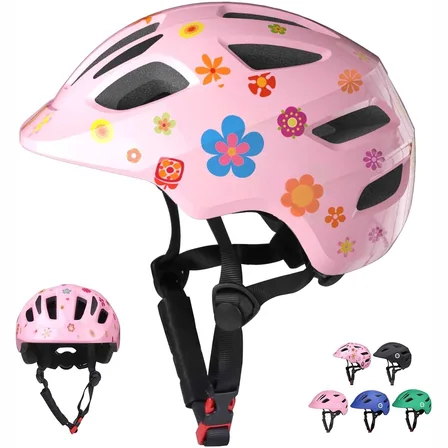
XJD Kids Bike Helmet for Girls, Pink Flowers, Adjustable (XS–S)
The XJD Kids Bike Helmet in Pink Flowers is an adjustable toddler-and-kids helme…$21.24
$24.99 -

Kids Bike Helmet by XJD for Boys & Girls – Black, Blue, Green, Pink, Purple
The XJD Kids Bike Helmet covers a wide 2-to-8-year age range thanks to two head-…$59.99
-

Kids Bike Helmet by XJD for Girls – Pink
The XJD Kids Bike Helmet in Pink is a lightweight multi-sport helmet for girls r…$59.99
$99