

How many inch bike for 7 year old
Most 7-year-olds should start by trying a 20-inch bike, but age alone cannot determine fit. Measure the child’s height and inseam, then check stand-over clearance, reach, brake control and confidence on the actual bicycle.
Which wheel size should a 7-year-old try?
Under the XBikes starting points, 20-inch bikes cover ages 7–12 and rider heights of 48–60 inches (122–152 cm). That makes 20 inches the usual first size to compare for a 7-year-old who is at least 48 inches tall.
A smaller 7-year-old may fit another size. The 18-inch range is ages 5–9 and heights of 43–52 inches (109–132 cm), while the 16-inch range is ages 4–7 and heights of 40–48 inches (102–122 cm). These ranges overlap, so height narrows the choices but does not settle the decision.
| Measured rider height | Sizes to compare | What to do |
|---|---|---|
| 40–43 in (102–109 cm) | 16 Inch | Check individual fit; 18 Inch is outside its stated height range. |
| 43–48 in (109–122 cm) | 16 and 18 Inch | Try both where possible and choose by control, not growth room. |
| 48–52 in (122–132 cm) | 18 and 20 Inch | Compare both on the actual rider. |
| 52–60 in (132–152 cm) | 20 Inch | Begin with a 20-inch fit check. |
Measure before comparing bicycles
Measure height without shoes, with the child standing straight against a wall. For inseam, have the child stand with feet slightly apart and measure from the floor to the crotch. Keep both measurements available when checking the bicycle or its exact sizing instructions.
Wheel size is only a starting point; it does not reveal the frame’s precise stand-over height or reach. Do not choose solely from an age label, and do not buy an oversized bicycle on the assumption that the child will grow into it.
Check the fit on the actual bike
Have the child try the bicycle in a controlled area with adult supervision. Confirm these points before deciding:
- Stand-over: The child can straddle the bicycle comfortably rather than being forced onto tiptoes or against the frame.
- Reach: The handlebars can be held without stretching, locking the elbows or losing a stable riding position.
- Brake control: The child can reach and operate the bicycle’s braking controls confidently. Check the exact bike rather than assuming all models of one wheel size feel alike.
- Starting and stopping: The child can mount, begin moving, steer and stop without the bicycle’s size overwhelming them.
- Confidence: The fit should support the child’s current ability. A size that is theoretically within range may still be too demanding today.
If the fit is uncertain, use a qualified bicycle mechanic. Follow the exact product manual for assembly, adjustment, maintenance, compatibility, load limits and torque requirements.
How the supplied 16-inch options are relevant
The supplied catalog bicycles help compare the upper end of the 16-inch range. They are relevant only if the rider’s measured height and individual fit support 16 inches; neither supplied product offers an 18-inch or 20-inch SKU. For many 7-year-olds seeking those sizes, these are nearest-size comparison points, not equal-size substitutes.
 Black XJD Kids' BMX Bicycle with Training Wheels
Offers 12 Inch, 14 Inch and 16 Inch SKUs. Its 16 Inch option is relevant only for a smaller 7-year-old whose height and hands-on fit support that size; it is not an 18- or 20-inch substitute.
 Pink Girls' 12/14/16" Bike by XJD – Basket & Doll Seat
Offers 12 Inch, 14 Inch and 16 Inch SKUs. The 16 Inch option can be compared for a rider within the supplied 40–48 inch height range, subject to stand-over, reach, brake control and confidence checks.
Black XJD Kids' BMX Bicycle with Training Wheels
The Black XJD Kids' BMX Bicycle with Training Wheels is listed in Kids' BMX Bikes with 12 Inch, 14 Inch and 16 Inch SKU labels. For this question, only its 16 Inch option is a plausible comparison, and only for a rider within the 40–48 inch (102–122 cm) starting range who also passes the individual fit check.
Pink Girls' 12/14/16" Bike by XJD – Basket & Doll Seat
The Pink Girls' 12/14/16" Bike by XJD – Basket & Doll Seat is listed in Training Wheel Bikes with 12 Inch, 14 Inch and 16 Inch SKU labels. Its 16 Inch option has the same limited relevance to a smaller 7-year-old; the title and category do not establish fit.
Helmet and final decision
Whatever size fits, use a bicycle helmet that fits properly, sits level and has its straps adjusted according to the helmet manufacturer’s instructions. A helmet cannot correct a bicycle that is too large or difficult to control.
For a 7-year-old, measure first: try 20 inches at 48–60 inches tall, compare 18 and 20 inches in their overlap, or consider 16 inches only within its stated height range. Choose the bicycle the child can straddle, reach, brake, start and stop confidently today.
Bikes for your next adventure
-
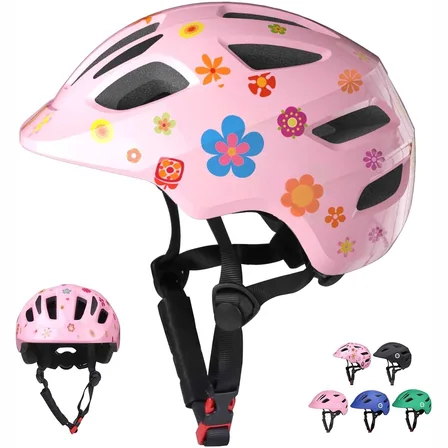
XJD Kids Bike Helmet for Girls, Pink Flowers, Adjustable (XS–S)
The XJD Kids Bike Helmet in Pink Flowers is an adjustable toddler-and-kids helme…$21.24
$24.99 -

Kids Bike Helmet by XJD for Boys & Girls – Black, Blue, Green, Pink, Purple
The XJD Kids Bike Helmet covers a wide 2-to-8-year age range thanks to two head-…$59.99
-

Kids Bike Helmet by XJD for Girls – Pink
The XJD Kids Bike Helmet in Pink is a lightweight multi-sport helmet for girls r…$59.99
$99