

How many inches bike for 5 year old
For most 5-year-olds, start by comparing 14-inch and 16-inch bikes. Measure your child’s height first: 14-inch bikes cover 37–45 in (94–114 cm), while 16-inch bikes cover 40–48 in (102–122 cm). Age is only a starting point; the correct choice depends on actual fit and control.
Which wheel size should you check first?
A 5-year-old can fall within several wheel-size ranges. Use the measured height to narrow the choice, then have the child try the bike. The overlap between sizes is intentional: two children of the same age may need different bikes because their height, leg length, reach and confidence differ.
| Wheel size | XBikes starting age | Rider height | Relevance at age 5 |
|---|---|---|---|
| 12 Inch | 3–4 | 34–40 in / 86–102 cm | Usually outside the age starting point; consider only if measured height and an individual fit check support it. |
| 14 Inch | 3–6 | 37–45 in / 94–114 cm | A common size to compare for a smaller or less confident 5-year-old. |
| 16 Inch | 4–7 | 40–48 in / 102–122 cm | A common size to compare when the child is taller or has outgrown a 14-inch bike. |
| 18 Inch | 5–9 | 43–52 in / 109–132 cm | Worth trying for a taller 5-year-old, but only if stand-over, reach and control are suitable. |
Do not move up merely because a larger bike will last longer. An oversized bicycle can make starting, stopping and steering harder. HealthyChildren guidance favors trying the bicycle and checking control rather than buying ahead for growth.
Measure before choosing 14 or 16 inches
Measure height with the child standing straight against a wall without shoes. For inseam, have the child stand with feet slightly apart and measure from the floor to the crotch. Record both measurements in inches or centimeters.
Wheel-size charts use height to identify candidates, but inseam helps with the real-world stand-over check. Wheel size is not the same as seat height, and frame shapes can differ, so inseam alone does not prove that a particular model fits.
What to check when the child tries the bike
Have the child wear ordinary riding shoes and try the exact bicycle or size being considered. A suitable candidate should let the rider mount and dismount without struggling and stand over the frame without being trapped against it.
- Reach: The child should hold the handlebar without stretching, locking the elbows or leaning excessively.
- Starting and stopping: Ask the child to demonstrate controlled starts and stops in a traffic-free area.
- Steering: The rider should turn both ways while remaining balanced and in control.
- Brake control: Confirm that the child can reach and operate the provided braking controls. Follow the exact product manual for their operation and adjustment.
- Confidence: Hesitation, wobbling or difficulty putting a foot down can be a reason to compare a smaller candidate.
If the fit is uncertain or adjustment is required, use the exact product manual or ask a qualified bicycle mechanic. Do not improvise assembly, compatibility, maintenance or torque procedures.
How the supplied 12, 14 and 16-inch options help
The catalog options below make it possible to compare 14-inch and 16-inch versions, the two most likely starting points for many 5-year-olds. They also include 12-inch versions for comparison when a child falls near the smaller height range, although age alone does not establish that size.
 XJD Pink Girls' Bike – Kids 12/14/16 Inch Training Wheel Bicycle
Offers 12 Inch, 14 Inch and 16 Inch SKU labels in the Training Wheel Bikes category, making it relevant for comparing the principal size candidates after measuring the child.
 XJD Girls Bike for Kids Ages 3-8, 12/14/16 Inch with Training Wheels – Purple
A training wheel bike with 12 Inch, 14 Inch and 16 Inch SKU labels. The “Ages 3-8” wording in its title is a catalog label, not individual fit evidence.
XJD Pink Girls' Bike – Kids 12/14/16 Inch Training Wheel Bicycle is categorized as a training wheel bike and has 12 Inch, 14 Inch and 16 Inch SKU labels. Compare only the size supported by the child’s measured height and successful fit check.
XJD Girls Bike for Kids Ages 3-8, 12/14/16 Inch with Training Wheels – Purple is also categorized as a training wheel bike with 12 Inch, 14 Inch and 16 Inch SKU labels. “Ages 3-8” is part of its catalog title, not evidence that every child in that span fits it.
Neither supplied product has an 18-inch SKU label. If your 5-year-old measures 43–52 in (109–132 cm) and fits an 18-inch bike better, these products are smaller-size comparison points, not substitutes for an 18-inch bike.
Make the final size decision
Begin with 14 inches for a child measuring 37–45 in (94–114 cm), or 16 inches at 40–48 in (102–122 cm). Within the overlapping 40–45 in (102–114 cm) range, try both rather than deciding from age. Choose only after the child shows comfortable stand-over clearance, natural reach, usable brake control and confident starting, steering and stopping.
Before the first ride, use a properly fitting bicycle helmet. It should sit level, with its straps fitted according to the helmet manufacturer’s instructions. For your 5-year-old, the next step is simple: measure height and inseam today, shortlist the matching wheel sizes, then arrange an exact-bike fit check.
Bikes for your next adventure
-
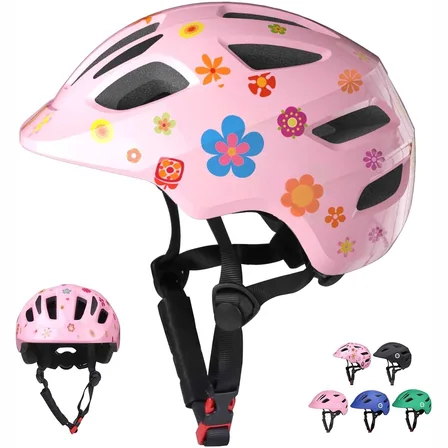
XJD Kids Bike Helmet for Girls, Pink Flowers, Adjustable (XS–S)
The XJD Kids Bike Helmet in Pink Flowers is an adjustable toddler-and-kids helme…$21.24
$24.99 -

Kids Bike Helmet by XJD for Boys & Girls – Black, Blue, Green, Pink, Purple
The XJD Kids Bike Helmet covers a wide 2-to-8-year age range thanks to two head-…$59.99
-

Kids Bike Helmet by XJD for Girls – Pink
The XJD Kids Bike Helmet in Pink is a lightweight multi-sport helmet for girls r…$59.99
$99