

How many kids are killed by bikes every year
In the United States, about 90 children under 18 died in reported bicycle-riding incidents per year in 2022–2023. That is an average, not a fixed annual total.
What the number actually means
The U.S. Consumer Product Safety Commission recorded 180 bicycle-riding fatalities among people under 18 across those two years: 14 among children younger than 5 and 166 among ages 5–17. Dividing the two-year total gives the annual average of 90.
This figure describes children who died in incidents associated with riding a non-powered bicycle. It does not mean bicycles independently “killed” 90 children, and it should not be presented as a worldwide count. Countries define, collect and publish cycling deaths differently, so there is no single reliable global annual answer to the title.
Counts also depend on the definition used. Road-traffic databases may include only crashes involving motor vehicles on public roads, while broader consumer-product data can include riding incidents elsewhere. When comparing figures, check the country, years, age cutoff, bicycle definition and whether non-traffic incidents are included.
What parents should compare before a child rides
A fatality count cannot predict an individual child’s risk. The useful next step is to compare the rider, bicycle and riding environment. Measure the child’s standing height and inseam, then have the child try the bicycle. Confirm adequate stand-over clearance, a comfortable reach to the handlebar, reliable access to the brakes and enough confidence to start, steer and stop under control.
Do not choose an oversized bicycle simply to allow room for growth. Age is only a starting point; measured height, inseam, reach, brake control and present confidence take priority.
| Wheel size | Starting age | Rider height |
|---|---|---|
| 12 Inch | 3–4 | 34–40 in / 86–102 cm |
| 14 Inch | 3–6 | 37–45 in / 94–114 cm |
| 16 Inch | 4–7 | 40–48 in / 102–122 cm |
| 18 Inch | 5–9 | 43–52 in / 109–132 cm |
| 20 Inch | 7–12 | 48–60 in / 122–152 cm |
| 24 Inch | 10–14 | 54–64 in / 137–163 cm |
| 26 Inch | Youth and adults | Over 60 in / 153 cm |
Where the supplied bikes are relevant
The three catalog options are relevant only when a family is comparing a training-wheel bicycle in a listed 12, 14, 16 or 20 Inch size. They help narrow the wheel-size choice, but they do not establish fit, reduce the official fatality count or prove that one model is safer than another.
The available comparison options are Girls' Training Wheel Bike by XJD, 12–20 Inch Wheels – Blue; XJD Girls' Bike with Training Wheels, 12/14/16/20 Inch – Purple; and XJD Kids Bike for Girls – Pink, 12/14/16/20 Inch with Training Wheels. Each is categorized as a training-wheel bike and is offered with 12, 14, 16 and 20 Inch SKU labels.
 Girls' Training Wheel Bike by XJD, 12–20 Inch Wheels – Blue
A training-wheel bike offered in 12, 14, 16 and 20 Inch SKU labels. Use the child’s measurements and an individual control check to select among those sizes.
 XJD Girls' Bike with Training Wheels, 12/14/16/20 Inch – Purple
This purple training-wheel bike provides 12, 14, 16 and 20 Inch size options for comparison. Its catalog details do not establish individual fit or safety performance.
 XJD Kids Bike for Girls – Pink, 12/14/16/20 Inch with Training Wheels
This pink kids training-wheel bike is available with 12, 14, 16 and 20 Inch SKU labels. It is relevant only when one of those sizes passes the rider’s fit check.
There is no supplied 18, 24 or 26 Inch version of these products. If the fit check points to one of those sizes, the displayed bikes are nearest-size comparison points only, not substitutes; another wheel size is not equivalent. Likewise, training wheels can assist with lateral balance during early practice, but their presence does not prove that the bicycle fits or that the rider can control its brakes and steering.
Helmet and pre-ride decisions
Use a bicycle helmet that fits properly, sits level and has its straps adjusted according to the helmet manufacturer’s instructions. A helmet is important protective equipment, but it does not make poor fit, uncontrolled riding or a hazardous location acceptable.
Before each ride, an adult should decide whether the child can demonstrate controlled starting, steering and stopping in the intended setting. Begin in a low-traffic practice area appropriate to the rider’s current ability, supervise according to maturity and conditions, and reassess after growth or a loss of confidence.
For assembly, maintenance, load limits, compatibility and torque, follow the exact bicycle’s manual. If instructions are missing, unclear or the bicycle cannot be checked confidently, use a qualified bicycle mechanic rather than guessing.
What to do next
- Record the child’s height and inseam without shoes.
- Use the table to identify a starting wheel size, then arrange an individual try-on.
- Check stand-over clearance, reach, brake access and controlled stopping.
- Fit the helmet level and adjust its straps exactly as its manufacturer directs.
- Choose the riding location and supervision for the child’s demonstrated ability.
The title’s practical answer is therefore about 90 U.S. child bicycle-riding deaths per year in the latest cited two-year CPSC dataset. Respond to that number by selecting only a bicycle the child can control now; if none of the supplied sizes passes the fit check, do not choose one merely because it is available.
Bikes for your next adventure
-
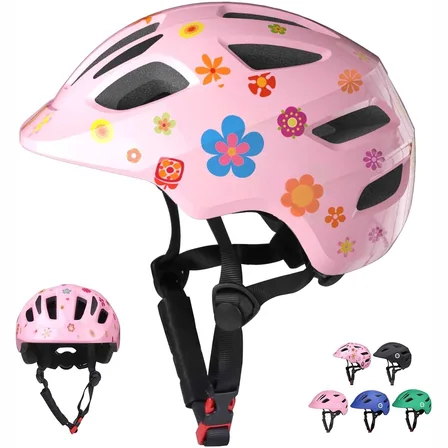
XJD Kids Bike Helmet for Girls, Pink Flowers, Adjustable (XS–S)
The XJD Kids Bike Helmet in Pink Flowers is an adjustable toddler-and-kids helme…$21.24
$24.99 -

Kids Bike Helmet by XJD for Boys & Girls – Black, Blue, Green, Pink, Purple
The XJD Kids Bike Helmet covers a wide 2-to-8-year age range thanks to two head-…$59.99
-

Kids Bike Helmet by XJD for Girls – Pink
The XJD Kids Bike Helmet in Pink is a lightweight multi-sport helmet for girls r…$59.99
$99