

How tall for 18 inch bike
An 18-inch bike is a starting point for a child 43–52 inches (109–132 cm) tall, usually age 5–9, but only an individual fit check can confirm it.
Start with height, not age
Measure the child without shoes, standing straight against a wall. Record the floor-to-top-of-head height and compare it with the XBikes starting range below. Age is only a rough reference because children of the same age can differ considerably in height, proportions and riding confidence.
| Wheel size | Rider height | Starting age range |
|---|---|---|
| 16 Inch | 40–48 in / 102–122 cm | 4–7 |
| 18 Inch | 43–52 in / 109–132 cm | 5–9 |
| 20 Inch | 48–60 in / 122–152 cm | 7–12 |
The overlapping ranges are intentional starting points, not proof that every bike in a wheel-size class will fit identically. Frame shape, saddle adjustment and handlebar position can change how two bikes with the same wheel diameter feel.
Measure inseam before choosing
Height narrows the search; inseam helps assess whether the child can manage the actual frame. With the child wearing normal riding clothes and no shoes, have them stand with feet slightly apart. Place a firm, thin book between the legs, raise it gently to simulate the bicycle saddle, then measure from the floor to the book’s top edge.
Compare that measurement with the stand-over clearance and saddle adjustment information for the exact 18-inch model under consideration. Because no frame dimensions are supplied here, do not infer clearance from wheel size alone. Follow the product manual or ask a qualified bicycle mechanic when the required measurements or adjustment limits are unclear.
Check the actual 18-inch bike
Have the child try the bicycle before committing to it. When standing over the frame, the child should have usable clearance rather than being pressed against the top tube. Seated, they should be able to start, stop and put a foot down without panic or an awkward lean.
Next, watch the upper body. The rider should reach the handlebar without stretching, locking the elbows or losing a centered position. Have the child operate every brake control fitted to the bike. Small hands must be able to reach and use the controls reliably while maintaining steering control.
Finally, observe a short ride in a controlled area. The child should steer, start, stop and turn with current confidence. A bike that technically matches the height chart can still be unsuitable if its reach, stand-over position or controls overwhelm the rider.
How the supplied bikes help with comparison
Neither supplied product has an 18-inch option, so these are nearest-size comparison points rather than substitutes for an 18-inch bike. They help bracket the requested size: one reaches 16 inches, while the other offers 20-inch and larger options. Their presence does not establish that either adjacent size fits.
 XJD Kids' Training Wheel Bike for Boys & Girls, 12/14/16 Inch – White
A 16-inch nearest-size comparison available in this product’s 12, 14 and 16 Inch labels; it is not an 18-inch substitute and still requires an individual fit check.
 26-Inch XJD Beach Cruiser Bike for Girls – Purple, V-Brake
Its supplied options include 20, 24 and 26 Inch labels. The 20-inch option is the nearest larger comparison, not an equivalent replacement for an 18-inch bike.
The XJD Kids' Training Wheel Bike for Boys & Girls, 12/14/16 Inch – White is available in 12 Inch, 14 Inch and 16 Inch labels. Its 16-inch option corresponds to an XBikes starting range of 40–48 inches (102–122 cm), ages 4–7. Consider it only through a separate fit check; do not treat it as an 18-inch equivalent.
The 26-Inch XJD Beach Cruiser Bike for Girls – Purple, V-Brake has supplied SKU labels covering 20 Inch, 24 Inch and 26 Inch color variants. The nearest relevant comparison is 20 Inch, whose starting range is 48–60 inches (122–152 cm), ages 7–12. That is a larger wheel-size category, not an interchangeable replacement for 18 Inch.
Do not size up just for growth
An oversized bicycle can make mounting, stopping, steering and reaching the brakes harder. Do not select a 20-inch bike merely because the child may grow into it. Likewise, do not automatically move down to 16 inches because the child is cautious; verify the real bike’s clearance, reach and control first.
- Pause if the child cannot stand over the frame comfortably.
- Reject the fit if the handlebar or brakes require an unstable stretch.
- Choose based on measured height, inseam and demonstrated control—not age alone.
- For assembly, adjustment limits, torque, maintenance or compatibility, follow the exact product manual or use a qualified bicycle mechanic.
Make the 18-inch decision
If the child is 43–52 inches (109–132 cm) tall, take the inseam measurement and arrange a trial on the exact 18-inch model. Proceed only when stand-over clearance, reach, brake operation and riding confidence all work together. Add a properly fitting bicycle helmet that sits level, with its straps adjusted according to the helmet manufacturer’s instructions. If any fit check fails, compare the child with the adjacent-size ranges and test the actual alternative rather than guessing from age or anticipated growth.
Bikes for your next adventure
-
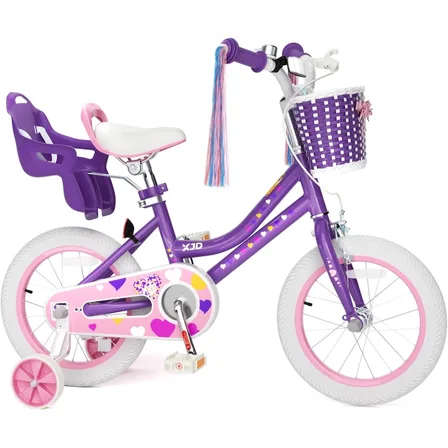
Purple XJD Girls' Bike with Doll Seat & Basket
For girls 71–122 cm tall (about ages 3–7), this XJD girls' bike in Purple pairs …$75.99
$99.99 -

Blue XJD Girls Bike with Training Wheels – 12/14/16 Inch
If you're shopping for a first pedal bike for a daughter roughly 3 to 8 years ol…$149
$169 -

XJD Boys 12/14/16" Training Wheel Bike – Blue
The XJD Boys Bike in Blue is a training wheel bike for riders 71–122 cm tall—rou…$169
$199