

How tall is 20 inch bike
A 20-inch bike is not 20 inches tall: the number describes its wheel size. XBikes uses 48–60 in (122–152 cm) rider height, usually ages 7–12, as the starting range. Measure the child and check the actual bike before deciding.
What “20 inch” tells you
The label identifies the wheel-size class, not the height of the frame, saddle or handlebars. Two 20-inch bikes can have different frame shapes and adjustment ranges, so there is no single overall height that applies to every model.
For a child’s fit, the useful comparison is the rider’s body against the complete bicycle. Age can narrow the search, but measured height, inseam, reach, brake control and current confidence matter more.
Start with the XBikes size range
| Wheel size | Starting age | Starting rider height |
|---|---|---|
| 18 Inch | 5–9 | 43–52 in / 109–132 cm |
| 20 Inch | 7–12 | 48–60 in / 122–152 cm |
| 24 Inch | 10–14 | 54–64 in / 137–163 cm |
These overlapping ranges show why age alone cannot settle the choice. A child near 48 inches may need to compare 18- and 20-inch bicycles, while one near 60 inches may need to compare 20- and 24-inch bicycles. The larger size should not be chosen simply to leave room for growth.
Measure the child before comparing bikes
- Standing height: Have the child stand without shoes, upright against a wall. Measure from the floor to the top of the head.
- Inseam: With feet naturally spaced, place a firm, thin book between the legs to represent the saddle and measure vertically from the floor to the book’s top edge.
- Record both measurements: Use standing height to check the XBikes starting range and inseam to judge clearance and mounting on the specific bicycle.
Do not convert age into an assumed measurement. Growth patterns differ, and the same standing height can come with different leg and arm proportions.
Check the actual 20-inch bike
Have the child try the bicycle. With both feet on the ground while straddling the frame, there should be usable stand-over clearance rather than contact with the frame. The child should be able to mount, start, stop and steer without stretching, leaning excessively or losing balance.
Next, check reach from the riding position. The child should hold the handlebars comfortably, turn them without the knees or body interfering, and operate the brakes with control. A rider inside the height range can still be a poor match if the frame shape, reach or brake access does not suit them.
- Too large: difficulty straddling, reaching the controls, starting or stopping confidently.
- Too small: a cramped posture or restricted steering and pedalling position.
- Promising fit: comfortable clearance, natural reach and controlled braking during a supervised trial.
Follow the exact product manual for assembly, adjustments, maintenance, compatibility and limits. If the instructions are unclear or the controls cannot be set appropriately, use a qualified bicycle mechanic.
How the supplied catalog options help
The catalog provides two useful ways to evaluate the requested size: one model offers several wheel-size labels for comparison, and the other offers 20-, 24- and 26-inch labels in selected colors. These are shopping references only; the available labels do not replace an individual fit check.
 Pink 12/14/16/20" XJD Girls Bike with Training Wheels & Basket
Offers a 20 Inch SKU matching the requested wheel size, alongside 12 Inch, 14 Inch and 16 Inch labels for comparison. It is categorized as a Training Wheel Bike; confirm the individual rider’s measurements and control.
 26-Inch XJD Beach Cruiser Bike for Girls – Purple, V-Brake
Its supplied SKUs include 20 Inch options in Mint Green and Pink, as well as distinct 24- and 26-inch options. It is categorized as a Beach Cruiser Bike; only the 20 Inch SKUs match the requested size.
The Pink 12/14/16/20" XJD Girls Bike with Training Wheels & Basket is categorized as a Training Wheel Bike and has 12 Inch, 14 Inch, 16 Inch and 20 Inch SKU labels. Its 20 Inch option matches the wheel size in the title, while the smaller labels make the size progression visible. Choose among them using the child’s measurements and trial fit, not the sequence alone.
The 26-Inch XJD Beach Cruiser Bike for Girls – Purple, V-Brake is categorized as a Beach Cruiser Bike. Despite “26-Inch” in its catalog title, its supplied SKU labels include Mint Green and Pink in 20 Inch, 24 Inch and 26 Inch, plus Purple in 26 Inch. Only the 20 Inch SKUs match the requested wheel-size class; 24- and 26-inch versions are different sizes, not equivalent substitutes.
Make the final decision
If the child measures 48–60 in (122–152 cm), place 20-inch bikes on the try list, then confirm stand-over clearance, comfortable reach, brake operation and confident control. Compare an adjacent size when the child is near an overlap or cannot control the 20-inch bike comfortably. Do not buy an oversized bicycle solely for future growth.
Before riding, add a properly fitting bicycle helmet. It should sit level and its straps should be used according to the helmet manufacturer’s instructions. The title-specific next step is simple: measure height and inseam today, then let the child try the exact 20-inch model before purchasing.
Bikes for your next adventure
-
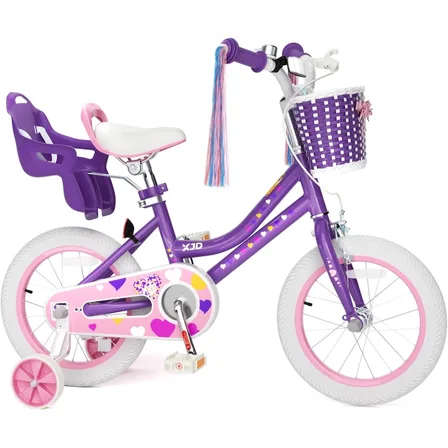
Purple XJD Girls' Bike with Doll Seat & Basket
For girls 71–122 cm tall (about ages 3–7), this XJD girls' bike in Purple pairs …$75.99
$99.99 -

Blue XJD Girls Bike with Training Wheels – 12/14/16 Inch
If you're shopping for a first pedal bike for a daughter roughly 3 to 8 years ol…$149
$169 -

XJD Boys 12/14/16" Training Wheel Bike – Blue
The XJD Boys Bike in Blue is a training wheel bike for riders 71–122 cm tall—rou…$169
$199