

How tall of a bike for my 10 year old
For a 10-year-old, compare 20-inch and 24-inch bikes first: use 20 inches at 48–60 in tall and 24 inches at 54–64 in, then confirm the fit in person. A rider over 60 in / 153 cm may need a 26-inch bike. Age is only a starting point.
Choose the starting size from measured height
Have your child stand barefoot against a wall and measure from the floor to the top of the head. Compare that number with the XBikes starting points below. The overlap is intentional: two wheel sizes can cover the same height, but they are not equivalent fits.
| Wheel size | XBikes age starting point | Rider height |
|---|---|---|
| 20 Inch | Ages 7–12 | 48–60 in / 122–152 cm |
| 24 Inch | Ages 10–14 | 54–64 in / 137–163 cm |
| 26 Inch | Youth and adults over 60 in / 153 cm | Over 60 in / 153 cm |
If your 10-year-old is 48–53 inches tall, begin with a 20-inch bike. At 54–60 inches, compare both 20-inch and 24-inch bikes in person. At 61–64 inches, begin with a 24-inch bike while recognizing that 26-inch sizing also starts above 60 inches. Do not settle the overlap by age alone.
Measure inseam before trying the bike
Height narrows the choices; inseam helps determine whether the frame itself works. With the child barefoot, place a book firmly between the legs as though it were a bicycle saddle. Measure straight from the floor to the top edge of the book.
Bring both the height and inseam measurements when comparing bikes. Wheel size does not specify the frame’s exact stand-over height, saddle range or geometry, so those measurements must be checked against the exact bicycle or its product manual. Do not invent clearance from wheel diameter alone.
Perform the fit check in this order
- Stand-over: Have the child straddle the bicycle with feet flat on the ground. The frame should not press into the body, and the child should be able to steady the bike comfortably.
- Starting and stopping: Ask the child to mount, begin riding and stop without struggling against the bicycle’s size or weight distribution.
- Reach: With hands on the controls, look for a comfortable posture rather than locked arms, an extreme forward stretch or difficulty turning the handlebar.
- Brake control: The child must be able to reach and operate the brakes confidently from a normal riding position.
- Confidence: Choose the size the child can control now. Do not buy an oversized bicycle merely to allow room for growth.
A short, supervised ride reveals more than an age label. If the child cannot turn smoothly, stop reliably or put a foot down with confidence, try another size or frame.
How the supplied catalog option helps
The Pink 12/14/16/20" XJD Girls Bike with Training Wheels & Basket is listed in the Training Wheel Bikes category with 12 Inch, 14 Inch, 16 Inch and 20 Inch SKU labels. For this question, its 20 Inch option is the relevant starting comparison for a child measuring 48–60 in / 122–152 cm. The smaller labels correspond to shorter XBikes height ranges and are generally not the starting point for a typical 10-year-old unless the child’s measured height places them there.
These catalog options help by providing a 20-inch comparison and smaller reference sizes in one listed product. There is no supplied 24-inch or 26-inch product, so the item below is not a substitute when the fit check points to either of those sizes.

The product title identifies training wheels and a basket, but those words do not establish fit. Confirm the selected SKU label, stand-over, reach, brake control and current confidence. For assembly, adjustment, compatibility, load limits, maintenance or torque instructions, follow the exact product manual or use a qualified bicycle mechanic.
Do not overlook the helmet
Use a bicycle helmet that fits the child properly. It should sit level and be secured with its straps according to the helmet manufacturer’s instructions. A larger bike does not justify a loosely adjusted helmet, and a correctly fitted helmet does not compensate for a bicycle the child cannot control.
Make the decision for your 10-year-old
Measure height and inseam today. Start with 20 inches at 48–53 inches tall, compare 20 and 24 inches at 54–60 inches, and begin with 24 inches at 61–64 inches while also assessing 26-inch options above 60 inches. Then let stand-over, reach, braking and confident control decide—not the promise of growing into a taller bike.
Bikes for your next adventure
-
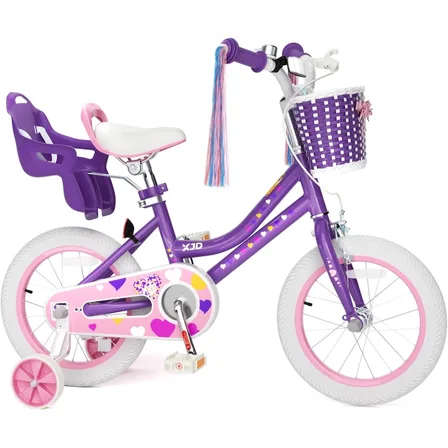
Purple XJD Girls' Bike with Doll Seat & Basket
For girls 71–122 cm tall (about ages 3–7), this XJD girls' bike in Purple pairs …$75.99
$99.99 -

Blue XJD Girls Bike with Training Wheels – 12/14/16 Inch
If you're shopping for a first pedal bike for a daughter roughly 3 to 8 years ol…$149
$169 -

XJD Boys 12/14/16" Training Wheel Bike – Blue
The XJD Boys Bike in Blue is a training wheel bike for riders 71–122 cm tall—rou…$169
$199