

How to child seat for bike
To choose a child seat for a bike, first decide whether you need a passenger seat or the correct saddle fit on a child’s own bicycle. Measure the child and verify the exact bike or seat manual before buying.
Identify which kind of child seat you mean
A child passenger seat attaches to an adult bicycle and carries a child. None of the supplied XBikes products is identified as a child passenger seat, so these bicycles are not substitutes for one. The “doll seat” named on one product is for a doll; it must not be treated as a child-carrying seat.
If you need a passenger seat, compare its stated child load limits, mounting requirements and bicycle compatibility with the exact adult bicycle. Those specifications are not supplied here. Follow both manufacturers’ manuals or ask a qualified bicycle mechanic to confirm compatibility and installation. Do not guess about mounting points, fasteners or torque.
If you mean choosing a bike and setting its saddle for a child rider, begin with the child’s height, inseam and ability to control the bicycle. Wheel size is only a starting point.
Measure before comparing sizes
- Height: Measure the child without shoes, standing straight against a wall.
- Inseam: Measure from the floor to the top of the inner leg. Use this when checking stand-over room and whether the child can start and stop confidently.
- Reach: On the actual bicycle, check that the child can hold the handlebar and steer without stretching or locking the arms.
- Brake control: Confirm that the child can reach and operate the fitted braking controls reliably.
- Confidence: Notice whether the rider can mount, balance, turn, stop and put a foot down without fear or loss of control.
Have the child try the bicycle whenever possible. Do not select an oversized bike simply to leave growth room; a size chart cannot replace checking stand-over, reach, control and brake access on the individual bicycle.
Use wheel size as a starting point
| Wheel size | Starting age | Starting rider height |
|---|---|---|
| 12 Inch | 3–4 | 34–40 in / 86–102 cm |
| 14 Inch | 3–6 | 37–45 in / 94–114 cm |
| 16 Inch | 4–7 | 40–48 in / 102–122 cm |
| 18 Inch | 5–9 | 43–52 in / 109–132 cm |
| 20 Inch | 7–12 | 48–60 in / 122–152 cm |
| 24 Inch | 10–14 | 54–64 in / 137–163 cm |
| 26 Inch | Youth and adults | Over 60 in / 153 cm |
Where ranges overlap, measured fit settles the decision. Prioritize height, inseam, reach, brake control and present confidence over age. A taller but hesitant beginner may need a different fit from a confident rider of the same age.
How the supplied bikes help with comparison
These catalog options help only when the goal is to choose a child’s own training-wheel bicycle in an available 12, 14, 16 or 20 Inch size. They let you compare listed wheel-size options after measuring the rider; they do not answer passenger-seat compatibility.
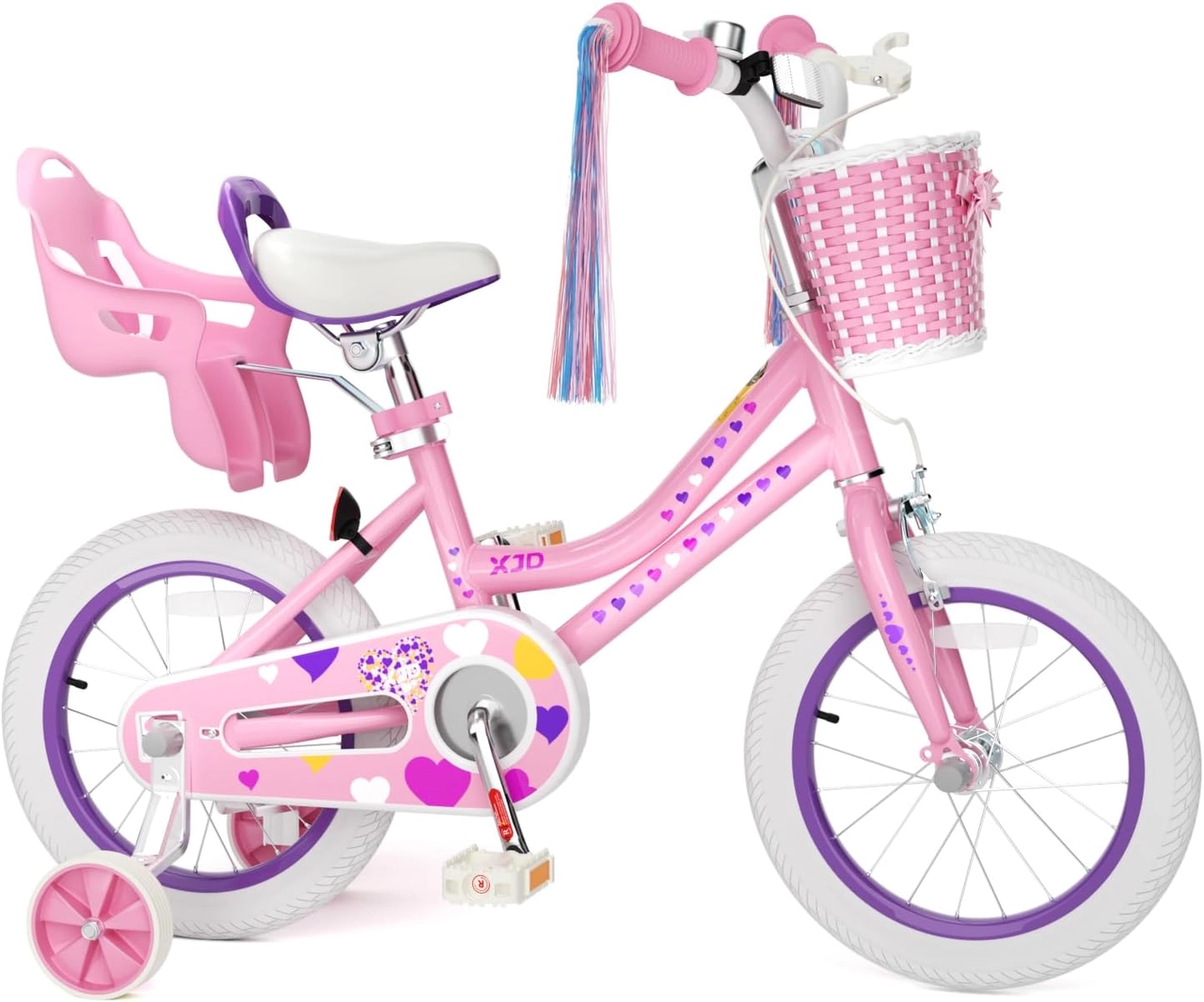 Pink Girls' 12/14/16" Bike by XJD – Basket & Doll Seat
A Training Wheel Bikes option in 12, 14 and 16 Inch labels. Its title mentions a doll seat, which is not evidence of a child passenger seat.
 Light Pink XJD Girls' Bicycle with Basket & Training Wheels
A Training Wheel Bikes model offered in 12, 14, 16 and 20 Inch labels, useful for comparing the supplied wheel-size choices after measuring the rider.
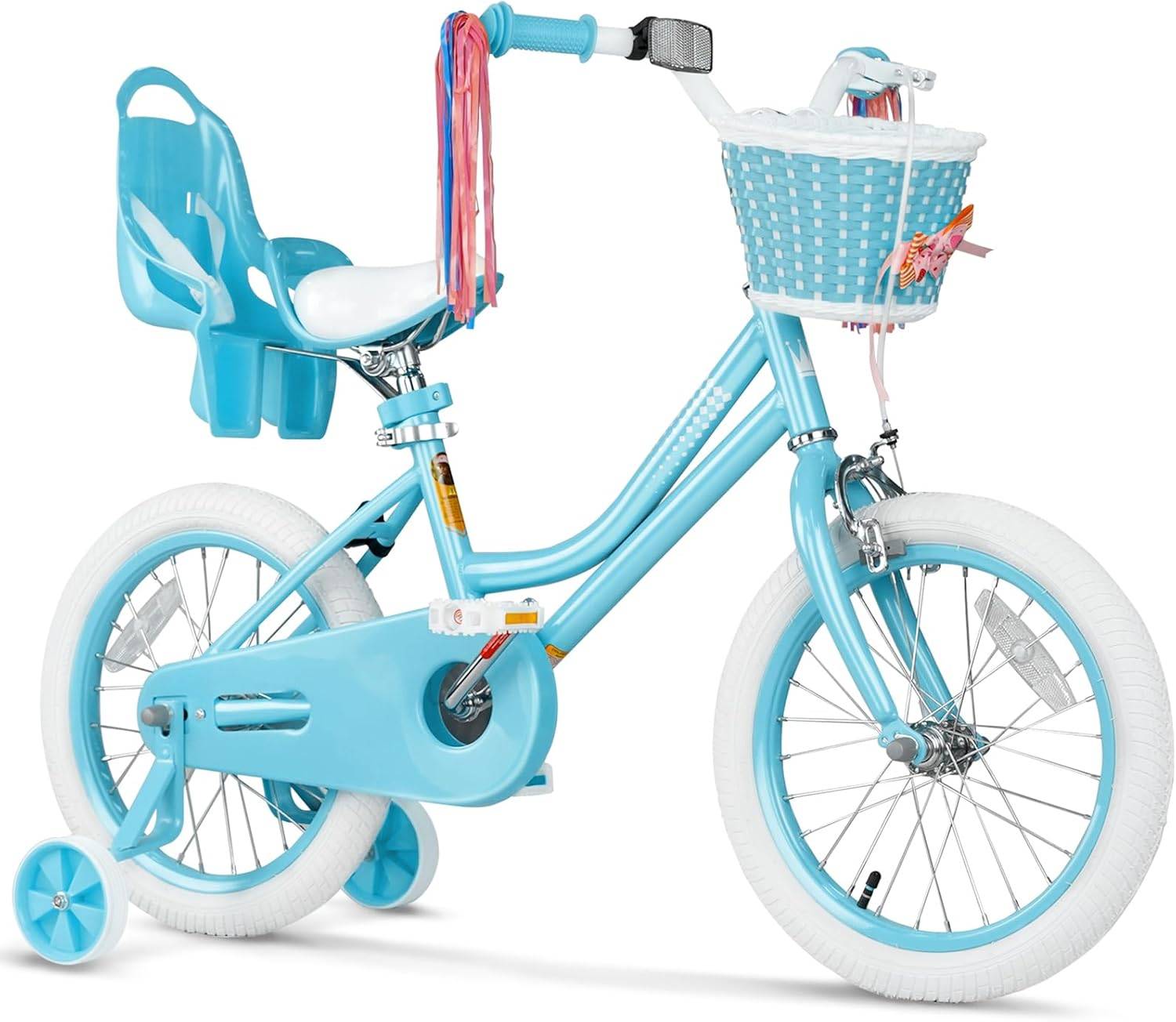 Blue XJD Girls Bike with Training Wheels – 12/14/16 Inch
A Training Wheel Bikes option with 12, 14 and 16 Inch labels. Its relevance is sizing a child’s own bicycle, not carrying a child on an adult bike.
Pink Girls' 12/14/16" Bike by XJD – Basket & Doll Seat is listed in Training Wheel Bikes with 12, 14 and 16 Inch options. Its named doll seat is not evidence of a seat designed to carry a child.
Light Pink XJD Girls' Bicycle with Basket & Training Wheels is also listed in Training Wheel Bikes. Its available labels are 12, 14, 16 and 20 Inch, giving it the widest supplied size range for comparison.
Blue XJD Girls Bike with Training Wheels – 12/14/16 Inch is listed in Training Wheel Bikes with 12, 14 and 16 Inch options. Choose among those sizes only after an individual fit check.
No supplied option is labeled 18, 24 or 26 Inch. If measurement points to one of those sizes, these products are nearest-size comparison points only, not equal-size substitutes.
Check the real bicycle before deciding
With the child present, check stand-over room, mounting and dismounting, comfortable reach, steering control and access to the fitted brakes. Adjust the saddle only as directed by the exact product manual. If the safe adjustment range, assembly or fastener setting is unclear, use a qualified bicycle mechanic rather than improvising.
Add a properly fitting bicycle helmet. It should sit level and its straps should be adjusted according to the helmet manufacturer’s instructions. Training wheels do not remove the need for a helmet or attentive supervision.
Make the title-specific decision
For a passenger seat, stop and obtain verified compatibility and load information for both the seat and adult bicycle; the products shown here are not passenger-seat options. For a child’s own bike, measure height and inseam, shortlist the matching wheel-size range, then approve the choice only after the child demonstrates comfortable stand-over, reach, braking and control.
Bikes for your next adventure
-

Kids Bike Helmet by XJD for Boys & Girls – Black, Blue, Green, Pink, Purple
The XJD Kids Bike Helmet covers a wide 2-to-8-year age range thanks to two head-…$59.99
-

Kids Bike Helmet by XJD for Girls – Pink
The XJD Kids Bike Helmet in Pink is a lightweight multi-sport helmet for girls r…$59.99
$99 -

XJD Kids Bike for Girls – Pink, 12/14/16/20 Inch with Training Wheels
The XJD Kids Bike for Girls in Pink is a training-wheel bike built to carry your…$139
$159