

How to choose bikes for kids
Choose a kids’ bike by measuring the child’s height and inseam, narrowing the wheel size, then checking stand-over clearance, reach and brake control in person.
Measure the rider before comparing bikes
Ask the child to stand straight against a wall without shoes, then measure from the floor to the top of the head. Record that height in inches or centimetres. Next, measure the inseam from the floor to the crotch while the child stands with feet slightly apart.
Height identifies a sensible wheel-size range; inseam helps you judge whether the child can stand over the bicycle comfortably. Age is only a starting point because children of the same age can differ substantially in proportions, coordination and confidence.
Use wheel size to make a shortlist
| Wheel size | Starting age | Rider height |
|---|---|---|
| 12 Inch | 3–4 | 34–40 in / 86–102 cm |
| 14 Inch | 3–6 | 37–45 in / 94–114 cm |
| 16 Inch | 4–7 | 40–48 in / 102–122 cm |
| 18 Inch | 5–9 | 43–52 in / 109–132 cm |
| 20 Inch | 7–12 | 48–60 in / 122–152 cm |
| 24 Inch | 10–14 | 54–64 in / 137–163 cm |
| 26 Inch | Youth and adults | Over 60 in / 153 cm |
Where ranges overlap, do not automatically choose the larger wheel. Compare both sizes through an individual fit check. A bicycle that is too large can make starting, stopping and steering harder; buying extra size solely for future growth is not a sound fit decision.
Check the fit on the actual bicycle
Have the child try the assembled bicycle with an adult supervising. The correct choice should let the rider stand over the frame without being forced onto tiptoes or against the bicycle. Exact clearance depends on the bicycle’s shape, so confirm it on the specific model rather than relying on wheel size alone.
Then check the riding position. The child should be able to hold the handlebar without stretching, turn it while remaining balanced, and operate the brakes confidently. Ask for several controlled starts and stops in a traffic-free area. If the rider cannot reach the controls, looks cramped, or struggles to keep control, compare another size or model.
Seat and handlebar adjustment can affect fit, but use only the limits and procedure in the exact product manual. For uncertain assembly, adjustment, compatibility, load limits or torque, use a qualified bicycle mechanic rather than guessing.
Decide whether training wheels are relevant
Training wheels may be relevant when a child is moving to a pedal bicycle and does not yet have enough confidence to balance independently. They do not replace correct sizing or the ability to reach and operate the controls. A confident rider who already starts, balances, turns and stops without assistance may not need a training-wheel model.
The two supplied XBikes options are useful only for shoppers seeking a Training Wheel Bike in a listed 12, 14 or 16 Inch selection. They let you compare the same relevant wheel-size labels after measuring the rider and confirming fit.
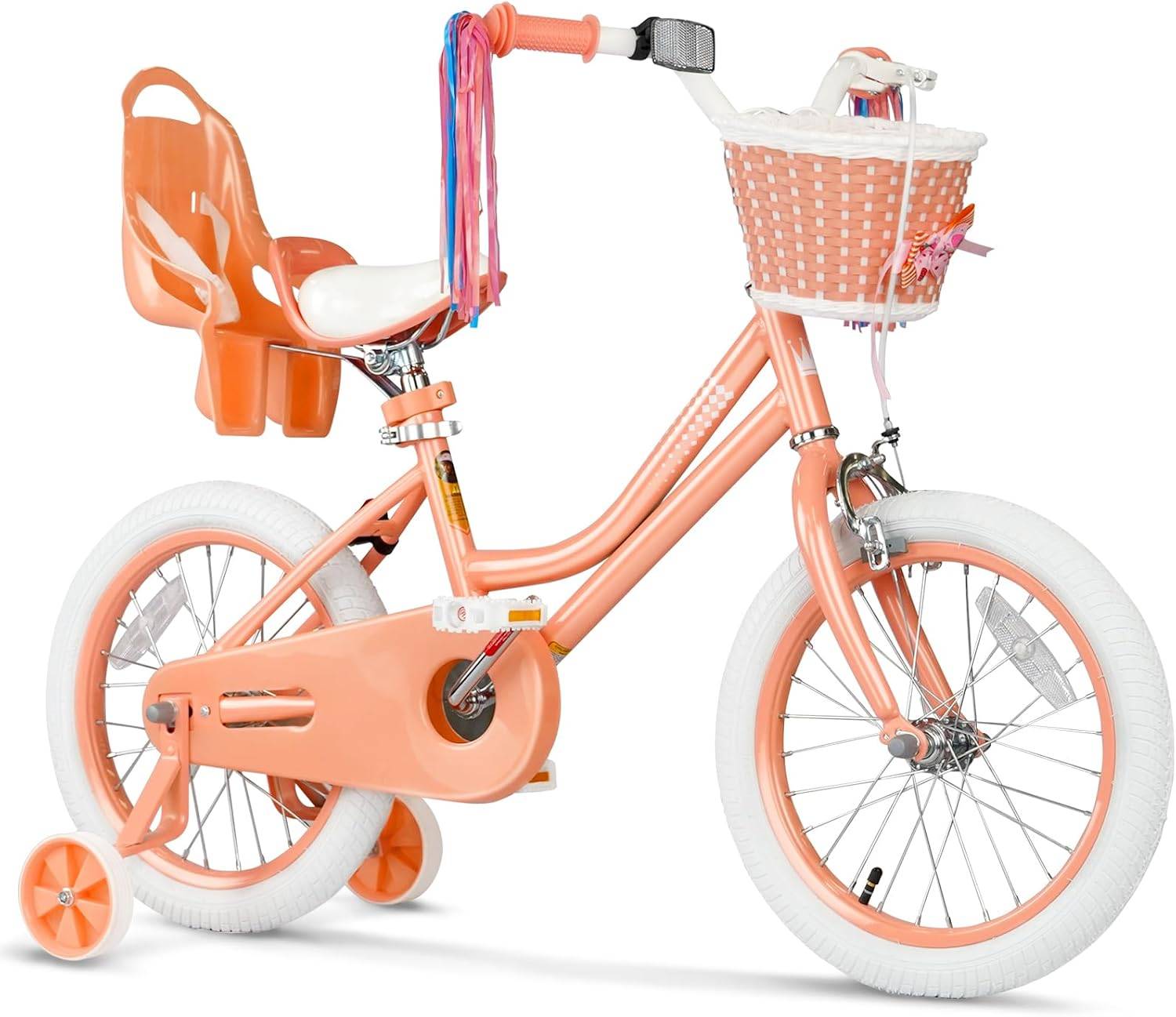 Girls 12/14/16 Inch Kids Bike by XJD with Training Wheels – Peach
A Training Wheel Bike with supplied 12 Inch, 14 Inch and 16 Inch SKU labels; relevant when the rider fits one of those size ranges and still benefits from training wheels.
 XJD Light Purple Girls Bike with Basket, Training Wheels, 12/14/16/20 Inch
A Training Wheel Bike with supplied available labels of 12 Inch, 14 Inch and 16 Inch. Its exact title mentions 20 Inch, but that size is not included in the supplied SKU labels.
Compare the supplied XBikes options accurately
Girls 12/14/16 Inch Kids Bike by XJD with Training Wheels – Peach is categorized as a Training Wheel Bike and has supplied SKU labels of 12 Inch, 14 Inch and 16 Inch. Consider it only if the child’s measurements first place them near one of those ranges and an individual check confirms control.
XJD Light Purple Girls Bike with Basket, Training Wheels, 12/14/16/20 Inch is also categorized as a Training Wheel Bike. Although “20 Inch” appears in its catalog title, the supplied available SKU labels are 12 Inch, 14 Inch and 16 Inch. Do not treat the title alone as proof that a 20 Inch selection is available.
Between these products, the verified comparison is limited to their exact catalog titles, Training Wheel Bikes category and supplied size labels. Choose neither if the rider needs an 18, 20, 24 or 26 Inch starting point, does not need training wheels, or cannot achieve suitable stand-over, reach and brake control.
Complete the safety check before riding
- Confirm that assembly and adjustments follow the exact product manual; consult a qualified bicycle mechanic when uncertain.
- Use a bicycle helmet that fits properly, sits level and has straps secured according to the helmet manufacturer’s instructions.
- Practise mounting, starting, steering and controlled stopping in a traffic-free area under adult supervision.
- Recheck fit as the child grows or if confidence and control change.
Measure height and inseam now, shortlist the matching wheel sizes, and buy only after the child demonstrates comfortable stand-over, reach and braking on the exact bicycle.
Bikes for your next adventure
-

Kids Bike Helmet by XJD for Boys & Girls – Black, Blue, Green, Pink, Purple
The XJD Kids Bike Helmet covers a wide 2-to-8-year age range thanks to two head-…$59.99
-

Kids Bike Helmet by XJD for Girls – Pink
The XJD Kids Bike Helmet in Pink is a lightweight multi-sport helmet for girls r…$59.99
$99 -

XJD Kids Bike for Girls – Pink, 12/14/16/20 Inch with Training Wheels
The XJD Kids Bike for Girls in Pink is a training-wheel bike built to carry your…$139
$159