

How to choose kids first bike
Choose a child’s first bike by measuring height and inseam, then confirming stand-over clearance, easy reach, brake control and confident handling.
Measure the rider before choosing a wheel size
Measure the child without shoes on a level floor. Record total height from floor to the top of the head. For inseam, place a book upright between the legs to represent the saddle, then measure from the floor to the book’s top edge.
Use height to find a starting wheel size, but use the inseam during the actual fit check. Age is only a rough guide because children of the same age can have different proportions, reach and confidence.
Use the XBikes size ranges as a shortlist
| Wheel size | Starting age | Rider height |
|---|---|---|
| 12 Inch | 3–4 | 34–40 in / 86–102 cm |
| 14 Inch | 3–6 | 37–45 in / 94–114 cm |
| 16 Inch | 4–7 | 40–48 in / 102–122 cm |
| 18 Inch | 5–9 | 43–52 in / 109–132 cm |
| 20 Inch | 7–12 | 48–60 in / 122–152 cm |
| 24 Inch | 10–14 | 54–64 in / 137–163 cm |
| 26 Inch | Youth and adults | Over 60 in / 153 cm |
Overlapping ranges are intentional. If the measured height fits two sizes, do not automatically choose the larger one. Compare both in person where possible and select the bike the child can mount, stop, steer and balance with better control.
Perform the fit check
Have the child try the bicycle rather than relying on its label. With the child standing over the frame, confirm there is comfortable clearance and no need to lean the bike sharply just to stand. Seated, the rider should reach the handlebar without stretching, locking the elbows or losing a stable posture.
Check every brake control provided on the bike. The child needs to reach and operate it reliably while keeping the handlebar controlled. Then watch a slow start, turn and stop in a traffic-free area. A suitable first bike should not require the child to fight its size.
Do not buy an oversized bicycle simply to allow for growth. Poor stand-over clearance, excessive reach or difficult brake operation are reasons to choose a smaller or differently proportioned bike, even when the age range appears suitable.
Account for confidence and learning support
Current ability matters alongside measurements. A cautious beginner may handle a smaller fitting option more confidently than the largest size inside the height range. A rider who cannot start, steer or stop predictably needs supervised practice before riding near vehicles, slopes or other hazards.
Training wheels can provide learning support, but their presence does not prove that a bike fits. Fit the bicycle first, then follow the exact product manual for assembly, adjustment, maintenance and compatibility. If instructions are missing or any control cannot be set correctly, use a qualified bicycle mechanic.
When the supplied XBikes options are relevant
The two catalog options help when measurements point toward a 12 Inch, 14 Inch or 16 Inch first bike and the parent wants a Kids’ BMX Bike supplied with training wheels. They do not cover riders whose fit check points to 18 Inch or larger wheels.
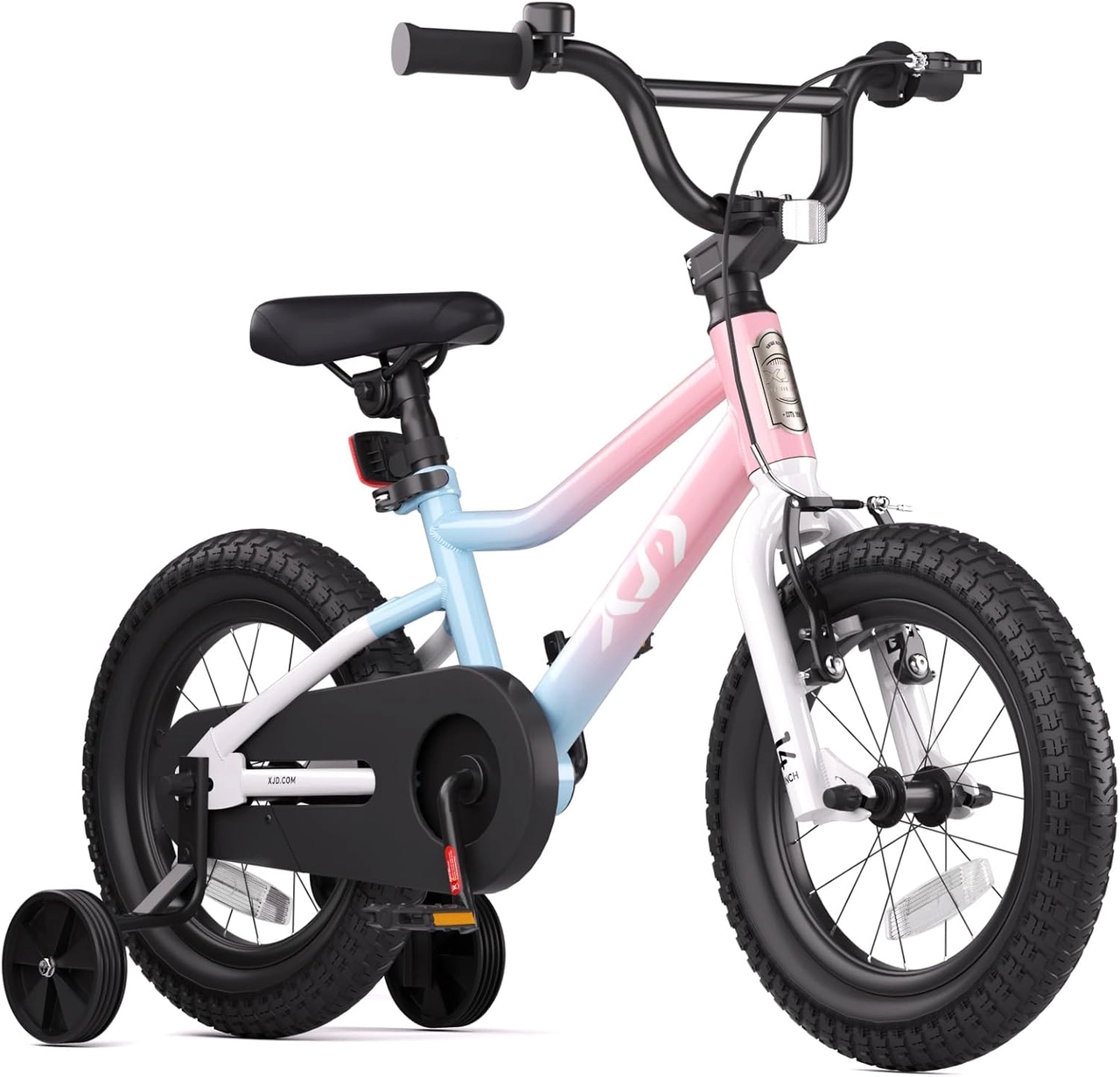 XJD Girls BMX Bike 12/14/16 Inch with Training Wheels – Pink Blue
Relevant when an individual fit check points to a 12 Inch, 14 Inch or 16 Inch Kids’ BMX Bike with training wheels; the catalog title identifies Pink Blue.
 XJD Boys & Girls BMX Bike with Training Wheels, 12/14/16" – Blue
Relevant for a first-bike shortlist requiring a 12 Inch, 14 Inch or 16 Inch Kids’ BMX Bike with training wheels; the supplied catalog title identifies Blue.
XJD Girls BMX Bike 12/14/16 Inch with Training Wheels – Pink Blue is listed in 12 Inch, 14 Inch and 16 Inch variants. XJD Boys & Girls BMX Bike with Training Wheels, 12/14/16" – Blue offers the same supplied wheel-size choices. Based on the provided facts, the meaningful comparison is the exact title and listed color wording; no difference in weight, materials, brakes or other components has been supplied.
Shortlist the variant matching the child’s measured height, then verify inseam clearance, reach, brake control and confidence on that exact bike. Neither product is relevant merely because its title sounds age-appropriate or because training wheels are included.
Finish with the helmet and a controlled first ride
Choose a bicycle helmet that fits properly, sits level and has straps adjusted according to the helmet manufacturer’s instructions. Recheck the fit whenever the child rides; a loose, tilted or incorrectly strapped helmet needs adjustment before starting.
Your next decision is simple: measure height and inseam, shortlist the matching wheel size, and let the individual fit check decide. Buy only when the child can stand over, reach, brake and steer the first bike with present-day control—not hoped-for future growth.
Bikes for your next adventure
-

Kids Bike Helmet by XJD for Boys & Girls – Black, Blue, Green, Pink, Purple
The XJD Kids Bike Helmet covers a wide 2-to-8-year age range thanks to two head-…$59.99
-

Kids Bike Helmet by XJD for Girls – Pink
The XJD Kids Bike Helmet in Pink is a lightweight multi-sport helmet for girls r…$59.99
$99 -

XJD Kids Bike for Girls – Pink, 12/14/16/20 Inch with Training Wheels
The XJD Kids Bike for Girls in Pink is a training-wheel bike built to carry your…$139
$159