

How to pace my child on a bike
To pace your child on a bike, ride at a speed they can control, stay close without crowding them, and choose short routes that match their confidence.
Set the pace from your child’s control
Let your child lead at first while you observe. A suitable pace is one at which they can look ahead, steer a predictable line, start and stop without panic, and respond when you call. If any of those skills deteriorate, slow down or pause; your speed is no longer appropriate merely because they can keep pedalling.
Record three practical measures: how long they ride comfortably, whether they can maintain control on the route’s easiest and hardest sections, and how often they need an unplanned stop. Compare those results with their previous ride, not with another child’s speed or distance.
Choose where the adult rides
On a quiet, open practice area, ride slightly behind and to one side so you can see the child’s line without pressing them forward. Leave enough room for an unexpected wobble or stop. Before entering a turn, slope or shared path, explain what is coming and agree on a simple instruction such as slow, stop or pull over.
Where traffic, crossings or other hazards are present, the adult should decide whether the setting is suitable rather than expecting the child to manage an adult route. Walking a difficult section or ending the ride is a valid pacing decision.
Check that bike fit is not limiting the ride
Poor fit can look like weak stamina or low confidence. Measure the rider’s height and inseam, then have the child try the bicycle. Check stand-over clearance, reach to the controls, comfortable steering and whether the child can operate the brakes reliably. Do not choose an oversized bicycle simply to allow room for growth.
Use these XBikes wheel-size ranges only as starting points:
| Wheel size | Age starting point | Rider height |
|---|---|---|
| 12 Inch | 3–4 | 34–40 in / 86–102 cm |
| 14 Inch | 3–6 | 37–45 in / 94–114 cm |
| 16 Inch | 4–7 | 40–48 in / 102–122 cm |
| 18 Inch | 5–9 | 43–52 in / 109–132 cm |
| 20 Inch | 7–12 | 48–60 in / 122–152 cm |
| 24 Inch | 10–14 | 54–64 in / 137–163 cm |
| 26 Inch | Youth and adults over 60 in | Over 60 in / 153 cm |
Overlapping ranges are intentional starting points, not proof of fit. Prioritize measured height, inseam, reach, brake control and current confidence over age alone.
Build the ride in manageable stages
- Warm up: begin on a familiar, level section and watch the child start, steer and stop.
- Set an easy rhythm: keep conversation possible and allow coasting or brief rests before fatigue affects control.
- Add one challenge: extend either time, distance or route difficulty—not all three on the same ride.
- Reassess: stop if steering becomes erratic, braking is delayed, the child stops scanning ahead or confidence drops.
Finish while the child still has enough concentration for the return journey. On the next outing, repeat the same route or duration before increasing it. Consistent control is more useful evidence than one unusually fast ride.
When the supplied bike is relevant
The Black XJD Kids Bike for Boys – 12, 14 & 16 Inch Sizes is a training-wheel bike offered in 12 Inch, 14 Inch and 16 Inch SKU labels. It is relevant when your child’s measurements place them near one of those XBikes starting ranges and you want to compare those three sizes. The labels do not replace an individual try-on and control check.
These particular catalog options help answer the sizing part of pacing: comparing 12, 14 and 16 Inch versions can reveal whether reach, stand-over and brake access are contributing to hesitation or poor control.

This product is not relevant when the rider’s measurements and fit check indicate an 18, 20, 24 or 26 Inch bicycle. A smaller listed option is not an equivalent substitute. For assembly, maintenance, load limits, compatibility and torque requirements, follow the exact product manual or consult a qualified bicycle mechanic.
Make safety part of the pace
Use a bicycle helmet that fits properly, sits level and has its straps adjusted according to the helmet manufacturer’s instructions. Recheck it before riding. Select a low-complexity practice area, account for surface and weather conditions, and make sure the child understands the agreed stopping signal before moving.
For the next ride, measure height and inseam, confirm the child can stand over and control the bike, then let them lead one short familiar loop. Keep that same pace until starts, steering, braking and stopping remain calm throughout.
Bikes for your next adventure
-
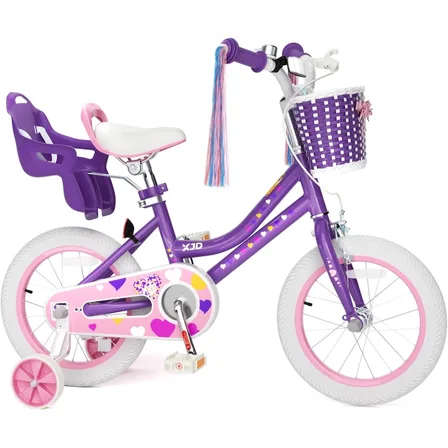
Purple XJD Girls' Bike with Doll Seat & Basket
For girls 71–122 cm tall (about ages 3–7), this XJD girls' bike in Purple pairs …$75.99
$99.99 -

Kids Bike Helmet by XJD for Boys & Girls – Black, Blue, Green, Pink, Purple
The XJD Kids Bike Helmet covers a wide 2-to-8-year age range thanks to two head-…$59.99
-

Kids Bike Helmet by XJD for Girls – Pink
The XJD Kids Bike Helmet in Pink is a lightweight multi-sport helmet for girls r…$59.99
$99