

How to teach a baby to ride a bike
Teach a baby to ride only after they can walk steadily, follow simple directions, hold the handlebars and stop on command. Measure first, choose a bike they can control now, practise balance and braking in a traffic-free area, and keep every session short.
Check readiness before choosing a bike
“Baby” is not a bicycle fit category. Age is only a starting point; coordination, confidence and physical fit decide whether a child is ready. Wait if the child cannot remain upright, understand “stop,” keep hands on the grips or tolerate a properly fitted helmet.
Do not buy an oversized bicycle for future growth. The child should try the actual bike. A suitable bike lets the rider stand over it comfortably, reach the handlebars without stretching, steer without wobbling caused by poor reach, and operate the brakes. If any control is beyond the child’s reach or strength, choose another fit.
Measure height, inseam and reach
Measure the child’s standing height without shoes. For inseam, have the child stand upright with feet slightly apart and measure from the floor to the crotch. Compare standing height with the XBikes starting points below, then confirm stand-over clearance, reach and brake control on the actual bicycle.
| Wheel size | Age starting point | Rider height starting point |
|---|---|---|
| 12 Inch | 3–4 | 34–40 in / 86–102 cm |
| 14 Inch | 3–6 | 37–45 in / 94–114 cm |
| 16 Inch | 4–7 | 40–48 in / 102–122 cm |
| 18 Inch | 5–9 | 43–52 in / 109–132 cm |
| 20 Inch | 7–12 | 48–60 in / 122–152 cm |
| 24 Inch | 10–14 | 54–64 in / 137–163 cm |
| 26 Inch | Youth and adults | Over 60 in / 153 cm |
These ranges overlap because children differ. Prioritize measured height, inseam, reach, brake control and current confidence over age alone. If the smallest listed range is still too large, neither supplied product is appropriate yet.
Prepare a safe first practice
Use a flat, open, traffic-free surface without obstacles. The child should wear a bicycle helmet that fits properly, sits level and has its straps adjusted according to the helmet manufacturer’s instructions. Check the bicycle before each session and follow its exact manual for assembly, adjustments, maintenance, load limits and compatibility. Ask a qualified bicycle mechanic when instructions are missing or the bike does not operate correctly.
Begin by showing the child where to look, how to hold the grips and how the stopping control works. Support the child rather than pulling the handlebars; steering must remain theirs to learn. Stop while the experience is still calm if fatigue, fear or repeated loss of control appears.
Teach stopping, steering and balance in order
- Stopping: While stationary, let the child practise using the bike’s stopping control. Then try very slow starts followed by a stop at a nearby marker.
- Steering: Ask the child to look toward a large, simple target and guide the bicycle toward it. Avoid tight turns at first.
- Balance: Use brief straight runs with only the support the child needs. Reduce your support gradually; do not release unexpectedly.
- Starting: Once stops and straight runs are controlled, practise setting off, looking ahead and stopping again.
Training wheels can support early pedalling and steering practice, but they do not remove the need to learn balance or braking. Follow the bicycle manual for their installation and adjustment; do not invent a setup or modify incompatible parts.
How the supplied bikes compare
The catalog options help because both are training-wheel bicycles with several wheel-size choices to compare against the child’s measurements. They are relevant only when one of their supplied sizes passes the individual stand-over, reach, brake-control and confidence checks.
 Girls' Training Wheel Bike by XJD with Basket – Purple
A training-wheel bike available in 14 Inch, 16 Inch and 20 Inch labels, useful for comparing measured riders across those XBikes height starting points before an individual fit check.
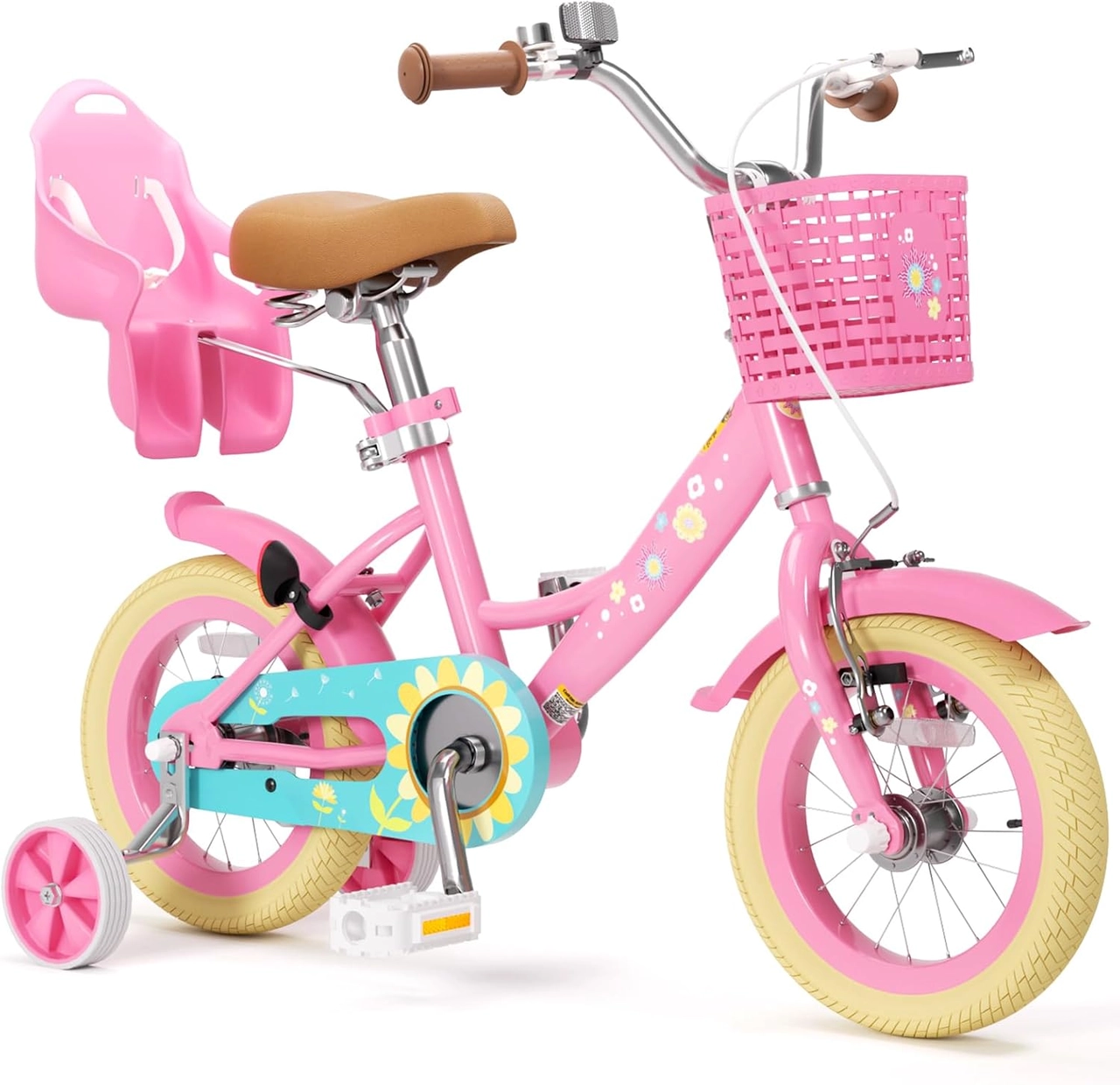 Flower Pink XJD Girls Bike with Doll Seat & Basket
A training-wheel bike available in 12 Inch, 14 Inch and 16 Inch labels. Its 12 Inch option is the smallest supplied comparison point, but measured fit and control still determine relevance.
Girls' Training Wheel Bike by XJD with Basket – Purple is offered in 14 Inch, 16 Inch and 20 Inch labels. Flower Pink XJD Girls Bike with Doll Seat & Basket is offered in 12 Inch, 14 Inch and 16 Inch labels. The second option provides the smallest listed comparison point; the first extends to a larger 20 Inch comparison point.
The basket, doll seat, color and title wording may influence preference, but they do not establish fit. Compare the matching wheel-size starting point first, then have the child try the bicycle. A listed size is not proof that the controls or frame suit a particular rider.
Know what to do next
If the child cannot control the smallest suitable candidate, pause bicycle instruction and continue age-appropriate movement and coordination play. If the fit works, begin with stopping and steering, then build balance through short sessions. Move forward only when the child can start, look ahead, steer and stop calmly without being held.
Your next decision is therefore specific: measure the child today, shortlist only the supplied wheel size that matches the height starting point, verify inseam, stand-over, reach and brakes in person, and postpone riding if any check fails.
Bikes for your next adventure
-

Kids Bike Helmet by XJD for Boys & Girls – Black, Blue, Green, Pink, Purple
The XJD Kids Bike Helmet covers a wide 2-to-8-year age range thanks to two head-…$59.99
-

Kids Bike Helmet by XJD for Girls – Pink
The XJD Kids Bike Helmet in Pink is a lightweight multi-sport helmet for girls r…$59.99
$99 -

XJD Kids Bike for Girls – Pink, 12/14/16/20 Inch with Training Wheels
The XJD Kids Bike for Girls in Pink is a training-wheel bike built to carry your…$139
$159