

How to teach a kid to pedal a bike
Teach a kid to pedal by fitting the bike first, practising the pedal motion with support, then combining a strong starting push with short, supervised rides.
Check the bike fits before teaching
Measure the child’s standing height and inseam without shoes. Use height to identify a starting wheel size, then have the child try the actual bicycle. Age is only a rough guide.
| Wheel size | Starting age | Rider height |
|---|---|---|
| 12 Inch | 3–4 | 34–40 in / 86–102 cm |
| 14 Inch | 3–6 | 37–45 in / 94–114 cm |
| 16 Inch | 4–7 | 40–48 in / 102–122 cm |
| 18 Inch | 5–9 | 43–52 in / 109–132 cm |
| 20 Inch | 7–12 | 48–60 in / 122–152 cm |
| 24 Inch | 10–14 | 54–64 in / 137–163 cm |
| 26 Inch | Youth and adults | Over 60 in / 153 cm |
On the bike, check that the child can stand over it comfortably, reach the handlebars without stretching, turn them with control, and operate the brakes reliably. Do not choose an oversized bicycle merely to allow room for growth. If the rider cannot control the bike confidently, compare a smaller appropriate size or ask a qualified bicycle mechanic to assess the fit.
Prepare a simple practice area
Choose a flat, open space away from traffic, slopes and obstacles. Fit a bicycle helmet so it sits level, feels secure and uses its straps exactly as the helmet manufacturer directs. Check the bicycle according to its product manual before riding; use a qualified bicycle mechanic for assembly, adjustments or maintenance you cannot verify.
Set expectations before starting: today’s goal is a few controlled pedal turns, not distance or speed. Short attempts with pauses usually make it easier for a child to notice what their feet and hands are doing.
Teach the pedal motion before launching
- With the bike held stable, place the child’s feet on the pedals and slowly guide each foot through a complete forward circle.
- Ask the child to press down with one foot while the other foot rises. Repeat until the alternating motion feels familiar.
- Position one pedal slightly forward and high enough for the child to press it down firmly. This becomes the starting pedal.
- Support the child lightly at the torso or beneath the arms. Avoid steering the handlebars for them, because they need to feel and correct their own direction.
- Have the child push down on the starting pedal, bring the second foot onto its pedal, look ahead and continue turning both pedals.
If the child repeatedly pedals backward, stop and rehearse one slow forward revolution rather than pushing the bike faster. If feet keep slipping or knees appear cramped, pause and recheck fit and foot placement.
Reduce help in small steps
Begin by walking beside the rider while providing only enough support to prevent a fall. As the child produces several continuous pedal strokes, loosen your support without making a surprise release. Tell the child when you are changing how much help you provide.
Practise three separate skills: starting, continuing to pedal, and stopping. For stopping practice, have the child stop pedalling, use the bicycle’s controls as instructed, and put a foot down only as the bicycle slows. Brake reach and control must be checked on the actual bike; do not assume wheel size alone guarantees either.
Training wheels can keep a bicycle upright while a child concentrates on pushing the pedals, but the rider must still learn steering, braking and eventually balancing without that support. Follow the exact bicycle manual for fitting or adjusting them, since no universal attachment or adjustment procedure applies to every model.
Compare the supplied 12, 14 and 16 Inch options
The supplied catalog choices are relevant because all three offer 12 Inch, 14 Inch and 16 Inch SKU labels, letting families compare training-wheel bicycles across the three smallest XBikes starting ranges after measuring the rider.
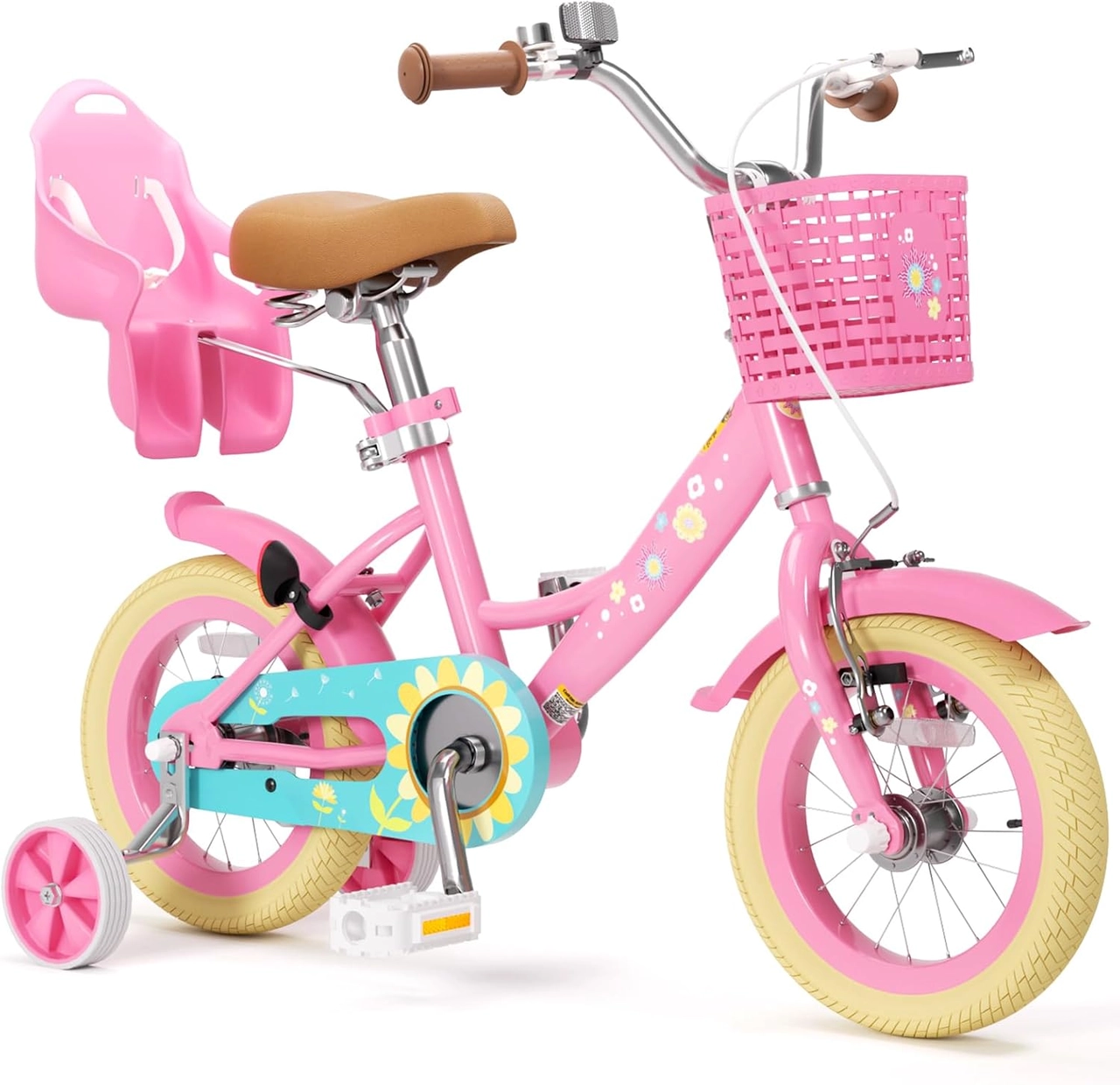 Flower Pink XJD Girls Bike with Doll Seat & Basket
A Training Wheel Bike offered in 12 Inch, 14 Inch and 16 Inch SKU labels. Its doll seat and basket are catalog features, while rider measurements and an individual fit check determine relevance.
 Purple XJD Girls' Bike with Doll Seat & Basket
This Training Wheel Bike is available with 12 Inch, 14 Inch and 16 Inch SKU labels. Compare the measured rider height, stand-over position, reach, brake control and confidence rather than relying on its title.
 Black XJD Kids' BMX Bicycle with Training Wheels
Listed in Kids' BMX Bikes with training wheels in its title, this model offers 12 Inch, 14 Inch and 16 Inch SKU labels. It is relevant only when the selected size passes an individual fit check.
The Flower Pink XJD Girls Bike with Doll Seat & Basket and Purple XJD Girls' Bike with Doll Seat & Basket are listed as Training Wheel Bikes, with 12 Inch, 14 Inch and 16 Inch options. Their titles identify a doll seat and basket; those details do not establish fit.
The Black XJD Kids' BMX Bicycle with Training Wheels is listed under Kids' BMX Bikes and likewise has 12 Inch, 14 Inch and 16 Inch options. Compare it using the same measured-height and individual-control checks rather than treating the BMX label as sizing evidence.
These products are relevant only when the rider’s measurements and try-on support one of their available sizes. If the child needs 18, 20, 24 or 26 Inch under the starting table and fit check, these three products are nearest catalog comparison points—not substitutes for the required wheel size.
Know what to do next
Continue when the child can reach the controls, start with a pedal push, look ahead, make several forward rotations and stop deliberately. Step back to supported pedal practice if the child cannot coordinate the circle; reassess the bicycle if reach, stand-over clearance or braking is the obstacle.
Your next decision is therefore specific: measure height and inseam, shortlist the indicated wheel size, verify the actual fit and controls, then practise one controlled start, several pedal turns and one planned stop.
Bikes for your next adventure
-

Kids Bike Helmet by XJD for Boys & Girls – Black, Blue, Green, Pink, Purple
The XJD Kids Bike Helmet covers a wide 2-to-8-year age range thanks to two head-…$59.99
-

Kids Bike Helmet by XJD for Girls – Pink
The XJD Kids Bike Helmet in Pink is a lightweight multi-sport helmet for girls r…$59.99
$99 -

XJD Kids Bike for Girls – Pink, 12/14/16/20 Inch with Training Wheels
The XJD Kids Bike for Girls in Pink is a training-wheel bike built to carry your…$139
$159